

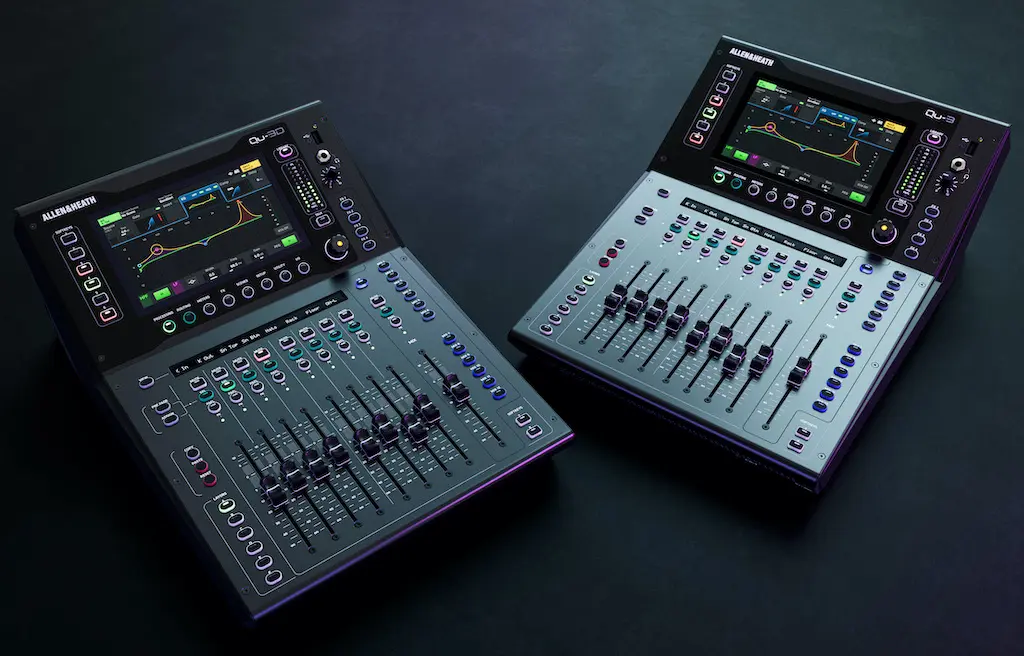
In a move that signals a significant evolution for one of the industry’s most enduring digital mixing platforms, Allen & Heath has officially announced the launch of the Qu-3 and the Qu-3D. These two new models represent the most compact hardware footprints in the Qu series to date, specifically engineered to deliver high-channel-count processing within a desktop-friendly form factor. By integrating the high-resolution 96 kHz XCVI FPGA engine into a chassis featuring an 8+1 fader configuration, the British manufacturer aims to bridge the gap between portable convenience and professional-grade audio performance. The Qu-3D variant further distinguishes itself by incorporating native Dante connectivity, catering to the increasingly networked environments of modern professional audio.
A New Benchmark for Compact Digital Architecture
The introduction of the Qu-3 and Qu-3D comes at a time when the demand for high-density, small-footprint mixing solutions is at an all-time high. Traditionally, small-format mixers have been forced to sacrifice processing power or input capacity to maintain their diminutive size. Allen & Heath has challenged this paradigm by outfitting the Qu-3 series with 36 input channels (consisting of 32 mono and 2 stereo inputs) and a comprehensive 32-channel processing suite.
The heart of these units is the XCVI core, the same proprietary FPGA (Field Programmable Gate Array) technology that powers the company’s higher-end SQ and dLive series. By utilizing 96 kHz processing, the Qu-3 and Qu-3D offer significantly lower latency—typically under 0.7ms—and a higher degree of phase coherency compared to standard 48 kHz consoles. This technical foundation ensures that even though the physical interface has been scaled down, the sonic integrity remains consistent with the larger consoles in the Allen & Heath lineup.
Technical Specifications and Interface Design
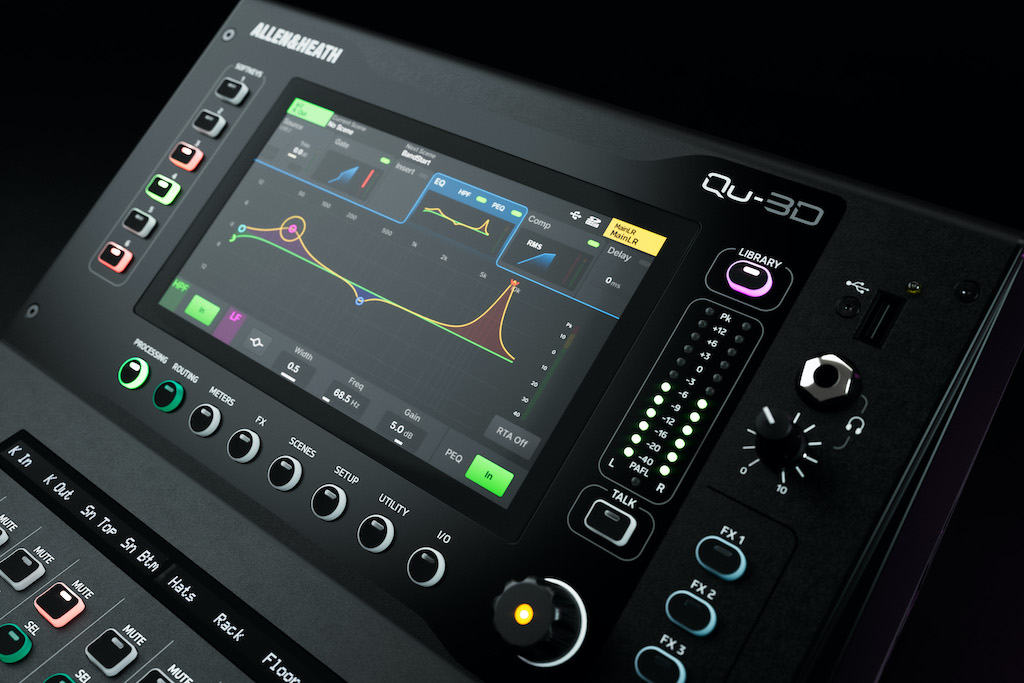
The Qu-3 and Qu-3D are built around an innovative "8+1" fader layout. This design utilizes eight motorized channel faders and one dedicated master fader, organized across six fader layers. This layering system allows engineers to manage all 36 inputs and various output mixes without the need for a massive physical console. To complement this, the mixers include eight user-assignable SoftKeys, allowing for immediate access to frequently used functions such as mute groups, tap tempo, or scene navigation.
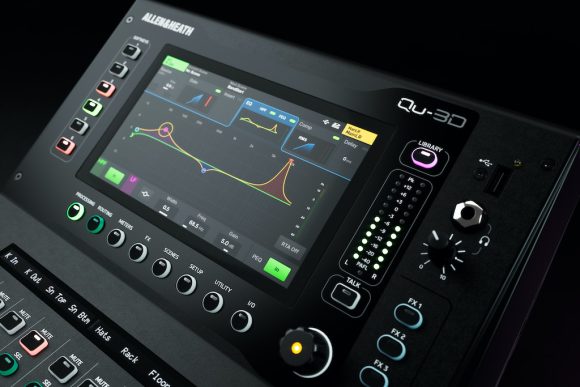
The visual interface is centered on a high-resolution touchscreen that provides intuitive control over the "SuperStrip"—the physical knobs and buttons dedicated to gain, EQ, and dynamics. A notable addition to the screen interface is the chromatic metering for all channels, which provides a clear, color-coded visual representation of signal levels, facilitating faster troubleshooting and gain staging during high-pressure live events.
For users requiring networked audio, the Qu-3D is equipped with an internal 16×16 Dante interface. Recognizing the scalability requirements of modern installations, Allen & Heath offers a paid upgrade path that allows the Dante module to be expanded to a 32×32 configuration. This makes the Qu-3D an ideal "edge" device in larger Dante ecosystems, capable of acting as a sub-mixer, a dedicated broadcast feed controller, or a high-end interface for multi-track recording.
Enhancing Workflow with Automated Assistants
One of the primary target markets for the Qu-3 series is the corporate AV sector, where operators often have to manage multiple microphones simultaneously for panels and conferences. To address this, the Qu-3 and Qu-3D include a sophisticated 32-channel Automatic Mic Mixer (AMM). The AMM is designed to manage gain sharing across multiple open microphones, reducing background noise and the risk of feedback while ensuring that every speaker is heard clearly.
Furthermore, the integration of "Feedback Assist" and "Gain Assist" features marks a step forward in user accessibility. Feedback Assist automatically identifies and notches out problem frequencies, while Gain Assist helps the operator set optimal preamp levels during soundcheck. These tools are not intended to replace the engineer but rather to provide a "safety net" in fast-paced environments where setup time is minimal.
The DEEP Processing Ecosystem
The Qu-3 series maintains full compatibility with Allen & Heath’s DEEP processing architecture. This allows users to insert boutique hardware emulations—such as classic compressors and EQs—directly into input and mix channels without adding any additional latency. These emulations are modeled after legendary studio gear, including the 1176 Peak Limiter and the LA-2A Leveling Amplifier. By hosting these models directly within the FPGA, the console avoids the "round-trip" latency issues associated with external plug-in hosts, providing a more responsive feel for the performer and the engineer alike.

Strategic Market Positioning and Ergonomics
The physical design of the Qu-3 series has been specifically optimized for "sit-down" operation. Unlike larger touring consoles designed for standing operators, the Qu-3’s low profile and angled surface make it suitable for studio desks, broadcast booths, and cramped front-of-house positions. This ergonomic focus is a direct response to the rise of the "hybrid" engineer who may be managing a live stream and a physical PA simultaneously from a single workstation.
Keith Johnson, Senior Product Manager at Allen & Heath, emphasized the company’s philosophy during the product launch. "With Qu-3 and Qu-3D, we wanted to provide the full Qu experience in the most compact format possible," Johnson stated. "Small mixers often come with big compromises. Here, however, you still get our proven FPGA processing, exceptional audio quality, versatile recording options, and the tactile control that professionals expect—all in a format that fits comfortably on a desk."
The target audience for these consoles is broad, encompassing:
- Corporate AV: Where the AMM and compact size are essential for meeting rooms and ballrooms.
- Broadcast and Streaming: Utilizing the Dante capabilities and high-resolution processing for clean audio delivery.
- Fixed Installations: Such as houses of worship or theaters where rack space is at a premium.
- Live Sound: For small bands or solo performers who require professional processing without the bulk of a full-sized desk.
- Home and Project Studios: Acting as a high-end 96 kHz audio interface with motorized fader control for DAWs.
Connectivity and the Audio-Technica Partnership
In terms of physical I/O, the Qu-3 series continues to support the dSNAKE and SLink protocols, allowing for seamless connection to Allen & Heath’s range of remote stage boxes (such as the AB168, AR2412, or the DX series). This ecosystem approach allows users to place their preamps on stage while keeping the compact Qu-3 at the mixing position, connected by a single Cat5e cable.
In the German market, the distribution and service of the Qu-3 and Qu-3D will be handled by Audio-Technica. This partnership ensures that professional users in the region have access to local support, training, and a robust supply chain. Audio-Technica’s extensive experience in the professional audio sector aligns with the premium positioning of the Qu series, providing a reliable backbone for the product’s rollout.
Chronology of the Qu Series and Future Implications
The Qu series first debuted in 2013 with the Qu-16, a console that revolutionized the "prosumer" market by making digital mixing accessible to a wider audience. Over the last decade, the series has expanded to include the Qu-24, Qu-32, and the rack-mounted Qu-Pac and Qu-SB. The launch of the Qu-3 and Qu-3D in late 2026 represents the "next generation" of this lineage.
By moving to 96 kHz processing as a standard across even the smallest models, Allen & Heath is effectively signaling the end of the 48 kHz era for professional-grade compact mixers. This shift mirrors the broader industry trend toward high-resolution audio and AoIP (Audio over IP) integration. As more venues move toward networked infrastructures, the inclusion of Dante as a primary feature in the Qu-3D ensures that the console remains relevant in an increasingly interconnected world.
Conclusion and Impact on the Industry
The release of the Qu-3 and Qu-3D is likely to put pressure on competitors in the compact digital mixer space. While other manufacturers have focused on "tablet-only" mixers for small-scale applications, Allen & Heath’s insistence on physical faders and a dedicated hardware interface suggests that tactile control remains a priority for professional operators.
By combining the power of the XCVI engine with the flexibility of Dante and the convenience of a desktop footprint, Allen & Heath has created a versatile tool that addresses the specific needs of the 2026 audio landscape. Whether used as a standalone console for a corporate event or as a networked component in a global broadcast, the Qu-3 series stands as a testament to the idea that size should not be a limiting factor in audio excellence.
