

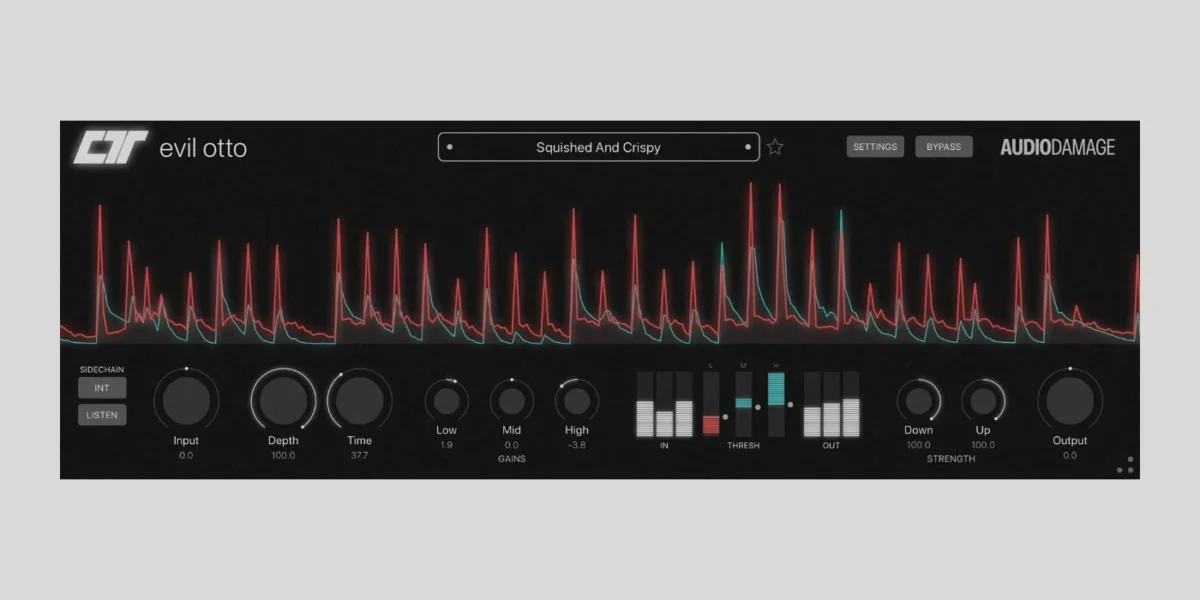
Audio Damage, a distinguished developer in the realm of audio effects and virtual instruments, has announced the immediate release of "Evil Otto," a new multiband compressor designed to deliver the popular OTT-style sound processing. The desktop version of Evil Otto is being offered to the global music production community completely free of charge, requiring only a subscription to the Audio Damage mailing list for download access. Concurrently, an iOS version is available for purchase at $2.99 via the Apple App Store, specifically designed for mobile music producers utilizing the AUv3 format.
This strategic release marks a significant moment for both Audio Damage and the wider audio plugin landscape. By making such a powerful and sought-after effect freely available on desktop, Audio Damage is not only enriching its product portfolio but also reinforcing its commitment to supporting and engaging with the producer community. The decision to gate the free desktop download behind a mailing list subscription is a common industry practice, allowing the company to build its audience and directly communicate future updates and product announcements to interested users.
Understanding the OTT Phenomenon in Modern Music Production
The term "OTT" has become synonymous with a distinct and often aggressive style of multiband compression that has profoundly influenced modern electronic music genres. Originating from the Xfer Records "OTT" (Over The Top) preset within their flagship Serum synthesizer, this effect rapidly transcended its initial context to become a standalone processing staple. Its appeal lies in its ability to simultaneously apply upward and downward compression across multiple frequency bands, typically low, mid, and high. This dual action dramatically enhances perceived loudness, tightens dynamics, and brings out intricate details, often imparting a characteristic "pump" or "glue" to sounds.
The original OTT gained widespread adoption in genres such as EDM, dubstep, future bass, and trap, where producers sought to achieve a polished, hyper-compressed, and energetic sound. It became an indispensable tool for shaping synth leads, basslines, drums, and even full mixes, providing a quick and effective way to achieve a professional, ‘radio-ready’ presence. The effect’s popularity sparked a wave of emulation and inspiration within the plugin development community, leading to numerous "OTT-inspired" plugins designed to capture or expand upon its core functionality. Notable examples in recent years include "8TT" by Discrete Signals and "Cramit" by Sixth Sample, both of which have received positive reception for their solid interpretations of the concept. Evil Otto enters this competitive arena, distinguished by Audio Damage’s established reputation and unique design philosophy.
Audio Damage: A Legacy of Innovation and Accessibility
Audio Damage has carved out a formidable reputation over two decades as a developer known for creating innovative, high-quality, and often unconventional audio effects and instruments. Founded on a principle of crafting tools that inspire creativity, the company has consistently delivered plugins that combine robust functionality with distinctive sonic character. Their extensive catalog includes several iconic products that have become staples in many studios worldwide.
Among their most celebrated creations are:
- Dubstation: A highly regarded digital delay known for its gritty character and versatile modulation capabilities, capturing the essence of classic tape echoes.
- Filterstation: A powerful dual-filter plugin that offers a wide array of filtering options, from subtle shaping to extreme sonic mangling.
- ADverb: A versatile algorithmic reverb that provides lush and expansive spaces.
- Tattoo: An acclaimed drum machine that offered a unique approach to beat creation with its powerful sequencing and sound design features, evoking a sense of nostalgia for many long-time users.
The consistent quality and enduring relevance of these products have cemented Audio Damage’s status as a developer committed to excellence. In a testament to their community-oriented approach, Audio Damage has also made several of its earlier, much-loved plugins available for free through its "Free and Legacy" page. This initiative allows a new generation of producers to access historically significant tools, fostering goodwill and demonstrating a philosophy that balances commercial innovation with a desire to give back to the creative community. The release of Evil Otto as a free desktop plugin aligns perfectly with this established pattern, signaling Audio Damage’s ongoing commitment to democratizing access to professional-grade audio tools.
A Deep Dive into Evil Otto’s Design and Functionality
Evil Otto distinguishes itself from its predecessors and competitors through a thoughtful combination of powerful processing, intuitive controls, and superior visual feedback. The plugin’s interface embodies the "classic Audio Damage" aesthetic: crisp, clean, and highly functional, with a carefully chosen color scheme that enhances usability without being distracting.
One of Evil Otto’s most significant advancements lies in its visual approach to multiband compression. Unlike the original Xfer Records OTT, which offered minimal visual representation of its complex internal workings, Evil Otto features a dynamic scrolling waveform display. This real-time visualization overlays the input and output signals, allowing users to instantly observe how the multiband compression is actively shaping their audio. This immediate visual feedback is invaluable for understanding the impact of parameter adjustments, enabling producers to make more informed decisions and achieve desired results more efficiently. For many, this visual clarity will make Evil Otto considerably easier to learn and operate than its more visually sparse counterparts.
At its core, Evil Otto operates by intelligently splitting the incoming audio signal into three distinct frequency bands: low, mid, and high. It then applies simultaneous upward and downward compression independently to each of these bands. This dual compression technique is crucial for achieving the characteristic OTT sound, where quiet details are brought forward (upward compression) while peaks are simultaneously controlled (downward compression), resulting in a dense, impactful, and dynamically controlled output.
The plugin provides a comprehensive set of controls to fine-tune this intricate processing:
- Depth: An overarching control that dictates the overall intensity of the compression effect across all bands.
- Time: Adjusts the attack and release speeds of the compressors, influencing how quickly the effect reacts to and recovers from transients. Faster times often lead to a more aggressive, "pumping" sound, while slower times can result in a smoother, more transparent dynamic shaping.
- Down Amount: Specifically controls the strength of peak reduction, allowing users to rein in the loudest parts of the signal within each band.
- Up Amount: Determines the degree of detail boosting, bringing up the quieter elements and enhancing the perceived density and presence.
Beyond these global controls, each of the three frequency bands features its own dedicated threshold and output level knobs. This granular control empowers producers to sculpt the compression’s interaction with different parts of the frequency spectrum with precision. For instance, one could apply aggressive compression to the mid-range for punch while maintaining a lighter touch on the low-end for bass integrity, and subtly boosting the highs for air and clarity.
Advanced Features and User Customization
Evil Otto is not merely a basic multiband compressor; it integrates several advanced features designed to enhance its utility and workflow:
- External Sidechain Input with Listen Mode: This crucial feature allows for creative dynamic processing, such as "ducking" a synth pad’s volume in response to a kick drum. The inclusion of a "listen mode" is particularly useful, enabling users to solo the sidechain input to verify routing and ensure the compressor is reacting to the intended signal.
- Bypass with Smooth Crossfade: Essential for critical A/B comparisons, this bypass function allows users to switch between the processed and unprocessed signal seamlessly, without clicks or pops, facilitating objective evaluation of the effect’s impact.
- Preset Browser: A robust system for managing presets, including options for importing and exporting user-created settings, marking favorites for quick recall, and even a randomized naming feature for creative exploration. This encourages experimentation and efficient workflow.
Furthermore, Audio Damage has included a dedicated settings panel for user interface customization and preferences. Here, producers can:
- Toggle helpful tooltips for on-demand information about controls.
- Enable or disable the scrolling waveform animation, catering to different preferences for visual complexity or CPU usage.
- Activate or deactivate glow effects for a personalized visual aesthetic.
- Switch to an alternate Outrun color scheme, offering a retro-futuristic visual alternative to the default interface.
These customization options underscore Audio Damage’s attention to user experience, allowing producers to tailor the plugin’s appearance and behavior to their specific workflow and visual preferences.
Technical Foundations: The Mechanics of Multiband Compression
To fully appreciate Evil Otto, it is beneficial to understand the technical principles behind multiband compression. Unlike a traditional full-band compressor that treats the entire frequency spectrum uniformly, a multiband compressor divides the audio signal into several distinct frequency ranges. Each band is then processed independently with its own set of compression parameters (threshold, ratio, attack, release, make-up gain). This allows for highly surgical dynamic control, addressing specific frequency issues without negatively impacting other parts of the spectrum. For example, excessive boominess in the low-end can be tamed without squashing the entire mix, or harshness in the high-mids can be smoothed out without dulling the overall sound.
Evil Otto’s implementation of simultaneous upward and downward compression is key to its distinctive "OTT" sound.
- Downward Compression: This is the more commonly understood form of compression, where signals exceeding a set threshold are reduced in gain. It primarily functions to control peaks, reduce dynamic range, and prevent clipping.
- Upward Compression: Less common in traditional compressors, upward compression works by increasing the gain of signals that fall below a certain threshold. This effectively brings up quieter details, enhances sustain, and makes the overall sound denser and more "present."
By combining these two approaches across three frequency bands, Evil Otto can create an extremely tight, controlled, and detail-rich sound that is highly desirable in modern music production, particularly for adding energy and consistency to individual tracks or even entire mixes.
Strategic Release and Market Impact
The release of Evil Otto, particularly its free desktop availability, carries several strategic implications for Audio Damage and the plugin market as a whole.
- Community Engagement and Brand Building: Offering a high-quality, in-demand effect for free is an excellent way to attract new users, demonstrate technical prowess, and foster goodwill within the music production community. This strategy often leads to increased brand visibility and loyalty.
- Freemium Model for iOS: The separate, paid iOS version highlights the distinct market dynamics of mobile music production. iOS users often expect to pay for high-quality AUv3 plugins, and this model allows Audio Damage to monetize its efforts in that growing segment while still offering a substantial free product for desktop users. The increasing sophistication of mobile DAWs means that professional-grade effects like Evil Otto are highly valued by iOS producers.
- Competitive Landscape: By entering the OTT-inspired plugin space with a visually enhanced and feature-rich offering, Audio Damage raises the bar for competitors. Its emphasis on clear visual feedback addresses a common pain point in dynamic processing, potentially setting a new standard for user interface design in this category.
- Democratization of Tools: Making such a powerful effect freely available significantly lowers the barrier to entry for aspiring and professional producers alike. It empowers those without large budgets to access professional-grade tools, fostering creativity and potentially influencing the sound of future productions across various genres.
- Cross-Promotion Potential: Users who download Evil Otto for free may be more inclined to explore and purchase other paid products from Audio Damage, having experienced the quality and design philosophy firsthand.
System Compatibility and Availability
Audio Damage has ensured broad compatibility for Evil Otto across various operating systems and plugin formats, reflecting their commitment to accessibility:
- Windows (10+): Available in CLAP, VST3, and AAX formats.
- macOS (10.13+, Universal Binary): Available in CLAP, VST3, AAX, and AU formats, ensuring native compatibility for both Intel and Apple Silicon processors.
- Linux (Ubuntu 20+): Available in CLAP, VST3, and LV2 formats, catering to the growing Linux audio production community.
- iOS: The mobile version is available as an AUv3 plugin, seamlessly integrating into compatible iOS DAWs and host applications.
The inclusion of CLAP and LV2 formats is particularly noteworthy, demonstrating Audio Damage’s forward-thinking approach to supporting emerging and open-source plugin standards, further broadening the plugin’s reach.
In conclusion, Evil Otto represents more than just another plugin release; it signifies Audio Damage’s continued evolution as a developer, blending their legacy of quality with an accessible, user-centric design. By offering a sophisticated, visually intuitive multiband compressor for free on desktop, they are not only providing an invaluable tool to the music production community but also strategically positioning themselves at the forefront of innovation and accessibility in the ever-evolving world of audio software. Its robust feature set, coupled with Audio Damage’s reputation, ensures that Evil Otto is poised to become an indispensable tool for producers seeking to achieve that sought-after "over-the-top" sound with enhanced control and clarity.
