

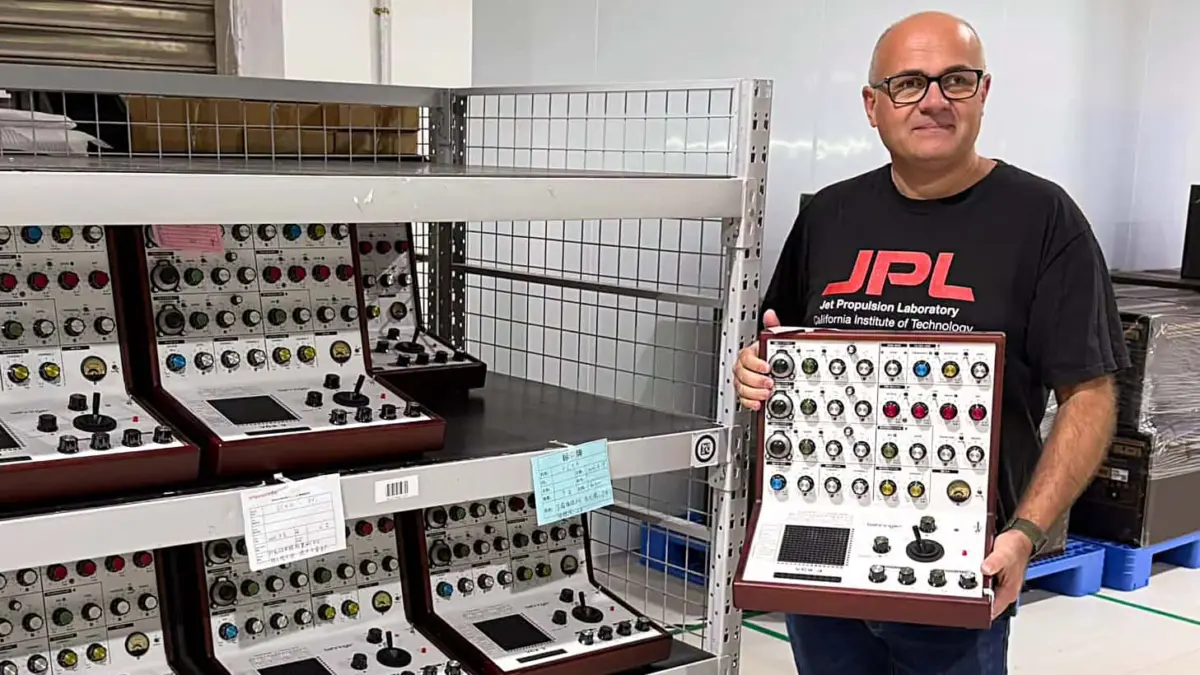
Behringer has officially released a new series of teaser images and production updates regarding the VCX3, a modern recreation of the legendary Electronic Music Studios (EMS) VCS3 analog synthesizer. The announcement, shared through the company’s social media channels, features a staged photograph of a technician—referred to by the company as one of their "mad jet propulsion scientists"—surrounded by multiple units of the VCX3. This update marks a significant milestone for a project that has been in development for over seven years, signaling that the instrument is finally approaching its commercial release.
The VCX3 is a non-authorized, hardware-level recreation of the 1969 EMS VCS3, an instrument that fundamentally altered the trajectory of electronic music. Behringer’s latest update acknowledges the protracted development timeline, with the company stating, “This beast has taken far longer than expected,” while confirming that they are “finally getting there.” Despite the new imagery, specific details regarding the final retail price and an exact shipping date remain unconfirmed, though the appearance of near-final hardware suggests that mass production is imminent.
The Historical Legacy of the EMS VCS3
To understand the industry anticipation surrounding the Behringer VCX3, one must look at the pedigree of the original Electronic Music Studios VCS3. Introduced in 1969 by Peter Zinovieff, David Cockerell, and Tristram Cary, the VCS3 (Voltage Controlled Studio, version 3) was one of the first truly portable synthesizers, though "portable" by 1960s standards meant it could be carried by a single person rather than occupying an entire room.
Commonly referred to as "The Putney," the VCS3 was distinct from its American contemporaries, such as Moog and Buchla, due to its unique patch-pin matrix system. Instead of using a forest of patch cables to route signals, the VCS3 utilized a 16×16 matrix board where users inserted small resistive pins to connect different modules. This design allowed for a compact form factor and encouraged experimental, non-linear sound design.
The instrument became a cornerstone of the 1970s progressive rock and avant-garde scenes. It provided the signature bubbling textures on Pink Floyd’s "On the Run" from The Dark Side of the Moon and served as a primary tool for Brian Eno during his tenure with Roxy Music and his later ambient works. Other notable users included Jean-Michel Jarre, Klaus Schulze, and The Who, the latter of whom famously utilized the VCS3 to process Pete Townshend’s organ on "Won’t Get Fooled Again."
Technical Architecture and Feature Set
While Behringer has noted that final features are subject to change, the VCX3 is designed to mirror the core architecture of the original EMS unit. The original VCS3 was a monophonic instrument featuring three voltage-controlled oscillators (VCOs), a noise generator, a ring modulator, and a unique 18dB/octave diode ladder filter.
One of the most defining characteristics of the VCS3, which Behringer appears to have replicated in the VCX3, is the integrated XY joystick. This controller allowed musicians to manipulate two parameters simultaneously, often used for real-time filter sweeps or pitch modulation, contributing to the instrument’s reputation as a performance-oriented machine rather than just a laboratory tool.
The Behringer VCX3 is expected to include:
- Three analog oscillators with variable waveforms.
- The iconic 16×16 pin matrix for modulation and signal routing.
- A voltage-controlled filter (VCF) based on the original diode ladder design.
- An integrated spring reverb (a staple of the original "Putney" sound).
- The characteristic XY joystick for real-time modulation.
- Modern additions likely to include MIDI/USB connectivity and potentially expanded CV (control voltage) inputs for integration with Eurorack systems.
A Chronology of the VCX3 Development
The journey of the Behringer VCX3 has been one of the longest in the company’s history of "tribute" synthesizers. The project was first publicly teased in December 2017, when Behringer indicated interest in cloning several classic synths, including the ARP 2600, the Wasp, and the Synthi/VCS3.
In January 2021, the company confirmed that a prototype was functional, sharing images of the circuit boards and the wooden enclosure that mimics the original’s iconic aesthetic. However, the project faced numerous delays. Between 2021 and 2023, the global semiconductor shortage significantly hampered the music technology industry. Behringer, which relies on high-volume production, was particularly affected, leading to many of their announced projects being labeled as "vaporware" by critics in the synthesizer community.
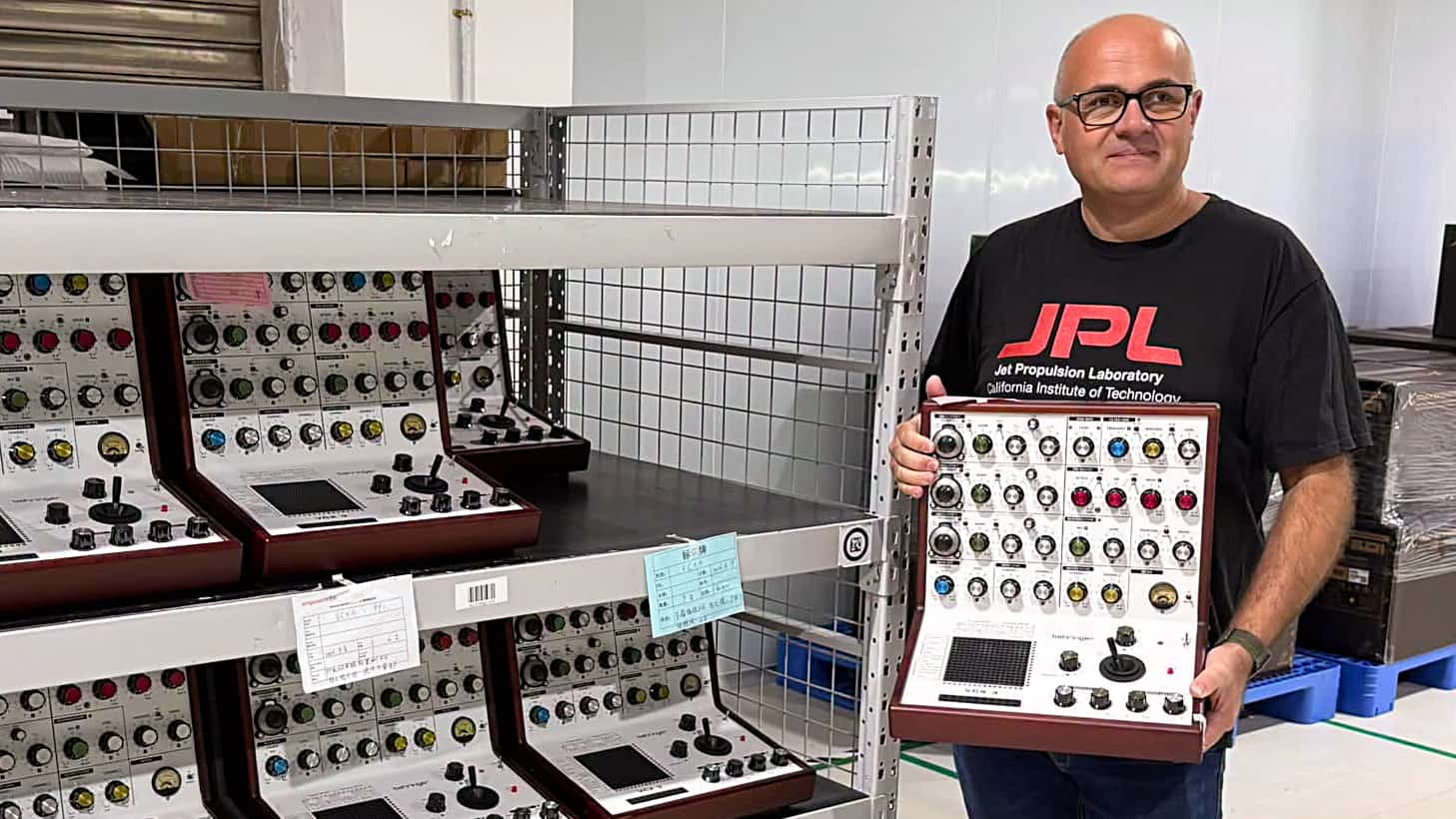
In March 2022, Behringer provided another progress update, showing a more refined version of the hardware but admitting that they were still sourcing specific components to ensure the tonal accuracy of the diode filter and the stability of the oscillators. The October 2024 teaser represents the most definitive evidence to date that the engineering hurdles have been cleared and the product is moving toward the retail pipeline.
The Economic Landscape: Boutique Rarity vs. Mass Production
The release of the VCX3 is poised to disrupt a very niche and expensive corner of the synthesizer market. Electronic Music Studios (EMS) London is still in operation today, maintaining the title of the world’s longest-established synthesizer manufacturer. They continue to produce the original Synthi A and VCS3 units on a bespoke basis.
However, the barrier to entry for an original EMS instrument is exceptionally high. A new VCS3 from EMS London is currently priced at approximately £5,950 (roughly $7,700 USD), and the waitlist is known to span several years. On the secondary market, vintage units from the 1970s frequently command prices between $15,000 and $25,000, depending on their condition and provenance.
Behringer’s business model focuses on "democratizing" these classic sounds. While the company has not announced the price for the VCX3, industry analysts expect it to fall within the $500 to $900 range, consistent with their other large-format recreations like the 2600 and the Poly D. This price discrepancy makes the VCX3 an attractive proposition for musicians who desire the unique workflow of the pin matrix but cannot justify the five-figure investment required for an original.
Industry Reactions and Implications
The announcement has garnered a mixed reaction from the synthesizer community, reflecting a long-standing debate regarding Behringer’s practice of cloning legacy hardware. Supporters argue that Behringer is providing a service to the music community by making "unobtanium" instruments accessible to the average bedroom producer. They point out that the patents on the original 1969 circuitry have long since expired, making the recreation legally permissible.
Conversely, critics and purists express concern over the impact on the original manufacturers. EMS London remains a small, artisan operation, and there are concerns that a mass-produced, low-cost alternative could devalue the brand’s legacy. There are also ongoing discussions regarding the "soul" of the instrument; the original VCS3 was known for its instability, quirks, and organic "fuzziness"—traits that are often difficult to capture in modern, precision-manufactured clones.
From a technical standpoint, the VCX3 represents a significant engineering challenge. The pin matrix, in particular, is a mechanical component that requires high durability and precise electrical resistance. If Behringer successfully replicates the tactile feel and the specific "bleed" and crosstalk of the original matrix, it will be viewed as a major achievement in affordable analog engineering.
Broader Impact on the Modern Music Ecosystem
The arrival of the VCX3 is likely to spark a resurgence in experimental electronic music. The VCS3 was never a "bread and butter" synthesizer meant for standard basslines or lead melodies; it was a machine designed for sound exploration, drones, and musique concrète. By placing this specific workflow into the hands of thousands of new users, Behringer may inadvertently influence a new generation of sound designers.
Furthermore, the VCX3 enters a market where "West Coast" and experimental synthesis have seen a revival through the Eurorack modular format. Competitors like Erica Synths have released the Syntrx, a modern take on the VCS3 concept that adds digital patch saving and modern stability while maintaining the matrix-based workflow. The VCX3 will likely compete directly with these high-end modern interpretations by offering a more traditional, "vintage-accurate" experience at a fraction of the cost.
As Behringer moves into the final stages of the VCX3 rollout, the industry will be watching closely to see if the hardware lives up to the seven-year hype. For a company that has built its recent reputation on reviving the past, the VCX3 is perhaps their most ambitious "tribute" to date, tackling an instrument that is as much a piece of modern art as it is a musical tool. With the "jet propulsion scientists" seemingly finished with their work, the electronic music world now awaits the first sound demos and the final shipping notices.
