

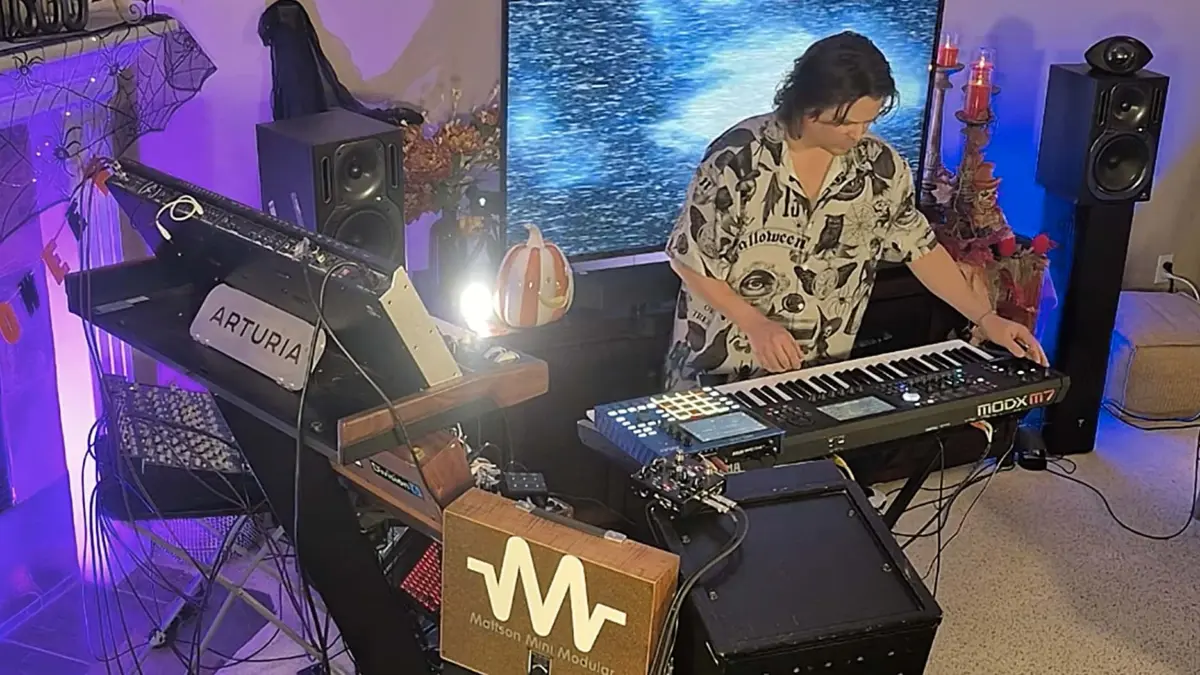
Renowned ambient and space music composer Craig Padilla has officially released a comprehensive live performance video of his new work, "Surface Ascent," providing a technical and artistic preview of his forthcoming album, First Light Over Aurora. The performance, an extended electronic instrumental piece presented in four distinct movements, showcases Padilla’s intricate approach to hardware-based synthesis and real-time sound manipulation. Captured in a live setting, the performance highlights the artist’s transition from studio-focused composition to a dynamic, hardware-centric live environment, utilizing a sophisticated array of analog and digital instruments to create an immersive "underwater" sonic atmosphere.
The performance serves as a cornerstone for the upcoming live album, First Light Over Aurora, which is expected to further solidify Padilla’s position within the "Berlin School" of electronic music—a genre characterized by long, evolving sequences, atmospheric pads, and improvisational synthesizer leads. By releasing this high-definition performance of "Surface Ascent," Padilla offers fans and technical enthusiasts a detailed look at the signal chain and performance techniques required to execute complex ambient soundscapes without the aid of a traditional Digital Audio Workstation (DAW) for primary sequencing.
Technical Architecture and Instrumentation
The performance of "Surface Ascent" is notable for its heavy reliance on a hybrid setup of vintage-inspired modular systems and modern digital controllers. Padilla’s technical configuration for this piece includes the Akai MPC ONE, which serves as the central rhythmic and sequencing hub, and the Yamaha MODX M7, utilized for its expansive polyphonic textures and FM synthesis capabilities.
A critical component of the "Surface Ascent" soundstage is the integration of modular synthesis. Padilla utilizes a Synthrotek MST and Division 6 modular system, processed through a Source Audio Collider for delay and reverb effects. Additionally, a Mattson Mini Modular system, paired with a Source Audio Nemesis delay, is employed to generate the foundational "underwater sonar-like" tones that define the opening movements of the piece. These modular units are characterized by their tactile nature, allowing Padilla to manipulate voltage-controlled oscillators (VCOs) and filters in real-time, ensuring that no two performances of the track are identical.
The rhythmic complexity of the piece is bolstered by an ARP 2500 Sequencer, a modern recreation of a classic design known for its precision and historical significance in the evolution of electronic music. For lead voices and aggressive tonal shaping, Padilla incorporates the Arturia MatrixBrute, a powerful analog synthesizer known for its complex modulation matrix. The signal chain is finalized through specialized boutique effects, including the Hologram Microcosm—a granular processor that breaks sounds into micro-loops—and the TC Electronics Ditto X4, which allows for multi-layered looping and phrase sampling during the performance.
The Artistic Vision of Surface Ascent
According to Padilla, the composition of "Surface Ascent" was designed to evoke a sense of vertical movement through a fluid medium. The initial stages of the performance are sparse and atmospheric, utilizing the Mattson Mini Modular and the ARP 2500 Sequencer to create rhythmic "pings" reminiscent of maritime sonar technology. This aesthetic choice establishes a sense of isolation and depth, which gradually evolves as the rhythmic sequences become more pronounced.
As the piece progresses through its four parts, the density of the soundscape increases. The introduction of the Yamaha MODX M7 provides a lush harmonic bed, while the Arturia MatrixBrute delivers more defined melodic structures. This progression is intended to simulate the experience of rising from the ocean floor toward the surface, moving from the dark, pressurized depths of the bass frequencies to the bright, shimmering highs of the lead synthesizers. The use of the TC Electronics Ditto X4 allows Padilla to build these layers in real-time, creating a "wall of sound" that remains grounded in the initial sonar motifs.
Chronology and Career Context
Craig Padilla’s career spans over three decades, during which he has become a staple of the international ambient and electronic music communities. Based in Northern California, Padilla has released dozens of albums, both as a solo artist and in collaboration with other luminaries of the genre, such as Skip Murphy and Marvin Allen. His work has frequently been featured on the long-running syndicated radio program Hearts of Space, and he has a long-standing relationship with labels specializing in high-fidelity electronic music.
The development of "Surface Ascent" and the First Light Over Aurora project represents a specific era in Padilla’s discography—one focused on the "DAW-less" movement. This movement emphasizes the use of hardware instruments over computer-based software, a return to the physical roots of electronic music that gained significant traction in the 2010s and 2020s. This performance demonstrates a mastery of this workflow, where the artist must manage multiple hardware interfaces simultaneously to maintain the momentum of an extended live piece.
The timeline for the release of First Light Over Aurora follows a series of successful studio efforts. The decision to release a live album follows a growing trend among electronic artists to document the ephemeral nature of hardware-based improvisation. Unlike studio recordings, which can be edited and polished, a live performance like "Surface Ascent" captures the raw interaction between the musician and the fluctuating voltages of his modular gear.
Implications for the Electronic Music Industry
The release of this performance video and the subsequent album on platforms like Bandcamp highlights a significant shift in the distribution and consumption of niche electronic music. Bandcamp has emerged as a vital ecosystem for artists like Padilla, allowing for direct-to-fan sales and the distribution of high-resolution audio formats that are essential for the nuanced frequencies of ambient music.
Furthermore, Padilla’s use of specific boutique hardware—such as the Hologram Microcosm and the Mattson Mini Modular—reflects the current "boutique boom" in the music technology industry. Smaller manufacturers are now producing highly specialized gear that allows artists to achieve unique "sonic signatures" that were previously impossible or required massive, room-sized systems. The visibility of this gear in Padilla’s performance serves as both a technical demonstration and an endorsement of the creative possibilities inherent in modern hardware synthesis.
From a broader perspective, "Surface Ascent" contributes to the ongoing "Berlin School" revival. By blending the sequencing styles of the 1970s (popularized by Tangerine Dream and Klaus Schulze) with modern granular synthesis and digital control, Padilla is helping to evolve the genre for a contemporary audience. This hybrid approach appeals to both veteran listeners of space music and a younger generation of "synth-fluencers" and modular enthusiasts.
Anticipation for First Light Over Aurora
While a specific release date for the full First Light Over Aurora album has not been disclosed, the "Surface Ascent" performance has generated significant interest within the electronic music community. The track’s availability on Padilla’s Bandcamp site serves as a precursor to what is expected to be a major entry in his discography.
Industry analysts suggest that live albums in the ambient genre often perform well because they offer a sense of "authenticity" that studio-perfected albums sometimes lack. For Padilla, the upcoming album is not just a collection of songs, but a document of a specific set of technical challenges and artistic triumphs achieved in a live setting. The "underwater sonar-like vibe" described by Padilla is expected to be a recurring theme throughout the album, providing a cohesive narrative arc for the listener.
As the electronic music landscape continues to fragment into highly specialized sub-genres, artists like Craig Padilla remain essential for their ability to bridge the gap between historical techniques and future-facing technology. "Surface Ascent" stands as a testament to the enduring power of the synthesizer as a tool for storytelling, capable of transporting the listener from the depths of the ocean to the far reaches of space through nothing more than the manipulation of sound waves.
