

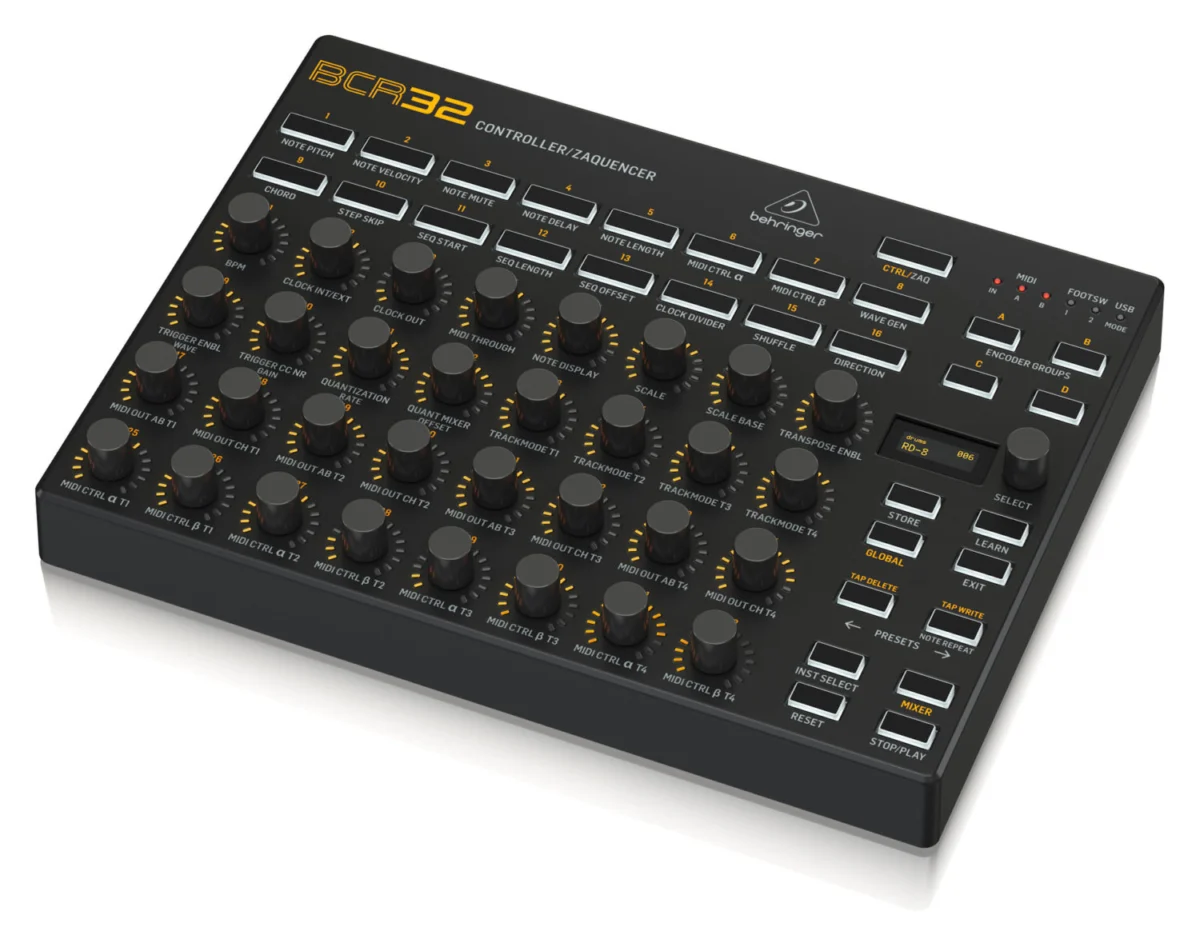
The music technology industry has reached a significant milestone with the official opening of pre-orders for the Behringer BCR32, a modernized and compact reimagining of the legendary BCR2000 MIDI controller. This announcement marks the culmination of a multi-year development cycle aimed at blending classic tactile control with contemporary sequencing capabilities. Priced at approximately $270 USD, the BCR32 is positioned to serve as a bridge between traditional digital audio workstation (DAW) environments and the burgeoning world of hardware-based modular synthesis. By integrating the highly acclaimed Zaquencer firmware directly into the hardware, Behringer has transitioned the device from a mere control surface into a sophisticated, standalone polyphonic step sequencer.
The Historical Significance of the B-Control Series
To understand the industry’s anticipation for the BCR32, one must look back at the release of the original B-Control series in the early 2000s. At that time, the BCR2000 (Rotary) and BCF2000 (Fader) represented a breakthrough in affordable studio hardware. While Behringer was often scrutinized for its business model, the B-Control series earned a reputation for being exceptionally robust and versatile.
The BCR2000, in particular, became a cult classic. Its array of 32 rotary encoders with LED rings provided visual feedback that was rare at its price point. It found a permanent home in the studios of professional electronic musicians and was famously utilized by artists such as Daft Punk during their live performances. The device’s longevity was further cemented by its open-ended nature, which allowed third-party developers to write custom firmware, eventually leading to the creation of the Zaquencer.
The Zaquencer Integration: From Boutique Firmware to Factory Standard
The defining feature of the BCR32 is the native integration of the Zaquencer step sequencer. Originally developed by Christian Stöcklmeier, the Zaquencer was a third-party firmware upgrade that transformed the BCR2000 from a MIDI controller into a standalone hardware sequencer comparable to high-end boutique devices.
For years, users had to purchase the firmware separately and navigate a complex installation process to "flash" their hardware. The BCR32 eliminates this barrier by building the Zaquencer logic into the device’s core operating system. This integration allows for a seamless workflow where the 32 encoders serve as the primary interface for step editing, note input, and parameter modulation.
The Zaquencer engine provides four independent tracks, each capable of handling polyphonic information. It includes advanced features such as individual track lengths (allowing for complex polymeters), various play directions, and chord modes. By bringing this software into the factory build, Behringer has effectively validated a decade of community-driven innovation.
Technical Specifications and Hardware Evolution
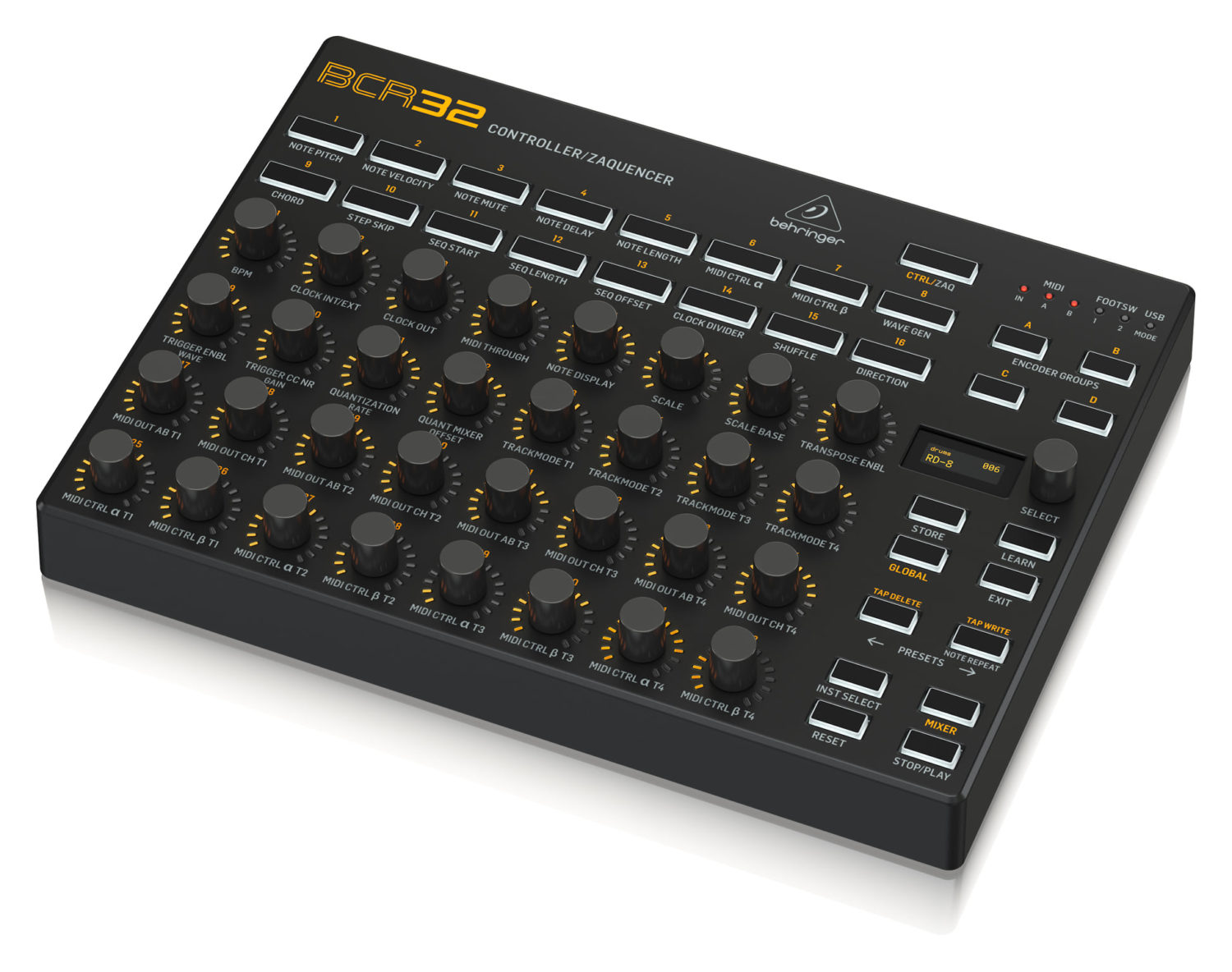
The BCR32 represents a significant physical evolution over its predecessor. The most immediate change is the form factor; the device is substantially more compact, aligning with the modern trend toward "desktop-friendly" gear. Despite the smaller footprint, the unit retains the 32 high-resolution rotary encoders that made the original famous.
Enhanced Connectivity Suite
While the original BCR2000 relied primarily on standard 5-pin DIN MIDI and USB, the BCR32 expands its reach into the analog realm. The rear panel features:
- Full Hardware DIN MIDI: Ensuring compatibility with legacy synthesizers and drum machines.
- USB MIDI: For high-speed integration with modern DAWs and virtual instruments.
- Analog Sync In/Out: Allowing the sequencer to clock-sync with vintage hardware and pocket operators.
- Four CV/Gate Pairs: This is perhaps the most critical addition for modern producers. These outputs allow the BCR32 to control Eurorack modular systems and semi-modular synthesizers directly, providing pitch and trigger signals without the need for an external MIDI-to-CV converter.
User Interface and Feedback
The encoders on the BCR32 feature high-visibility LED rings. These rings provide instantaneous feedback on parameter values, a feature that remains superior to traditional potentiometers, which can suffer from "parameter jump" when switching between presets. The compact chassis also includes a dedicated display and a streamlined button layout for navigating the Zaquencer’s various menus and performance modes.
Development Chronology and Market Context
The journey of the BCR32 from concept to pre-order has been closely watched by the synthesizer community. The project was first teased in early 2021, generating immediate interest among "DAW-less" performers who prioritize hardware sequencing over computer-based composition.
The timeline of the BCR32’s development coincided with a global shift in the electronics industry. Between 2021 and 2023, the production of music technology was significantly hampered by the global semiconductor shortage. Industry analysts note that Behringer’s decision to wait until 2024 to open pre-orders likely reflects a strategic move to ensure stable supply chains and finalized firmware stability.
The pricing of $270 USD places the BCR32 in a competitive bracket. It sits between entry-level sequencers like the Arturia BeatStep Pro and more expensive, high-end units like the Squarp Pyramid or the Polyend Play. By offering 32 encoders—a higher density than almost any competitor—Behringer is targeting users who require deep, hands-on control over multiple parameters simultaneously.
Community and Industry Reactions
The reaction from the music production community has been largely positive, particularly regarding the collaboration with Christian Stöcklmeier. In an era where large corporations are often criticized for ignoring the contributions of independent developers, Behringer’s decision to officially license and integrate the Zaquencer is seen as a win for the boutique coding community.

Sources close to the development have indicated that the collaboration involved extensive testing to ensure that the Zaquencer’s logic translated perfectly to the new hardware’s processor architecture. Early beta testers have praised the unit’s "immediacy," noting that the tactile nature of the 32 encoders makes melodic and rhythmic programming far more intuitive than mouse-and-keyboard sequencing.
However, some legacy users have expressed a desire for a "BCF" version of the new hardware, featuring motorized faders. While Behringer has not officially confirmed a fader-based companion to the BCR32, the modular nature of their current product line suggests that a modern BCF32 could be a logical next step if the BCR32 meets sales expectations.
Broader Implications for the Music Technology Market
The release of the BCR32 is indicative of a broader trend in the industry: the democratization of high-end sequencing. Features that were once reserved for devices costing upwards of $600 are now being made available to a wider audience. This shift is expected to further fuel the popularity of Eurorack and modular synthesis, as the barrier to entry for controlling these complex systems continues to lower.
Furthermore, the BCR32 highlights the enduring appeal of "knob-per-function" interfaces. Despite the rise of touchscreens and tablets, the tactile feedback of a physical encoder remains the preferred choice for live performance and expressive studio work. The BCR32’s ability to function as a class-compliant MIDI controller also means it will likely become a favorite for users of software like Ableton Live and Bitwig Studio, where mapping multiple encoders to device macros is a core part of the workflow.
Conclusion and Availability
As pre-orders begin to circulate through major retailers, the Behringer BCR32 stands as a testament to the longevity of well-designed control surfaces. By combining the proven hardware layout of the BCR series with the innovative sequencing logic of the Zaquencer, Behringer has created a tool that is simultaneously a nostalgia-driven tribute and a forward-looking powerhouse.
For the modern producer, the BCR32 offers a unique value proposition: a professional-grade sequencer, a comprehensive MIDI-to-CV bridge, and a high-density DAW controller, all housed in a single, affordable desktop unit. As shipping dates approach, the industry will be watching closely to see how this device reshapes the landscape of hardware-based electronic music production. With its $270 price point and robust feature set, the BCR32 is poised to become as ubiquitous in the next decade as its predecessor was in the last.
