

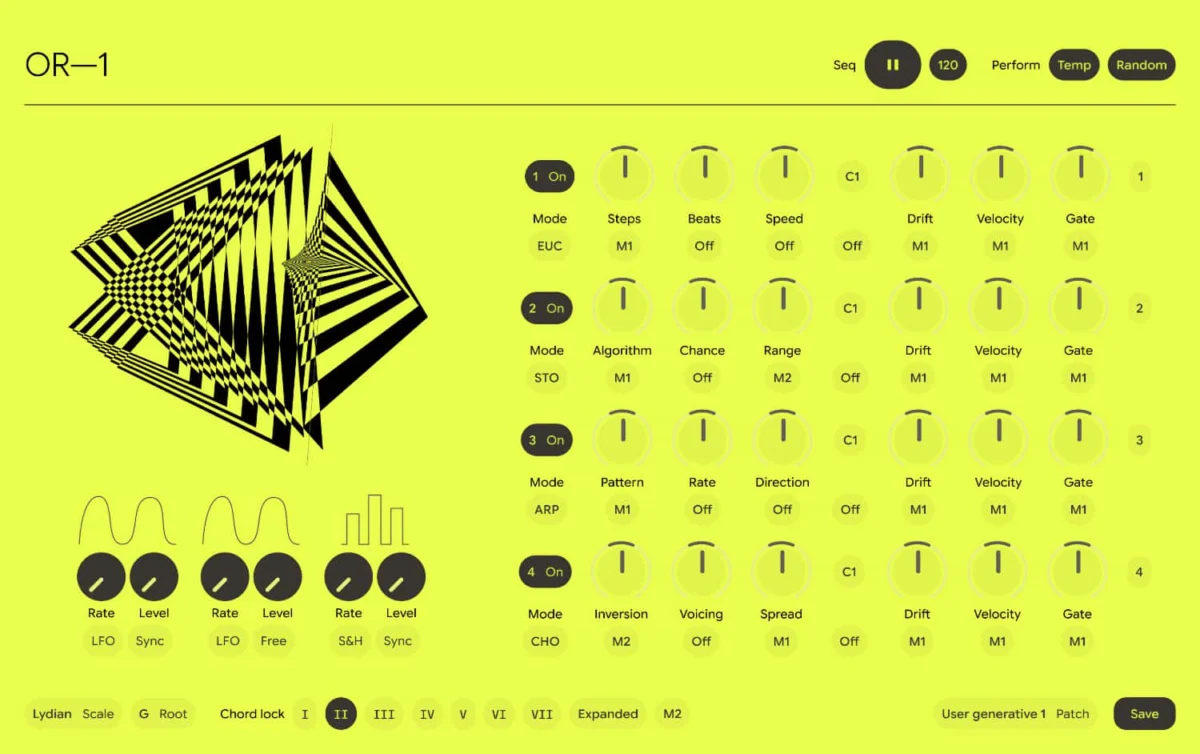
The arrival of OR—1 comes at a time when generative music—a method of composition where systems follow a set of rules to create ever-evolving arrangements—is seeing a resurgence in both the hardware modular synth community and the software-based mobile production world. By leveraging the iPad’s touch interface and processing power, Organismi Instruments provides a platform for users to explore non-linear music creation that moves beyond the traditional fixed-loop paradigm.
The Technical Architecture of Generative Sequencing
To understand the impact of the OR—1, one must first examine the nature of generative MIDI sequencing. Unlike standard sequencers that play back a predetermined sequence of notes (such as a 16-step drum loop or a piano melody), a generative sequencer utilizes probabilistic algorithms and mathematical functions to determine which notes are played, when they are triggered, and how they are modulated.
The OR—1’s philosophy of "breathing" patterns suggests an emphasis on organic movement. In technical terms, this often involves the use of Low-Frequency Oscillators (LFOs), random walk generators, and Euclidean rhythms. These elements work in tandem to ensure that while a sequence may have a recognizable core, it never repeats identically. For the user, this means the iPad becomes a partner in the creative process rather than just a recording medium.
Because the OR—1 is a MIDI-only application, its utility is dependent on its connectivity. It is built to integrate seamlessly within the iOS music ecosystem, typically utilizing the AUv3 (Audio Units version 3) standard. This allows the sequencer to be loaded as a plugin within host applications such as AUM, Audiobus, Loopy Pro, or Apple’s own Logic Pro for iPad. By routing the MIDI output of OR—1 into a virtual instrument—such as a Moog Model D emulation or a Korg Gadget synthesizer—users can transform abstract data into complex, evolving soundscapes.
Historical Context and the Evolution of Generative Music
The release of OR—1 is part of a long historical trajectory that dates back to the mid-20th century. The concept of generative music was popularized by Brian Eno in the 1970s, though its roots lie in the "aleatory" music of composers like John Cage and the "Musique en jeu" experiments of the French avant-garde. Eno famously described generative music as being like a seed: "You plant the seed, and then the environment takes over and the thing grows in a certain way."
In the 1990s, the Sylvan Koan software allowed for the creation of generative pieces on early home computers, but these tools were often cumbersome or required significant programming knowledge. The transition to mobile platforms like the iPad has democratized these complex compositional techniques. Apps like the OR—1 follow in the footsteps of groundbreaking iOS tools such as Bram Bos’s Rozeta Sequencer Suite and Fugue Machine by Alexandernaut. However, by offering the OR—1 as a free utility, Organismi Instruments is making a strategic move to lower the entry point for experimental music production.
Industry Reception and Performance Capability
Initial reactions from the electronic music community have been positive, with notable figures highlighting the app’s capacity for experimentation. Peter Kirn, a well-known music technologist and founder of CDM (Create Digital Music), recently showcased the OR—1 in a performance demo, illustrating how the app can be used to drive external hardware and software simultaneously. Kirn’s demonstration emphasized the "unpredictable yet musical" nature of the sequencer, noting its ability to generate textures that feel human rather than mechanical.
From a performance perspective, the OR—1 is designed to be interacted with in real-time. While the algorithms handle the note generation, the user maintains "macro" control over parameters such as scale constraints, density, and rhythmic complexity. This allows a performer to guide the music’s direction—increasing intensity during a climax or thinning out the arrangement for a breakdown—while the app handles the "micro" decisions of individual note placement.

The Role of the iPad in Modern Music Production
The choice of the iPad as the primary platform for OR—1 is significant. Over the last decade, the iPad has evolved from a consumer media device into a professional-grade music workstation. The introduction of iPadOS and the refinement of MIDI handling have made it a preferred choice for live performers and studio musicians who value portability and tactile control.
The "app-centric" nature of iOS music production relies on small, specialized tools that do one thing exceptionally well. The OR—1 fits perfectly into this "modular" software workflow. Rather than being a bloated, all-in-one production suite, it is a specialized component that users can "patch" into their existing setups. This modularity mirrors the logic of Eurorack synthesizers, where a musician might use a dedicated module for sequencing, another for sound generation, and another for effects.
Analysis of the Free Software Model
The decision by Organismi Instruments to release OR—1 for free is a point of interest for industry analysts. In the current "app economy," developers often struggle to balance visibility with profitability. By providing a high-quality generative tool at no cost, Organismi Instruments may be employing a "freemium" or "brand-building" strategy.
Historically, free tools in the music software space serve to establish a developer’s reputation, potentially leading to future paid releases or hardware integrations. Alternatively, it reflects a growing movement of independent developers who contribute to the "open" or "accessible" software community, ensuring that advanced creative tools are available to students, hobbyists, and professionals regardless of their financial situation. This democratization is vital for the continued evolution of electronic music, as it allows for a more diverse range of voices to experiment with high-level compositional techniques.
Integration and Compatibility
For users looking to incorporate OR—1 into their workflow, compatibility is a key consideration. The app is optimized for modern iPads running the latest versions of iPadOS, ensuring low-latency MIDI transmission. It supports standard MIDI protocols, meaning it can communicate with:
- Internal iOS Apps: Through Virtual MIDI or AUv3 hosting.
- External Hardware: Via USB-MIDI interfaces or Bluetooth MIDI, allowing it to control vintage analog synths or modern digital workstations.
- Desktop DAWs: By connecting the iPad to a Mac or PC, the OR—1 can act as a touch-based generative controller for Ableton Live, Logic Pro, or Bitwig Studio.
The versatility of the MIDI-only approach means that the OR—1 is not limited by a specific "sound." It is as capable of generating a delicate ambient piano melody as it is a chaotic industrial techno bassline, depending entirely on the instrument to which it is patched.
Broader Implications for the Future of Composition
The proliferation of tools like OR—1 suggests a shift in how we define "the composer." When a software algorithm is responsible for selecting notes, the human role shifts toward that of a curator or a system designer. This transition is not without controversy, as some traditionalists argue it diminishes the skill required to write music. However, proponents of generative systems argue that these tools actually require a higher level of conceptual thinking, as the composer must design the boundaries and rules within which the music exists.
As artificial intelligence and machine learning continue to permeate the creative arts, the OR—1 represents a "human-centric" version of algorithmic assistance. It does not use "black box" AI to write songs for the user; instead, it provides a transparent mathematical framework that the user can manipulate in real-time. This maintains the "performative" aspect of music while embracing the power of modern computation.
Conclusion
Organismi Instruments OR—1 stands as a testament to the creative potential of the mobile platform. By offering a sophisticated, generative MIDI sequencer for free, Organismi Instruments has provided the global music community with a powerful new resource for exploration and performance. Whether used as a source of inspiration for a new studio track or as the central engine of a live electronic set, the OR—1’s "breathing" patterns represent a bridge between the rigid world of digital sequencing and the fluid, unpredictable nature of organic sound. As the iPad ecosystem continues to mature, tools like the OR—1 will likely play an increasingly central role in shaping the sound of contemporary music.
