

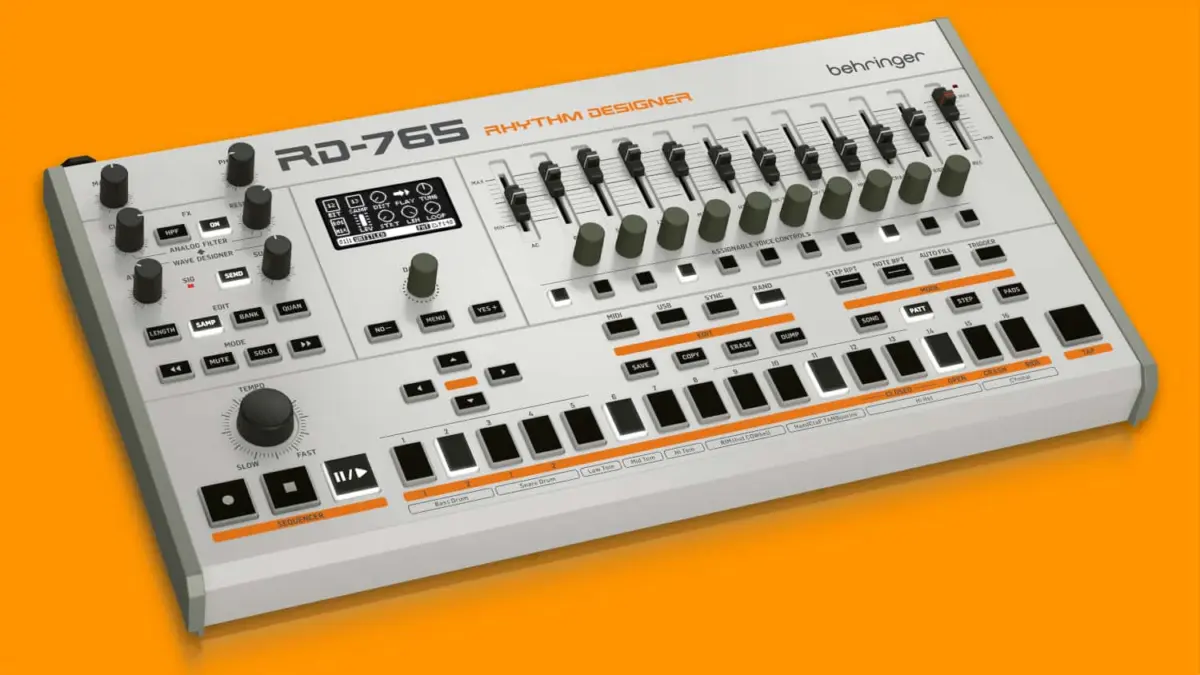
The music technology landscape has witnessed a significant development with the official listing of the Behringer RD-765 Rhythm Designer, a hardware drum machine that represents a strategic expansion of the company’s "RD" series. Following the successful releases of the RD-8 and RD-9, which sought to replicate the legendary TR-808 and TR-909 respectively, the RD-765 takes a more eclectic approach. It integrates the sonic characteristics of multiple classic instruments from the 1980s—most notably drawing inspiration from the Roland TR-707, TR-606, and TR-505—while introducing a robust sampling engine and modern sequencing tools. This announcement, made via a product listing and a technical demonstration video, signals Behringer’s intent to bridge the gap between fixed-sound vintage clones and flexible modern workstations.
A Hybrid Approach to Percussion Synthesis
The RD-765 Rhythm Designer distinguishes itself from its predecessors by moving away from a singular focus on analog synthesis. While the RD-8 and RD-9 were lauded for their faithful reproduction of analog circuits, the RD-765 embraces the "hybrid" era of the mid-1980s. During this period, drum machines began transitioning from purely analog sound generation to Pulse Code Modulation (PCM) digital samples. By combining these elements, the RD-765 offers a palette that includes the punchy, metallic hi-hats of the TR-606 and the realistic, grit-filled snare and kick drums of the TR-707 and TR-505.
However, the RD-765 is more than a simple library of pre-recorded sounds. The inclusion of a sampling engine allows users to record their own audio directly into the hardware, providing a level of customization that was largely absent from the original hardware of the 1980s. This feature transforms the unit into a creative tool capable of blending historical textures with contemporary field recordings or vocal snippets. To further sculpt these sounds, Behringer has integrated an analog filter, allowing for real-time manipulation of the digital voices, effectively marrying digital precision with analog warmth.
Technical Specifications and Design Architecture
The physical design of the RD-765 pays clear homage to the industrial aesthetic of the mid-80s, featuring a layout that will be immediately familiar to users of the TR-707. The interface is dominated by a series of faders for individual voice levels, providing a tactile mixing experience that is often lost in menu-dive-heavy modern equivalents.
Key technical features identified in the product listing include:
- 16 Drum Voices: A comprehensive selection of sounds including kicks, snares, toms, cymbals, and percussion, with the ability to assign user samples to specific pads.
- Onboard Sampling: A dedicated input for capturing external audio, with tools for trimming, tuning, and normalization.
- 64-Step Sequencer: An advanced sequencing engine that supports polyrhythms, step-repeat, note-repeat, real-time triggering, and track-specific probability.
- Analog Filtering: A multi-mode filter (Low Pass/High Pass) that can be applied to individual voices or the master bus for sweeping transitions and tonal shaping.
- Connectivity Suite: The rear panel includes individual outputs for each voice, a feature highly sought after by studio engineers for external processing. It also features USB-MIDI, traditional 5-pin MIDI In/Out/Thru, and Clock I/O for synchronization with modular synthesizers and vintage gear.
Historical Context: The Legacy of the 700 Series
To understand the market positioning of the RD-765, it is necessary to examine the history of the machines it emulates. In 1984, the Roland TR-707 was released as a digital alternative to the analog TR-808. It used 12-bit samples and featured a large LCD grid that revolutionized how producers visualized their patterns. It became a staple in the early Chicago House and Detroit Techno scenes due to its affordability on the second-hand market and its distinctively "crunchy" digital sound.
The TR-606, released earlier in 1981, was originally intended as a companion to the TB-303 Bass Line. Its all-analog circuitry produced a unique, "tinny" hi-hat and a soft kick drum that eventually became a hallmark of acid house and indie pop. By combining these different eras—the analog warmth of the 606 and the digital grit of the 707—the RD-765 offers a comprehensive retrospective of 1980s rhythm production within a single chassis.
Chronology of Behringer’s Rhythm Designer Series
The development of the RD-765 is the latest step in a multi-year strategy by Behringer to dominate the affordable hardware market. The chronology of this series highlights the company’s evolving technical capabilities:
- 2019: The RD-8 Release. Behringer launched the RD-8, an analog recreation of the TR-808. It was praised for its price point and the addition of a "Wave Designer" and analog filter.
- 2021: The RD-9 Launch. After significant delays and firmware refinements, the RD-9 (a TR-909 clone) was released, featuring improved MIDI implementation and a dedicated "Authentic" mode.
- 2022–2023: Expansion and Prototyping. Behringer began teasing various prototypes, including the RD-6 (a TR-606 clone) and smaller-format drum machines.
- 2024: The RD-765 Announcement. The listing of the RD-765 marks a shift from 1:1 cloning to a "best-of" hybrid approach, suggesting that the company is now comfortable synthesizing multiple hardware architectures into a single product.
Market Analysis and Industry Implications
The announcement of the RD-765 comes at a time when the "dawless" music production movement is reaching its peak. Producers are increasingly seeking hardware that can function independently of a computer, and the inclusion of sampling in the RD-765 makes it a much more viable "brain" for a live setup than a standard drum machine.
From a competitive standpoint, the RD-765 enters a crowded market. It will compete directly with Roland’s own TR-8S and TR-6S, which use "Analog Circuit Behavior" (ACB) modeling to recreate vintage sounds. However, Behringer’s competitive advantage typically lies in its aggressive pricing and the use of physical analog components where possible. While Roland’s modern offerings are digital, Behringer’s inclusion of a true analog filter and individual voice outputs may appeal to purists who prefer physical signal paths.
Industry analysts suggest that the RD-765 could disrupt the vintage market. Currently, a well-maintained TR-707 can fetch anywhere from $600 to $900 on the used market, while a TR-606 often exceeds $700. If Behringer follows its established pricing patterns, the RD-765 is expected to retail for a fraction of that cost, potentially making these iconic sounds accessible to a new generation of bedroom producers who were previously priced out of the vintage market.
Anticipated Reactions and Community Feedback
While official statements from Behringer’s leadership have been limited to technical descriptions, the reaction from the synthesizer community has been polarized. On one hand, hobbyists and semi-professional producers have expressed enthusiasm for a device that consolidates three distinct machines into one, particularly with the added benefit of user sampling. The ability to load modern samples into a 707-style interface is seen as a significant workflow improvement.
On the other hand, some purists remain skeptical of Behringer’s business model, which relies heavily on replicating the designs of established manufacturers. However, because the patents on the original 1980s circuits have long since expired, Behringer’s "Rhythm Designer" series exists within a legal framework that allows for the recreation of these classic instruments. The addition of new features like the 64-step sequencer and sampling helps the RD-765 avoid being labeled as a mere "copy," positioning it instead as an evolution of the platform.
Future Outlook and Availability
As of the current reporting period, Behringer has not disclosed a specific release date or a final MSRP (Manufacturer’s Suggested Retail Price) for the RD-765. Based on previous product cycles, there is often a gap of several months between a website listing and the appearance of units at major retailers. Supply chain considerations and final firmware testing are likely the primary factors influencing the eventual launch date.
The RD-765 represents a maturation of the Behringer brand. It shows a company moving beyond simple replication toward a more sophisticated synthesis of historical technologies. For the electronic music industry, it signifies the continued democratization of high-quality hardware. By integrating sampling, analog filtering, and classic sequencing into a single affordable unit, the RD-765 is poised to become a staple in both studio and live performance environments, ensuring that the rhythmic legacy of the 1980s continues to influence the music of the 2020s and beyond.
