

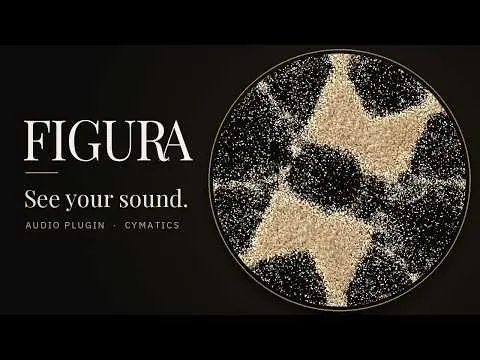
The intersection of acoustic science and digital artistry has reached a new milestone with the release of Figura, a specialized audio visualization tool developed by AcusMagic. Designed to function as both a high-fidelity plugin and a standalone application for macOS and Windows, Figura represents a departure from the traditional, often repetitive visualizers that have dominated the music software market for decades. By leveraging advanced frequency analysis and simulated physical models, the software provides a dynamic visual representation of sound that mimics the organic behavior of matter under the influence of vibration. This methodology, rooted in the study of cymatics, allows musicians, producers, and visual artists to generate unique imagery that is inextricably linked to the specific harmonic content of their audio input.
The Evolution of Sound Visualization and the Role of Cymatics
To understand the significance of Figura’s entry into the market, one must look at the historical context of sound visualization. For years, digital audio workstations (DAWs) and media players relied on basic oscilloscopes or spectrum analyzers—tools that were functional for engineering but lacked the aesthetic depth required for artistic performance. As the "creator economy" expanded, the demand for more sophisticated, generative visuals grew.
Figura draws its primary inspiration from cymatics, the study of visible sound and vibration. Historically, this field was pioneered by figures such as Ernst Chladni, an 18th-century physicist who demonstrated that sound waves could create geometric patterns in sand on vibrating plates. In the 1960s, Swiss scientist Hans Jenny expanded these studies, coining the term "cymatics" and documenting how various substances—ranging from liquids to powders—organized themselves into complex, symmetrical shapes when subjected to specific frequencies.
AcusMagic has effectively digitized these physical phenomena. Rather than using pre-rendered video loops that pulse to a rhythmic beat, Figura utilizes a real-time engine to simulate how particles of sand or beams of light would react if they were physically present on a vibrating surface. This transition from "reactive animation" to "physical simulation" marks a significant shift in how visual content is generated for musical performances.
Technical Architecture and Functional Capabilities
Figura is built to accommodate the workflows of modern creators, offering compatibility with macOS 11 or later and 64-bit Windows 10 and 11 environments. The software operates through a sophisticated analysis engine that decomposes incoming audio into its constituent frequency bands. This data is then fed into a physics-based simulation engine.
The core functionality revolves around the translation of frequency magnitude into physical force. High-frequency transients may scatter simulated particles with high velocity, while sustained low-end frequencies might cause particles to coalesce into the intricate geometric shapes characteristic of Chladni patterns. Because the visuals are generated in real-time, no two performances are identical; the visual output is as variable as the audio performance itself.
For studio-based producers, the software serves as a powerful content creation tool. The Figura Studio edition includes comprehensive export options, allowing users to render high-resolution images and video files. This is particularly valuable for artists producing music videos, social media promotional clips, or "visualizers" for platforms like YouTube and Vimeo, where high-quality video content is essential for algorithmic visibility and audience engagement.
Specialized Features for Live Performance and Projection
Recognizing the needs of the live performance sector, AcusMagic has introduced a "Live" tier of the software. The primary differentiator for Figura Live is the inclusion of a dedicated projection window. This feature allows performers to output the visual generation to a second display, a professional projector, or a LED wall without the interference of the software’s user interface.
This capability addresses a common pain point for DJs and electronic musicians who often have to toggle between their performance software and separate visual applications. By integrating the visualizer directly into the audio signal chain as a plugin (supporting VST3, AU, and other common formats), Figura ensures that the latency between the sound produced and the visual response is minimized. This synchronization is critical in a live setting, where the audience’s immersion depends on the tight alignment of auditory and visual stimuli.
Market Positioning and Pricing Structure
AcusMagic has adopted a tiered pricing model designed to lower the barrier to entry while providing professional-grade features for power users.
- Figura Studio (€59): This version is aimed at content creators and studio producers. It includes all visualization modes, the ability to run the software as a plugin within a DAW or as a standalone app, and full export capabilities for static images and video.
- Figura Live (€75): This version targets the professional performance market. It includes all the features of the Studio version but adds the critical secondary projection window, facilitating seamless integration with stage setups and live visual rigs.
In a move that contrasts with the increasingly common subscription-based models in the software industry, AcusMagic offers a free, non-expiring demo. This allows potential users to test the full range of simulation modes and the projection features before committing to a purchase. This transparency is often viewed favorably by the professional community, as it allows for thorough testing of hardware compatibility and performance stability.
Industry Implications and the Rise of Generative Art
The release of Figura arrives at a time when generative art is seeing a resurgence in the music industry. As independent artists take on more responsibility for their visual branding, tools that can produce professional-quality visuals without the need for extensive coding knowledge (such as Max/MSP or TouchDesigner) are becoming highly sought after.
Industry analysts suggest that the democratization of these tools will lead to a more diverse visual landscape in music. "The era of the generic ‘pulsing bar’ visualizer is coming to an end," notes one digital media consultant. "Audiences now expect a level of synesthesia—a true blending of the senses. Tools like Figura allow an artist to create a visual identity that is literally shaped by their sound, providing a level of authenticity that stock footage cannot match."
Furthermore, the software’s reliance on physical modeling rather than AI-generated imagery provides a different kind of value. While AI tools can generate complex scenes, they often lack the direct, sample-accurate responsiveness to audio that a physics-driven engine provides. For the purist, the fact that Figura’s patterns are a mathematical reflection of the audio signal is a compelling selling point.
Comparative Analysis: Figura vs. Traditional Visualization Software
When compared to legacy visualization tools like the iconic MilkDrop or the basic visualizers included in media players, Figura offers several distinct advantages:
- Organic Movement: Because it simulates physical matter, the movement in Figura feels more "natural" and less "computer-generated." The way particles settle or drift mimics real-world physics, which is often more pleasing to the human eye.
- Customization: Unlike "preset-only" visualizers, Figura allows users to tweak parameters of the simulation. Users can likely adjust the "sensitivity" of different frequency bands, the "weight" of the particles, and the "color palette" of the light simulations.
- Workflow Integration: By existing as a plugin, it lives inside the musician’s creative environment. It can be automated within a DAW, meaning a producer can program the visualizer to change its behavior during a bridge or a drop, just as they would automate a filter or a reverb.
Chronology of AcusMagic’s Development Path
While AcusMagic is a relatively focused entity in the software space, the development of Figura follows a clear trajectory of increasing sophistication in audio-reactive software. The project began with the goal of making complex cymatic patterns accessible to those without access to expensive laboratory equipment or high-end coding skills.
The development phase involved rigorous testing of the physics engine to ensure it could run efficiently on standard consumer hardware. Real-time physics simulations are notoriously CPU and GPU intensive; however, by optimizing the code for modern 64-bit systems and leveraging GPU acceleration, AcusMagic has ensured that Figura can run alongside a heavy DAW project without causing significant performance degradation.
Conclusion and Future Outlook
AcusMagic’s Figura is positioned to become a staple tool for a wide array of audio-visual professionals. By bridging the gap between the scientific beauty of cymatics and the practical needs of modern music production, it provides a solution that is both aesthetically sophisticated and functionally robust.
As the music industry continues to move toward a more "video-first" strategy for discovery and engagement, the ability to quickly and easily generate high-quality, reactive visuals will become a necessity rather than a luxury. With its fair pricing, flexible hosting options, and unique approach to sound representation, Figura is well-equipped to lead this new wave of generative visual tools. Whether used on a massive LED screen at a music festival or in a short clip for a social media story, Figura offers a glimpse into the future of how we see sound.
