

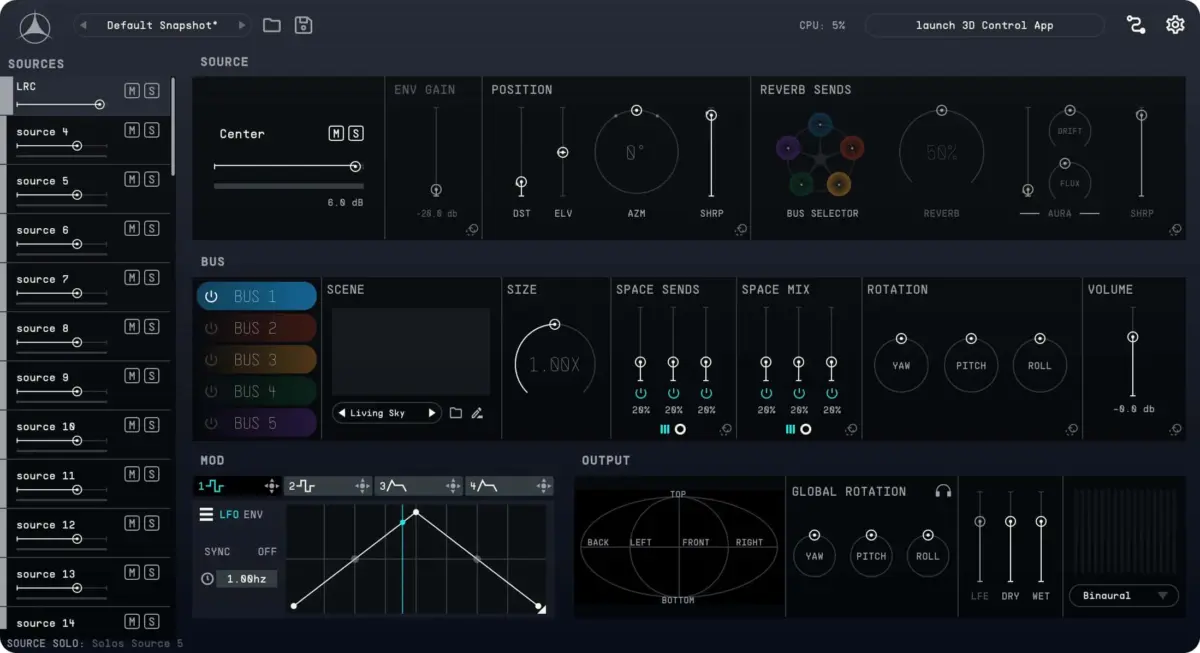
The landscape of immersive audio production has undergone a significant transformation with the official release of Living Sky, a sophisticated spatial mixing and reverb engine developed by the Canadian audio technology firm MNTRA. This new software utility represents a departure from traditional central processing unit (CPU) bound audio processing by leveraging the massive parallel processing capabilities of the graphics processing unit (GPU). Designed to serve the growing demands of film scoring, game development, and immersive music production, Living Sky integrates three-dimensional sound positioning with an expansive library of real-world acoustic environments, effectively blurring the line between spatial panning and reverberation.
By utilizing GPU acceleration, Living Sky is capable of performing hundreds of simultaneous high-resolution convolutions in real time—a feat that would typically overwhelm standard computer processors. This technical foundation allows the software to handle up to 64 independent audio sources within a single instance, providing sound designers and engineers with the ability to place, move, and envelop sounds within a complex 3D field. The system supports a wide array of output formats, ranging from traditional stereo and binaural configurations to advanced immersive setups such as 7.1.4 and beyond, utilizing higher-order Ambisonics as its internal processing backbone.
The Technical Foundation of GPU-Accelerated Audio
The shift toward GPU-powered audio processing is a strategic response to the increasing complexity of modern sound design. While CPUs are optimized for serial processing—handling tasks one after another with high speed—GPUs are designed for massive parallelism. In the context of Living Sky, this allows for the simultaneous calculation of complex spatial reflections and acoustic tails for dozens of individual sound objects. Each of the 64 supported sources can be processed through its own dedicated spatial path without the latency or "jitter" often associated with high-buffer CPU processing.
MNTRA’s implementation of convolution technology within Living Sky is particularly noteworthy. Convolution reverb utilizes impulse responses (IRs) to replicate the acoustic characteristics of physical spaces. While standard convolution plugins often struggle with more than a few stereo instances, Living Sky’s architecture supports hundreds of these processes. This enables the engine to simulate not just the tail of a reverb, but the early reflections and spatial orientation of every source relative to the listener’s position.
Advanced Spatial Modulation and Acoustic Environments
At the heart of Living Sky is an extensive library comprising more than 120 high-resolution spatial responses. These responses were captured using proprietary microphone arrays and higher-order Ambisonics (HOA) techniques in a variety of real-world locations. The library includes diverse environments, from cavernous cathedrals and industrial warehouses to intimate studios and unique natural outdoor settings.
The software allows users to distribute their 64 audio sources across five distinct reverb buses. Within each bus, up to three different "Spaces" can be combined and layered, allowing for the creation of hybrid acoustic environments that do not exist in the physical world. For example, a sound designer could blend the early reflections of a wooden chamber with the long, lush tail of a stone cathedral, all while maintaining the precise 3D coordinates of the original sound source.
Further shaping is made possible through MNTRA’s proprietary "Aura" processing. This feature functions as a source-responsive reverb send, dynamically adjusting the relationship between the dry signal and the reverberant field based on the characteristics of the input audio. Combined with spatial modulation and automation tools, this allows for a "living" soundscape where the acoustics evolve in tandem with the movement of the sound sources.
The 3D Control App and Workflow Integration
Recognizing the complexity of managing 64 independent sources in a 360-degree environment, MNTRA has included a dedicated 3D Control App. This external interface provides a visual representation of the spatial field, allowing users to drag and drop sound sources in a virtual room. Users can adjust critical parameters such as distance, elevation, azimuth, and spatial width through an intuitive graphical interface, which then syncs directly with the plugin hosted inside the Digital Audio Workstation (DAW).
This visual approach is essential for modern immersive formats like Dolby Atmos or Sony 360 Reality Audio. Because Living Sky processes audio internally using Ambisonics, the spatial mix is format-agnostic. An engineer can craft a complex mix using the 3D Control App and then output that mix to binaural for headphone monitoring, or instantly switch to a multi-speaker surround configuration without having to re-position the individual sources. This "translate once, output anywhere" workflow significantly reduces the time required for multi-format delivery.
Chronology of Development and Market Context
The development of Living Sky follows MNTRA’s established reputation for pushing the boundaries of digital signal processing. The company first gained prominence with its MNDALA engine, which focused on ultrasonic sampling and non-traditional instrument design. The transition into spatial mixing represents a logical evolution for the firm as the professional audio industry moves toward object-based audio.
The timeline of Living Sky’s release coincides with a period of rapid adoption of immersive audio standards by major streaming platforms. With Apple Music, Amazon Music, and Tidal all supporting spatial audio, the demand for tools that can bridge the gap between traditional stereo mixing and 3D environment modeling has reached an all-time high. MNTRA began teasing the technology behind Living Sky in early 2023, conducting extensive beta testing with film composers and game sound designers to ensure the GPU-based architecture remained stable across various hardware configurations.
Supporting Data and System Requirements
To facilitate the high-performance requirements of Living Sky, MNTRA has optimized the plugin for both macOS and Windows environments. On the macOS side, the engine takes advantage of Metal, Apple’s hardware-accelerated graphics API, ensuring seamless performance on M1, M2, and M3 silicon. On Windows, the software utilizes industry-standard graphics drivers to interface with NVIDIA and AMD GPUs.
Key technical specifications include:
- Processing Core: Higher-Order Ambisonics (HOA).
- Source Capacity: 64 independent 3D audio sources.
- Bus Architecture: 5 reverb buses with 3-space blending per bus.
- Acoustic Library: 120+ spatial impulse responses.
- Output Support: Stereo, Binaural, 5.1, 7.1, 7.1.4, up to 9.1.6 and higher custom arrays.
- Connectivity: VST3, AU, and AAX plugin formats.
While the software is highly optimized, the reliance on GPU resources means that users with older integrated graphics cards may experience limitations in source count. However, for the target demographic of professional studios, the offloading of audio tasks to the GPU is viewed as a benefit, as it frees up the CPU to handle virtual instruments and other processing-heavy plugins.
Industry Implications and Professional Reception
The introduction of Living Sky has sparked significant interest among professionals who find current spatial mixing workflows cumbersome. Historically, spatializing a mix required complex routing through third-party panners and separate reverb returns, often leading to phase issues and a lack of "glue" in the final soundstage. By integrating positioning and acoustics into a single engine, MNTRA offers a more cohesive solution.
Early reactions from the sound design community suggest that the $799 price point positions Living Sky as a premium professional tool, comparable to high-end hardware units or specialized cinematic software suites. Industry analysts note that while the price may be a barrier for hobbyists, the time-saving potential for professional mixing houses—specifically those working on tight deadlines for streaming content—provides a clear return on investment.
Furthermore, the "Aura" processing and the ability to blend multiple spaces provide a creative edge for game audio designers. In interactive environments, the ability to smoothly transition between different acoustic zones (such as moving from a small hallway into a large hall) is a perennial challenge. Living Sky’s architecture simplifies this transition, allowing for more immersive and realistic transitions in non-linear media.
Broader Impact on the Audio Production Landscape
The launch of Living Sky is more than just the release of a new plugin; it is a marker of the "GPU revolution" in audio. For decades, audio processing has lagged behind visual processing in terms of utilizing hardware acceleration. As the visual effects (VFX) industry moved to GPU rendering years ago to achieve photorealism, the audio industry is now following suit to achieve "sonorealism."
Living Sky’s ability to simulate complex physical acoustics in real-time brings the industry closer to a future where digital environments are indistinguishable from real ones. This has profound implications for Virtual Reality (VR) and Augmented Reality (AR), where the accuracy of spatial audio is critical for maintaining user immersion. If the sound of a virtual room does not match the visual cues, the "presence" of the experience is broken. MNTRA’s use of real-world captured Ambisonic responses ensures that the subtle cues of height and depth are preserved.
Availability and Future Outlook
MNTRA Living Sky is currently available for purchase through the company’s official website and authorized retailers for $799 USD. To accommodate the professional evaluation process, MNTRA has also launched a 30-day free trial. This trial version is slightly restricted, offering up to four sources and stereo/binaural outputs, allowing users to test the GPU compatibility and sonic character of the engine before committing to the full license.
Looking ahead, MNTRA has indicated that the Living Sky platform will be subject to ongoing updates, including the expansion of the spatial response library and potential integration with head-tracking hardware for enhanced binaural monitoring. As the industry continues to define the standards for immersive media, tools like Living Sky are positioned to become central components of the modern producer’s toolkit, providing the computational power and creative flexibility required to build the next generation of soundscapes.
