

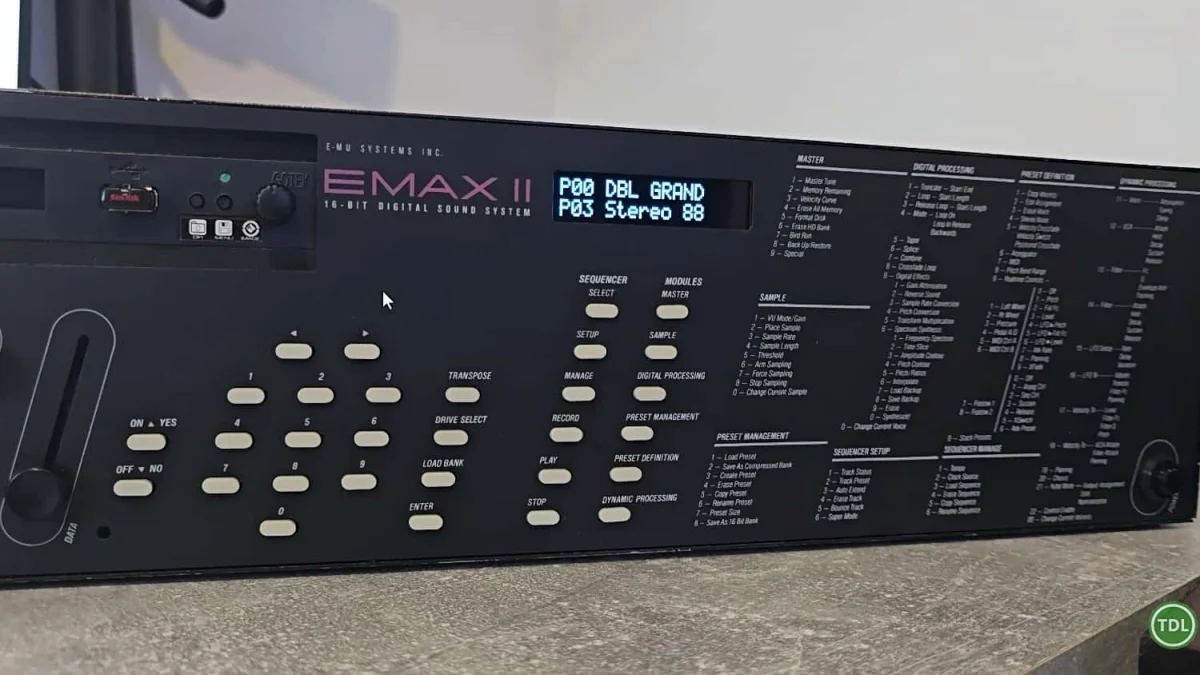
Synthesist and sound designer Ian Dixon recently released a comprehensive retrospective and technical exploration of the E-mu Emax II, a 16-bit digital sampling workstation that occupies a pivotal position in the history of electronic music production. Released in 1989 as the successor to the original 12-bit Emax, the Emax II represented a transitional era for E-mu Systems, a company that defined the sampling landscape throughout the 1980s. Dixon’s analysis arrives at a time when vintage digital hardware is experiencing a resurgence in professional studios, driven by a desire for the specific sonic imprints and tactile workflows that modern software often fails to replicate.
The Emax II Rack serves as a bridge between the grit of early 80s sampling and the high-fidelity standards that became the industry norm in the 1990s. While the original Emax was celebrated for its 12-bit crunch and analog filters, the Emax II moved toward a 16-bit architecture, offering a cleaner signal path while retaining the sophisticated modulation and library access that made E-mu a household name in synthesis. Dixon’s investigation highlights why this specific rack unit, particularly when modified with modern storage solutions like the Gotek drive, remains a potent tool for contemporary sound design.
The Historical Lineage of E-mu Systems and the Emulator Family
To understand the significance of the Emax II, one must look at the trajectory of E-mu Systems, founded by Dave Rossum and Scott Wedge. By the late 1980s, E-mu had already established itself as a premier manufacturer with the Emulator series. The original Emulator I (1981) was a pioneer in affordable sampling, followed by the legendary Emulator II (1984), which became the backbone of 1980s pop and film scores, used extensively by artists ranging from Depeche Mode to Pet Shop Boys.
However, the Emulator series was prohibitively expensive for many musicians. This led to the development of the Emax line in 1986, designed to offer the "E-mu sound" at a more accessible price point. The original Emax utilized the same SSM2047 analog filter chips found in the Emulator II, providing a warm, resonant character that many producers still covet.
When the Emax II was introduced in 1989, the industry was shifting toward 16-bit digital standards, spearheaded by competitors like Akai with the S1000. E-mu responded by upgrading the Emax to 16-bit resolution and replacing the analog filters with digital resonant filters. This shift was controversial at the time, as it marked the end of the analog-filter era for E-mu’s sampling line, yet it opened new doors for polyphony and clarity. The Emax II was eventually succeeded by the Emulator III and the E IV series, but it remains a distinct "middle child" that captures a specific moment in the evolution of digital signal processing.
Technical Specifications and the Shift to 16-Bit Architecture
The Emax II Rack examined by Dixon features a 16-bit sampling engine, a significant leap from the 12-bit architecture of its predecessor. In the late 1980s, the move to 16-bit was essential for capturing the full dynamic range of acoustic instruments, such as pianos and orchestral strings, which were becoming staples in pop production.
Key specifications of the Emax II include:
- Polyphony: 16 voices (expandable to 32 in some configurations).
- Sampling Rates: Variable rates up to 39 kHz (standard) or 44.1 kHz (on later models/upgrades).
- Memory: Ranging from 1MB to 8MB of RAM, a massive amount for the era but modest by modern standards.
- Synthesis Engine: Features the "G-Chip," E-mu’s proprietary digital signal processor that handled the digital resonant filters and envelope generation.
- Connectivity: MIDI In/Out/Thru, SCSI for external hard drives, and individual outputs for multi-timbral routing.
The transition to digital resonant filters in the Emax II was a defining technical choice. Unlike the subtractive analog filters of the Emax I, the Emax II used digital algorithms to simulate resonance. While some purists missed the "warmth" of the SSM chips, the digital filters offered a different kind of precision and a unique "chirp" at high resonance settings that became a signature of early 90s electronic music.
Modern Workflow: Integrating the Gotek Drive and SCSI
One of the primary hurdles in using vintage samplers today is the obsolescence of floppy disks. Dixon’s unit addresses this through the installation of a Gotek drive, a hardware emulator that allows the sampler to read disk images from a USB flash drive. This modification is transformative for the Emax II workflow, as it allows users to store thousands of floppy disk images on a single thumb drive, bypassing the slow and unreliable nature of physical 3.5-inch disks.
The Emax II also supports SCSI (Small Computer System Interface), which was the high-speed data standard of the late 80s and 90s. By using SCSI-to-SD adapters, modern users can simulate internal hard drives, providing near-instant loading of large sample banks. Dixon notes that while the 2MB memory limit of his specific unit might seem restrictive, it encourages a more disciplined approach to sampling, forcing the user to focus on the essential character of a sound rather than relying on massive multi-sampled libraries.
The Sonic Character: Digital Filters and the E-mu Library
The core appeal of the Emax II lies in its sonic character and the vast E-mu sound library. During his demonstration, Dixon explores the factory-style patches and the "Grey Sounds" Volume 1 library. These sounds—ranging from lush brass and cinematic strings to the iconic "Loon" and "Shakuhachi" samples—defined the aesthetic of late 20th-century media.
The Emax II’s digital resonant filter (Q) is a highlight of the unit’s synthesis capabilities. When applied to the high-quality 16-bit samples, the filter allows for synth-style modulation that can turn a standard piano sample into an atmospheric pad or a percussive texture. The envelope controls are similarly robust, offering classic ADSR (Attack, Decay, Sustain, Release) shaping that behaves with a predictable, musical linearity.
Furthermore, the Emax II’s ability to "transpose" samples across the keyboard introduces "aliasing" artifacts—a type of digital distortion that occurs when a sample is played far from its original pitch. In modern high-fidelity software, this is often smoothed out, but in the Emax II, these artifacts add a sought-after "vintage digital" texture that provides weight and presence to a mix.
Chronology of the Emax Series Development
The development of the Emax series reflects the rapid pace of technological change in the music industry during the transition from the 1980s to the 1990s:
- 1986: Launch of the original Emax. It featured 12-bit sampling and analog SSM2047 filters. It was available in keyboard and rack versions.
- 1988: E-mu introduces the Emax SE (Synthesis Enhanced), which added additive synthesis and spectral interpolation features, allowing users to create sounds without samples.
- 1989: The Emax II is released. It moves to 16-bit sampling and introduces the G-chip for digital filtering. It offered stereo sampling and increased polyphony.
- 1990-1991: The Emax II "Turbo" models are released, featuring expanded memory (up to 8MB) and internal hard drives, solidifying the unit’s place in professional touring rigs.
- 1994: The Emax line is officially phased out as E-mu focuses on the Emulator IV and the "Ultra" series of samplers, which offered even higher polyphony and more complex DSP.
Implications for Modern Music Production
The decision to integrate a 35-year-old sampler into a modern studio is rarely about convenience; it is about the "curation of sound." As Dixon points out, the process of building a personal Emax library—tagging useful sounds and sampling original material—creates a more intentional relationship with the instrument.
In an era where "Infinite Choice" in software can lead to creative paralysis, the limitations of the Emax II act as a catalyst for creativity. The 2MB memory limit requires the producer to choose sounds that truly matter, while the hardware interface encourages "listening" rather than "looking" at a waveform on a computer screen.
The market for vintage samplers has seen a notable uptick in prices over the last five years. While the Emax I remains the most expensive due to its analog filters, the Emax II is increasingly viewed as a "sweet spot" for those who want the E-mu library and 16-bit clarity without the exorbitant cost of an Emulator III.
Conclusion and Industry Outlook
Ian Dixon’s exploration of the E-mu Emax II Rack underscores a broader trend in the music industry: the "Digital Vintage" movement. Just as analog synthesizers saw a massive revival in the early 2000s, early digital gear is now being re-evaluated for its unique character. The Emax II represents a pinnacle of 16-bit technology, offering a combination of historical prestige, a world-class sound library, and a synthesis engine that remains relevant today.
For producers looking to move beyond the "sterile" nature of modern VSTs, the Emax II offers a tangible connection to the history of electronic music. Whether used for its classic library sounds or as a dedicated processor for new samples, the Emax II Rack remains a testament to E-mu Systems’ legacy of innovation. As Dixon continues his journey of building a usable library and integrating the unit into modern tracks, the Emax II proves that in the world of sound design, "old" does not mean "obsolete"—it means "character."
