

The Technical Framework of Convolution in Audio Production
To understand the significance of the Convolution Playground, one must first examine the underlying mathematical process of convolution. In the realm of digital signal processing (DSP), convolution is a mathematical operation on two functions that produces a third function expressing how the shape of one is modified by the other. In audio, this typically involves an "input signal" (such as a dry snare drum or a vocal) and an "impulse response" (IR).
The impulse response is essentially a sonic "fingerprint." Historically, this was captured by recording a short, sharp burst of sound—like a starter pistol or a balloon pop—in a physical space. The resulting recording captured the echoes, frequency absorption, and resonant characteristics of that environment. When a dry signal is convolved with that IR, the signal takes on the characteristics of the space. However, as Eliraz demonstrates in his latest release, the IR does not have to be a recording of a room; it can be any audio file, from a synthesized chord to a recording of rainfall. This realization opens the door to "cross-synthesis," where the rhythmic and harmonic characteristics of two disparate sounds are fused together.
Features and Functional Capabilities of Convolution Playground
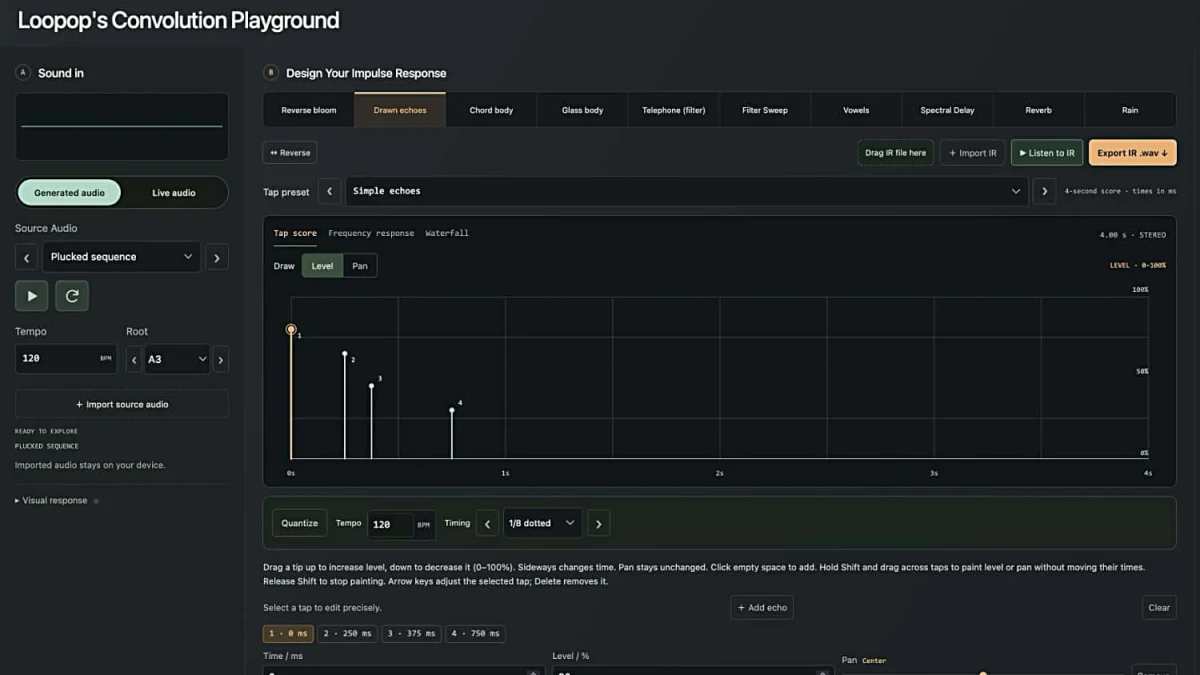
The Convolution Playground is structured to provide both educational value and creative utility. It offers ten distinct methodologies for designing and applying impulse responses, moving far beyond the "set and forget" nature of standard reverb plugins.
Creative Sound Design Modalities
- Reverse Blooms: By time-reversing an impulse response, the application allows users to create "pre-verb" effects and swelling textures that build in intensity before the dry signal occurs.
- Drawn Echoes: The tool provides manual controls to shape the timing and decay of echoes, allowing for rhythmic patterns that do not follow standard delay laws.
- Chord Bodies: By using a short musical chord as an IR, any percussive input can be made to "ring out" with the harmonic content of that chord, effectively turning a drum kit into a melodic instrument.
- Filter Sweeps and Vowels: The application uses spectral shaping to mimic the behavior of resonant filters and human vocal formants. This is achieved by convolving the input with IRs that have specific peaks in the frequency spectrum.
- Spectral Delays and Rain: These modes focus on the granular decomposition of sound, where the IR creates a dense cloud of micro-delays, resulting in textures that mimic natural phenomena like rain or mechanical granular synthesis.
Visual Feedback and Analysis Tools
A core component of the Convolution Playground is its emphasis on visual learning. The interface allows users to toggle between three primary views:
- Waveform View: Provides a time-domain representation of the impulse response, essential for understanding the envelope and decay.
- Frequency Response: Offers a spectral look at which frequencies are being boosted or attenuated by the convolution process.
- Waterfall Plot: A three-dimensional representation that shows how the frequency content of the IR changes over time, a crucial tool for analyzing complex reverbs and evolving textures.
Chronology of Development and Distribution
The release of the Convolution Playground follows a multi-year trajectory in which Ziv Eliraz has transitioned from a hardware reviewer to a developer of specialized educational tools. Loopop, established in 2016, quickly became a primary source for "deep dive" synthesis tutorials, characterized by a lack of hyperbole and a focus on technical transparency.
In recent years, the audio industry has seen a move toward "in-browser" synthesis and processing, powered by the Web Audio API and WebAssembly (Wasm). These technologies allow web browsers to execute code at speeds nearly identical to native desktop applications. The Convolution Playground represents a culmination of this trend, offering a zero-latency (or near-zero, depending on hardware) environment for complex DSP.
The distribution model for the tool reflects the modern "creator economy." While the application is free to use for experimentation—allowing users to drag and drop their own audio files and process live inputs—the ability to export the resulting impulse responses as high-quality WAV files is reserved for members of the "WaveShaper" tier on Eliraz’s Patreon. This model ensures that the tool remains accessible for educational purposes while providing a sustainable revenue stream for continued development.
Data Privacy and Local Processing
A notable technical detail of the Convolution Playground is its approach to data handling. In an era where cloud-based processing often involves uploading user data to remote servers, this application processes all audio locally on the user’s device. When a user "drags in" their own audio file, the data stays within the browser’s local memory. This not only ensures privacy for professional sound designers working with proprietary samples but also minimizes the bandwidth requirements, making the tool more responsive even on slower internet connections.
Industry Implications and Professional Reactions
The release of such a tool has broader implications for the music technology industry. Historically, high-quality convolution was gated behind expensive software packages like Altiverb or specialized hardware units. By providing a sophisticated convolution engine for free in a web browser, Eliraz is contributing to the democratization of advanced sound design tools.
Educational Impact
Educators in audio engineering programs have noted that convolution is often one of the most difficult concepts for students to grasp visually. The ability to manipulate an IR and immediately see the change in a waterfall plot provides a pedagogical advantage that static textbooks cannot offer. Professional reactions within the synth community have highlighted the "Chord Body" and "Vowel" functions as particularly useful for creators of "glitch" and "IDM" (Intelligent Dance Music), where non-traditional textures are highly valued.
Market Competition
The Convolution Playground enters a market where "freemium" tools are increasingly common. However, its browser-based nature sets it apart from VST or AU plugins that require specific Digital Audio Workstations (DAWs) to run. This makes it a versatile utility for mobile producers using tablets or those working in restricted environments where software installation is prohibited.
Analysis of Future Trends in Browser-Based Audio
The success of projects like the Convolution Playground suggests a future where the distinction between "web apps" and "pro audio software" continues to blur. As browser engines become more efficient at handling multi-threaded processing, we can expect to see more complex tools—such as multi-band compressors, spectral editors, and even full-scale DAWs—operating entirely within a web environment.
Furthermore, the integration of community-driven platforms like Patreon into the software lifecycle suggests a shift away from traditional retail models. Instead of a one-time purchase of a "versioned" software, users are opting for subscription-based access to a living ecosystem of tools that are updated based on direct community feedback.
Conclusion
Ziv Eliraz’s Convolution Playground is more than a simple audio effect; it is a comprehensive educational resource and a powerful creative engine. By stripping away the complexities of traditional DSP interfaces and focusing on visual, tactile interaction, the tool empowers a new generation of sound designers to explore the hidden potential of impulse responses. As the tool gains traction, it will likely serve as a benchmark for how independent developers can leverage web technology to provide professional-grade audio processing to a global audience. The move from simple reverb to complex spectral design through convolution marks a new chapter in the accessibility of high-end audio manipulation.
