

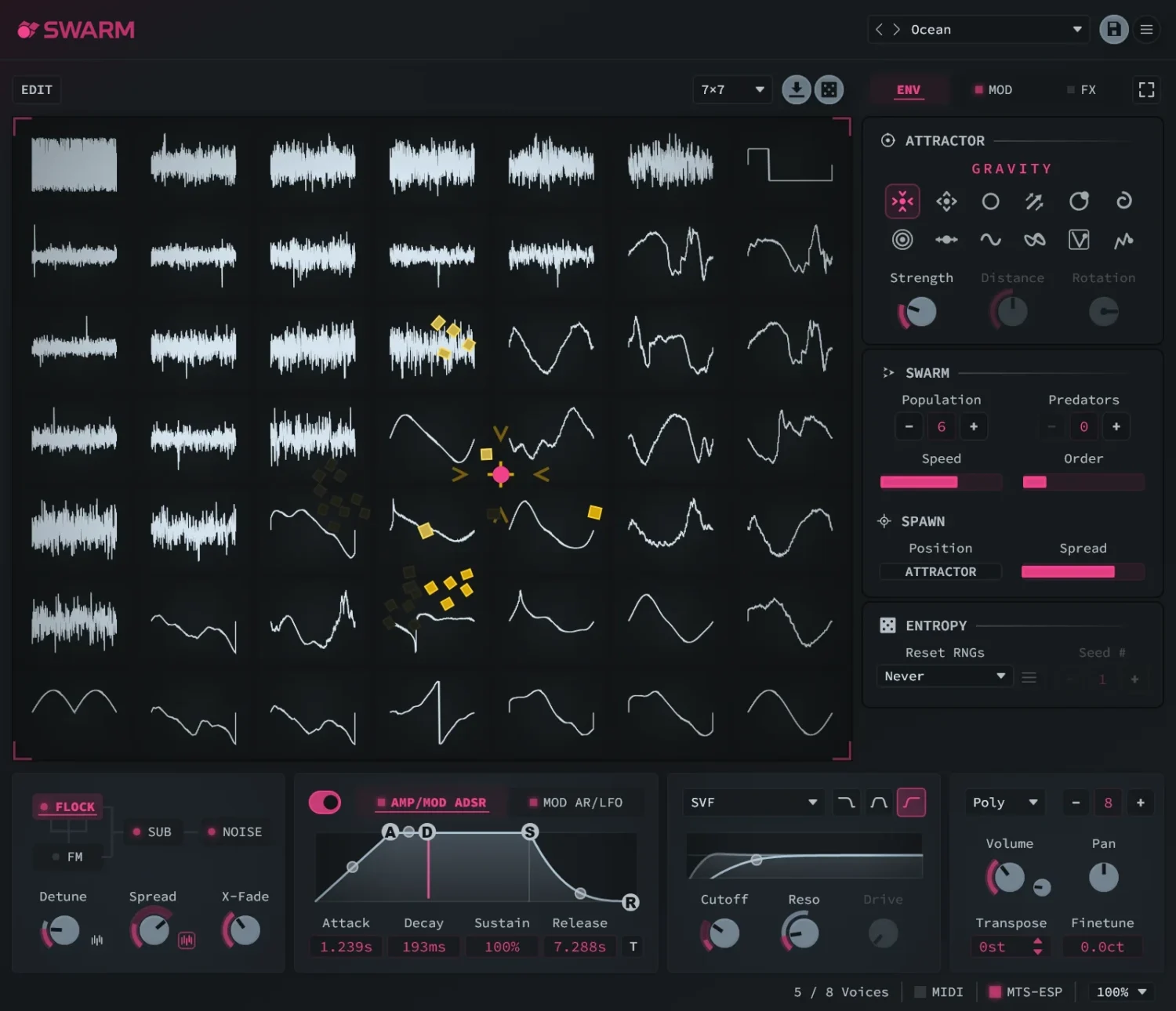
Morpheral Machines, a newly established software instrument developer founded by the visionary creator of the Renoise tracker, Eduard Müller, has officially entered the digital signal processing market with the release of its flagship product, The Swarm. This polyphonic wavetable synthesizer represents a departure from traditional oscillator architectures by implementing a synthesis engine rooted in biological mimicry and algorithmic flocking behavior. While conventional wavetable synthesizers typically rely on a linear or two-dimensional scan of a static table, The Swarm utilizes a dynamic system of virtual entities to dictate the sonic character of each note. By integrating complex behavioral physics into the core of the oscillator, Müller aims to provide sound designers with a tool capable of producing evolving, organic textures that are difficult to achieve through standard modulation techniques.
A New Paradigm in Oscillator Behavior: The Boid System
The fundamental innovation of The Swarm lies in its "boid" architecture. The term "boid" refers to an artificial life program developed by Craig Reynolds in 1986, which simulates the flocking behavior of birds. In Müller’s implementation, each note triggered in the synthesizer is generated by a group of these virtual boids, with each individual boid controlling its own independent wavetable oscillator. Users can configure the density of the sound by assigning between one and 24 boids per voice. With a maximum of 12 voices of polyphony, the synthesizer can manage hundreds of simultaneous oscillators, all moving according to the laws of emergent behavior.
These boids do not move randomly; instead, they navigate a two-dimensional grid of single-cycle waveforms. Their specific coordinates on this grid determine the exact waveform being played at any given moment. Because the boids are programmed to respond to their neighbors—balancing the desire to stay together with the need to maintain individual space—the resulting sound is a complex, shifting composite of multiple waveforms. This creates a natural chorus and phasing effect that feels inherently "alive," as the oscillators are constantly micro-adjusting their timbral positions in relation to one another.
Technical Specifications and Navigational Logic
The Swarm provides a sophisticated set of tools for governing the movement of these oscillator flocks. Central to this is the "attractor" system, which serves as a gravitational point that guides the flock across the wavetable grid. There are 12 distinct attractor types available, ranging from simple point-based gravity to more complex geometric paths. These attractors can operate in a free-running state or can be synchronized to the host digital audio workstation (DAW) tempo, allowing for rhythmic timbral shifts that align with a project’s meter.
To introduce tension and chaos into the synthesis, Müller has included a "predator" mechanic. Users can deploy up to nine virtual predators that move through the grid, disrupting the flock’s formation. When a predator approaches the boids, they scatter or alter their trajectory, leading to sudden, unpredictable shifts in the harmonic content. This interplay between the cohesive force of the attractor and the disruptive force of the predators allows for a level of generative sound design that moves beyond the capabilities of standard Low-Frequency Oscillators (LFOs) or envelopes.
The wavetable grid itself is highly customizable. It can be configured in sizes ranging from a 3 x 3 matrix to a 13 x 13 grid, allowing for a maximum of 169 unique single-cycle waveforms per patch. This spatial arrangement of waveforms means that the transition from one sound to another is determined by the physical path the flock takes across the grid, rather than a simple one-dimensional slider.
Advanced Wavetable Editing and Audio Analysis
Recognizing the needs of modern sound designers, Morpheral Machines has equipped The Swarm with a comprehensive wavetable editor. Users are not limited to factory content; they can draw waveforms directly onto the grid using integrated tools. To ensure smooth transitions between disparate sounds, the software offers six different morphing methods, which use various interpolation algorithms to fill the gaps between user-defined waveforms.
One of the most potent features of the editor is its audio analysis capability. The Swarm can ingest external audio files in WAV or FLAC formats, as well as existing WT wavetables. Upon import, the software analyzes the audio to extract the most harmonic or distinctive cycles. It then intelligently arranges these cycles across the 2D grid, positioning similar waveforms near each other to ensure that the flock’s movement results in musically coherent timbral changes. This feature effectively turns any recorded sample into a navigable sonic territory for the boids to explore.
Behavioral Modulation: Data as Music
In The Swarm, the behavior of the oscillators is not just a method for choosing waveforms; it is also a primary source of modulation. The synthesizer tracks various metrics of the flock’s state in real-time, converting biological data into control signals. These parameters include:
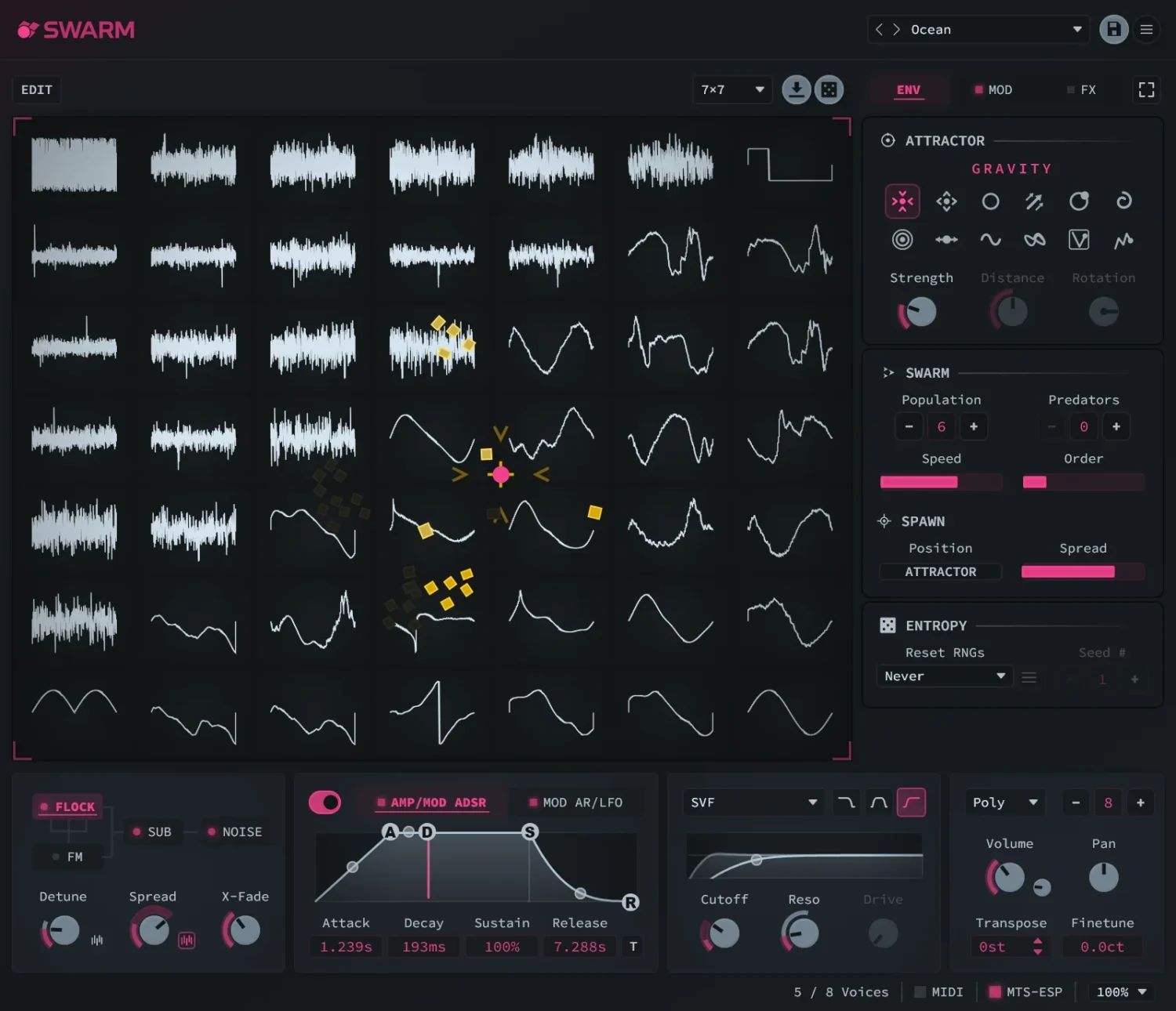
- Flock Alignment: How closely the boids are moving in the same direction.
- Separation: The average distance between individual boids.
- Attractor Proximity: The distance of the flock’s center of mass from the current attractor.
- Grid Position: The X and Y coordinates of the flock.
These behavioral metrics can be routed through a modulation matrix containing 32 routings per voice. With 17 modulation sources and 28 possible destinations—including filter cutoff, resonance, effects parameters, and even the physics constants of the flock itself—the synthesizer allows for a recursive feedback loop where the sound influences the movement, and the movement further shapes the sound.
The Legacy of Eduard Müller and the Renoise Connection
The launch of Morpheral Machines is a significant event in the electronic music community due to the reputation of its founder. Eduard Müller is best known as the lead developer of Renoise, a modern DAW based on the "tracker" heritage. Renoise is celebrated for its precision, its unique vertical timeline, and its highly efficient coding, which has made it a favorite among IDM (Intelligent Dance Music), breakcore, and industrial producers for over two decades.
The transition from a DAW developer to a dedicated synthesizer designer suggests a broadening of Müller’s focus toward specialized synthesis engines. The Swarm carries over the technical efficiency and deep customization options that defined Renoise. By supporting the CLAP (CLever Audio Plug-in) format alongside VST3 and AU, Müller is also signaling a commitment to open, modern standards in the audio industry. CLAP, developed by Bitwig and u-he, is designed to offer better performance and more advanced modulation capabilities than older formats, aligning perfectly with the high-voice-count requirements of a flocking-based synthesizer.
Market Context and Industry Implications
The Swarm enters a competitive market currently dominated by wavetable giants like Xfer Records’ Serum, Vital Audio’s Vital, and Spectrasonics’ Omnisphere. However, the "swarm intelligence" approach differentiates it from these established players. While most wavetable synths focus on the "purity" of the wavetable or the complexity of the effects rack, The Swarm focuses on the "movement" within the oscillator itself.
The use of bio-inspired algorithms in music technology is a growing trend, reflecting a desire among artists to move away from the rigid, "perfect" nature of digital synthesis toward something more chaotic and unpredictable. By quantifying the movement of birds and applying it to phase and timbre, Morpheral Machines is tapping into a niche of "organic digitalism" that appeals to ambient, cinematic, and experimental composers.
Furthermore, the inclusion of native Linux support is a notable move. While many major plugin developers overlook the Linux platform, Müller’s history with Renoise—which has long been a staple of the Linux audio community—ensures that The Swarm is accessible to a broad range of users across all major operating systems, including native support for Apple Silicon.
Chronology of Release and Availability
The Swarm was officially announced in early November 2026, marking the public debut of Morpheral Machines. The development of the instrument reportedly spanned several years, as Müller refined the physics engine to ensure it could run efficiently without overwhelming modern CPUs, despite the high number of calculations required for the boid simulations.
As part of the launch strategy, Morpheral Machines has implemented a tiered pricing structure:
- Introductory Period: The synthesizer is available for $59 / €59 through November 30, 2026.
- Regular Pricing: Following the introductory window, the price will increase to $79 / €79.
The software is currently available for purchase and download via the official Morpheral Machines website. The package includes the plugin in VST3, CLAP, and AUv2 formats, a comprehensive manual detailing the physics parameters, and a library of factory wavetables and presets designed to showcase the flocking engine’s capabilities.
Conclusion: The Future of Morpheral Machines
With the release of The Swarm, Eduard Müller has successfully translated his reputation for technical excellence into a new venture that pushes the boundaries of wavetable synthesis. By treating oscillators as living entities rather than static functions, Morpheral Machines offers a fresh perspective on sound generation. As the industry continues to evolve, the integration of complex algorithmic behaviors like those found in The Swarm may become a new standard for creating the "evolving" sounds that modern music production demands. For now, The Swarm stands as a unique intersection of biology, physics, and digital signal processing, providing a powerful new tool for the global community of electronic musicians and sound designers.
