

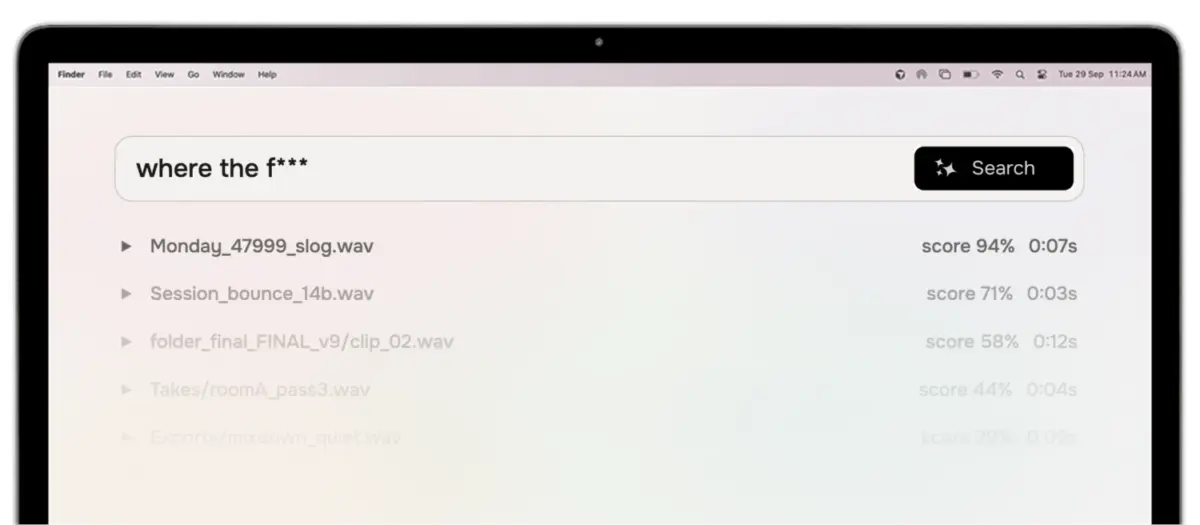
The modern music production landscape is characterized by an abundance of digital assets, with producers and sound designers often managing libraries containing hundreds of thousands, if not millions, of individual audio samples. Recognizing the logistical challenges inherent in navigating these vast repositories, Sampleson has officially released Wavefinder, a desktop-based audio search application that leverages artificial intelligence to streamline the sound discovery process. Unlike traditional file browsers that rely on rigid metadata or specific naming conventions, Wavefinder utilizes a sophisticated neural network to analyze the acoustic characteristics of audio files, allowing users to locate sounds based on descriptive text or sonic similarity.
The Evolution of Sample Management and the Metadata Problem
For decades, the primary method for organizing digital audio samples involved manual folder structures and descriptive filenames. As storage costs plummeted and the volume of available sample packs increased, this manual approach became increasingly untenable. Producers frequently find themselves "sample hunting" for hours—a process that involves auditioning hundreds of files to find a specific texture or tone.
The industry attempted to solve this through metadata tagging, where files are embedded with keywords such as "kick," "dark," "analog," or "distorted." However, the efficacy of metadata is limited by the inconsistency of third-party creators; one developer’s "warm" pad might be another’s "lo-fi" atmosphere. Furthermore, manually tagging a legacy library of 500 gigabytes is a task few professionals have the time to undertake. Wavefinder enters the market as a solution to this "metadata fatigue," shifting the burden of categorization from the human user to a locally hosted AI model.
Technical Architecture and Local AI Processing
At the core of Wavefinder is a machine learning engine designed to perform high-dimensional vector analysis on audio data. When the software scans a user’s hard drive, it creates a mathematical representation of each sound’s frequency content, temporal characteristics, and harmonic structure. This process, often referred to as "fingerprinting" or "embedding," allows the software to understand what a sound actually represents rather than what it is named.
One of the most significant technical features of Wavefinder is its commitment to local processing. In an era where many AI-driven tools require an active internet connection and the uploading of user data to remote servers, Sampleson has engineered Wavefinder to run entirely on the user’s local hardware. This approach offers three distinct advantages:
- Privacy and Security: Professional sound designers often work with proprietary recordings or unreleased material. By keeping the AI model and the indexing process local, Sampleson ensures that no sensitive audio data ever leaves the user’s workstation.
- Latency and Performance: Local indexing eliminates the bottleneck of internet upload speeds. Once the initial scan of a library is complete, search results are generated almost instantaneously, facilitating a more fluid creative workflow.
- Longevity and Ownership: By avoiding a cloud-dependent architecture, the software remains functional regardless of the developer’s server status or future changes to service terms.
Core Functionalities: Text-to-Audio and Audio-to-Audio Search
Wavefinder provides two primary modes of discovery that depart from the traditional "folder-diving" workflow. The first is a natural language search interface. Users can input descriptive phrases such as "metallic percussion with long reverb" or "gritty 808 bass," and the AI will rank the library’s contents based on how closely they match the semantic meaning of the request. This capability suggests that the underlying model has been trained on a vast dataset of audio-visual associations, allowing it to bridge the gap between human language and acoustic properties.
The second core functionality is the "similarity search" or audio-to-audio matching. If a producer has a specific snare drum sound that is "almost" right but requires a different tonal balance, they can use that file as a reference. Wavefinder will then analyze the reference file and display a list of similar sounds within the user’s own collection, ranked by their mathematical proximity in the AI’s vector space. This feature is particularly useful for finding alternatives to overused samples or for layering sounds that share complementary characteristics.
Market Context and Competitive Landscape
The release of Wavefinder comes at a time when AI integration is becoming a standard expectation in the music technology industry. Sampleson is positioning the tool against both established file managers and newer AI competitors. For example, tools like Sononym have long offered similarity searching, while cloud-based platforms like Splice and Loopcloud have integrated AI-driven "bridge" technologies to match user samples with their subscription libraries.
However, Sampleson’s pricing strategy and "no-subscription" model appear designed to appeal to users who are weary of recurring monthly fees. The software is currently offered at an introductory price of $29.00 USD, which is expected to rise to a regular retail price of $49.00 USD. Notably, the company has extended the introductory offer through November 15, 2026, an unusually long promotional window that suggests a long-term strategy to build a substantial user base before transitioning to full pricing.
Chronology of Development and Release
The development of Wavefinder follows a broader trend in Sampleson’s portfolio, which has increasingly focused on utilizing computational efficiency to create lightweight yet powerful tools. While the specific development timeline of the Wavefinder AI model has not been publicly detailed in a day-to-day log, the release follows several years of industry-wide advancement in "Audio Information Retrieval" (AIR) technology.
- Pre-2020: The industry relies heavily on manual tagging and basic waveform visualization.
- 2021–2023: Large-scale AI models (like CLIP for images and various audio-language models) prove that semantic searching of media is viable.
- Early 2024: Sampleson begins teasing a solution for "sample library paralysis."
- Late 2024: Wavefinder is officially launched for desktop platforms (Windows and macOS), focusing on local-first AI search.
Industry Implications and the Future of Sound Design
The implications of tools like Wavefinder extend beyond simple convenience. By lowering the barrier to finding specific sounds, these tools may inadvertently change the "sound" of modern music. When it is easier to find a "distorted cello" sample, producers may be more likely to experiment with diverse textures rather than defaulting to the most easily accessible sounds in their "Favorites" folder.
From a technical standpoint, the success of Wavefinder may prompt other developers to move away from cloud-centric AI models. As consumer CPUs and GPUs become increasingly capable of handling neural network inference, the "Local AI" movement is gaining momentum. This shift preserves user privacy and ensures that professional tools remain functional in offline studio environments.
Furthermore, the transition toward AI-driven search may eventually render the manual tagging of sample packs obsolete. If an AI can accurately identify a sound as a "dampened rimshot," there is less pressure on developers to provide exhaustive metadata. This could potentially lead to a standardization of how audio libraries are indexed across different software platforms.
Official Positioning and User Accessibility
Sampleson has emphasized that Wavefinder is intended to be a "companion" to existing Digital Audio Workstations (DAWs) rather than a replacement for internal browsers. The software is designed to sit alongside programs like Ableton Live, Logic Pro, or FL Studio, acting as a high-speed gateway to the user’s external drive arrays.
The user interface of Wavefinder is intentionally minimalist, focusing on a clean search bar and a results list that provides immediate playback. This design philosophy reflects a growing demand for "invisible" technology—tools that perform complex background tasks (like AI analysis) while presenting a simple, non-distracting interface to the creative professional.
Conclusion and Outlook
As the volume of digital audio content continues to grow, the necessity for intelligent management tools becomes undeniable. Sampleson’s Wavefinder represents a significant step in the democratization of AI for independent musicians and small-scale studios. By offering a one-time purchase price and local processing, it addresses the primary concerns regarding cost and privacy that often accompany AI-integrated software.
The long-term impact of Wavefinder will likely be measured by its ability to maintain accuracy across diverse genres and recording qualities. As AI models continue to evolve, the industry can expect further refinements in how machines understand the nuances of timbre and emotion in sound. For now, Wavefinder provides a practical, immediate solution to the age-old problem of finding the perfect sound in a sea of data. With its introductory period extending into 2026, Sampleson has signaled its commitment to making AI-assisted search a staple of the modern studio environment.
