

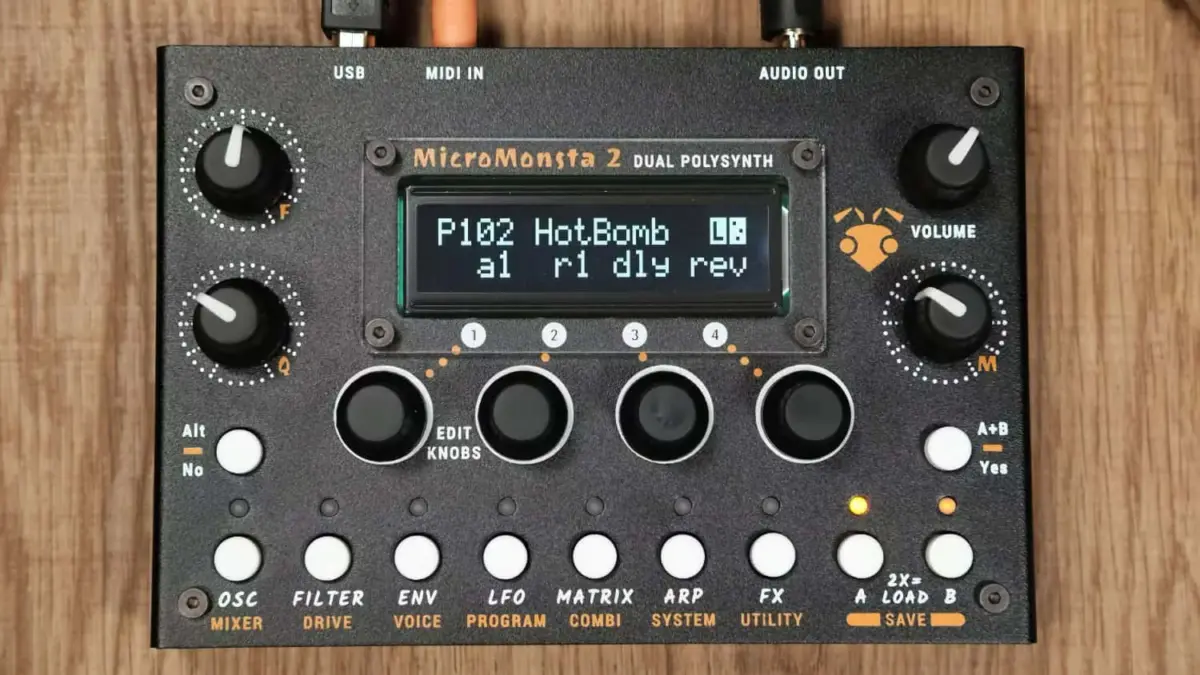
The release of firmware version 3.0 for the AudioThingies MicroMonsta 2 marks a significant milestone for the compact, bi-timbral digital synthesizer, transforming the device from a portable powerhouse into a highly sophisticated instrument capable of professional-grade expressive performance. AudioThingies, a manufacturer known for packing extensive synthesis capabilities into diminutive hardware footprints, has utilized this update to address long-standing user requests while simultaneously expanding the unit’s sound design architecture. By introducing polyphonic aftertouch support, a revamped chord and scale engine, and expanded modulation options, the version 3.0 update reinforces the MicroMonsta 2’s position in a competitive market of desktop synthesizers.
The Evolution of the MicroMonsta Series
To understand the impact of the firmware 3.0 update, it is necessary to examine the lineage of the MicroMonsta hardware. The original MicroMonsta was launched as an affordable, eight-voice polyphonic synthesizer that gained a cult following for its high-quality wavetables and lush internal effects. When the MicroMonsta 2 was introduced, it doubled the polyphony to 12 voices (or 6+6 in bi-timbral mode) and transitioned to a more powerful processor capable of more complex digital signal processing (DSP).
The MicroMonsta 2 has traditionally been lauded for its balance between portability and sonic depth. However, as the electronic music industry has shifted toward more expressive controllers—such as the ASM Hydrasynth, the Arturia MicroFreak, and various MPE (MIDI Polyphonic Expression) devices—the demand for more nuanced control over individual notes has increased. Firmware 3.0 is the manufacturer’s direct response to this shift, ensuring that the hardware remains relevant in an era where expressive playability is as important as raw oscillator power.
Implementation of Polyphonic Aftertouch
The most prominent feature of the firmware 3.0 update is the inclusion of polyphonic aftertouch support. Unlike standard channel aftertouch, which applies a single modulation value to all held notes simultaneously, polyphonic aftertouch allows each individual key to modulate parameters independently based on the pressure applied to that specific key. This capability is particularly transformative for a bi-timbral synthesizer, allowing performers to hold a chord and swell the brightness or volume of a single note within that chord.
AudioThingies has implemented this feature with a focus on user-friendliness. Presets that are already configured for aftertouch modulation will now automatically respond to either channel aftertouch or polyphonic aftertouch, depending on the data sent by the external MIDI controller. This eliminates the need for users to menu-dive or reconfigure individual patches when switching between different types of controllers. For sound designers, this opens new avenues for creating "living" pads and expressive lead sounds that were previously only possible on much larger and more expensive instruments.
Redesigned Harmonic Engine: Scaler and Chorder
The internal melodic architecture of the MicroMonsta 2 has undergone a complete overhaul in version 3.0. The redesigned system now features 21 distinct scales and 63 chord types, providing a massive expansion over previous versions. This update caters specifically to musicians who use the MicroMonsta 2 as a standalone composition tool or those who prefer to perform within a set harmonic framework.
The chorder functionality has been refined to include various three- and four-note voicings, allowing for more complex harmonic textures. A significant workflow improvement in this update is the ability to assign different chord types to individual notes within a chosen scale. This level of customization allows for the creation of sophisticated progressions where the harmonic structure changes dynamically as the player moves across the keyboard. Furthermore, these settings—including the selected scale, chord assignments, and keyboard configurations—are now saved independently with each preset. This ensures that a specific melodic setup is recalled instantly when a patch is loaded, a feature that is essential for live performance stability.
Expanded Modulation Matrix and Sequencing
The MicroMonsta 2 has always featured a robust modulation matrix, but firmware 3.0 expands this capability to accommodate more complex sound design tasks. The update adds two additional modulation matrix slots, bringing the total number of routings available to the user to a level that rivals much larger desktop poly-synths.
In addition to the matrix expansion, AudioThingies has introduced a second 16-step modulation sequence. This sequencer is designed to work in tandem with the internal arpeggiator, allowing for rhythmic, synchronized changes to various synthesis parameters. For example, a user could program a filter cutoff pattern that cycles every 16 steps while the arpeggiator handles the note data. The update also introduces new modulation destinations, including specific parameters for internal effects, envelopes, oscillators, and the arpeggiator itself. This creates a feedback loop of creative possibilities where almost every aspect of the sound can be set into motion.
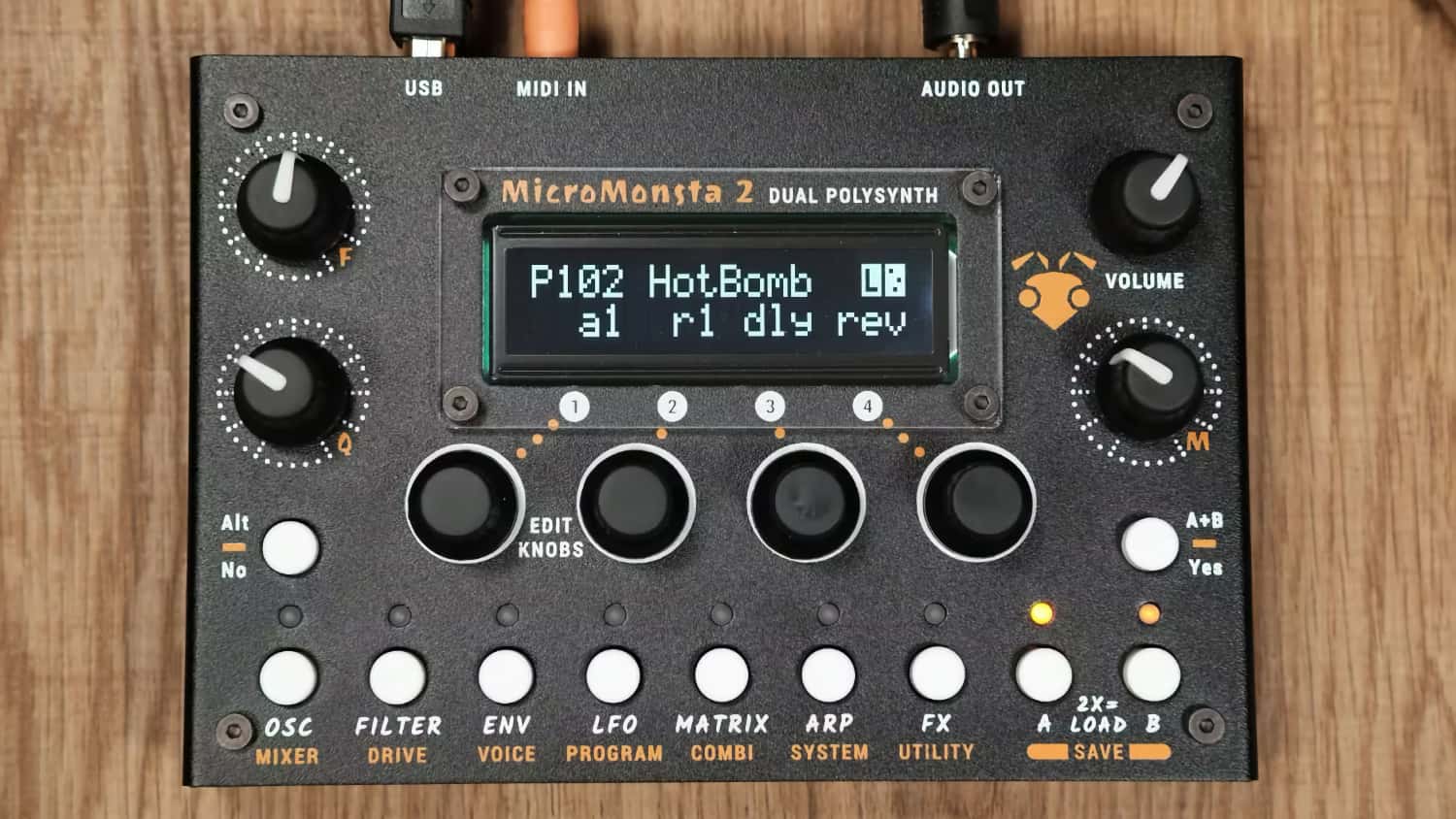
Technical Refinements and DSP Optimizations
Beyond the headline features, firmware 3.0 includes several "under-the-hood" improvements that enhance the overall sonic character and operational reliability of the unit. The filter resonance behavior has been revised to provide a more musical response, particularly at high resonance settings where digital filters can sometimes become harsh or unpredictable.
The update also features a new soft-clipping algorithm. In digital synthesis, clipping can often result in unpleasant digital distortion; the new algorithm aims to emulate the warmer, more saturated characteristics of analog clipping, providing the MicroMonsta 2 with a more "organic" edge when pushed to its limits. Additionally, oscillator tuning ranges have been expanded, allowing for deeper sub-basses and higher-frequency textures that push the boundaries of the unit’s frequency response.
To improve the tactile experience of the device, AudioThingies has introduced a "Scale" mode for the encoders. One of the common frustrations with digital synthesizers using endless encoders is the "parameter jump" that occurs when a physical knob position does not match the stored value of a preset. The new Scale mode prevents these jumps by requiring the user to "catch" the current value or by scaling the movement of the encoder to provide a smooth transition from the stored value to the new physical position.
Market Context and Industry Impact
The release of firmware 3.0 occurs at a time when the "small-format" synthesizer market is increasingly crowded. Devices such as the Dreadbox Typhon, the Roland S-1, and the 1010music Nanobox series all vie for the attention of mobile producers. By providing a free, substantial update that adds high-end features like polyphonic aftertouch and a sophisticated chord engine, AudioThingies is leveraging the longevity of digital hardware.
Industry analysts suggest that the trend of "evergreen" hardware—where a device receives significant feature updates years after its initial launch—is becoming a key factor in consumer purchasing decisions. In an era of rapid technological turnover, the commitment to improving existing hardware provides a sense of security to the end-user. The MicroMonsta 2, which was already considered a high-value instrument due to its 12-voice polyphony and bi-timbral architecture, now competes more directly with premium boutique synthesizers.
Chronology of the Update and Availability
The development of firmware 3.0 follows a period of beta testing during which the AudioThingies community provided feedback on the implementation of the new features. The manufacturer has a history of maintaining a close relationship with its user base, often incorporating specific feature requests into official releases.
The update process for the MicroMonsta 2 is handled via MIDI SysEx (System Exclusive) data. Owners of the device can download the firmware file from the official AudioThingies website and transmit it to the synthesizer using a standard MIDI interface and a computer. This method of delivery ensures that even older units can be updated to the latest specifications without the need for specialized hardware or proprietary cables.
Conclusion and Future Implications
AudioThingies MicroMonsta 2 firmware 3.0 is more than a simple patch; it is a comprehensive re-imagining of what the hardware can achieve. By focusing on expressivity through polyphonic aftertouch and harmonic flexibility through the redesigned scaler and chorder, AudioThingies has addressed the needs of both performers and studio composers.
As digital synthesis technology continues to evolve, the ability of small manufacturers to provide meaningful software updates remains a critical differentiator. The MicroMonsta 2 now stands as a testament to the power of modern DSP, proving that physical size is no longer a limiting factor for complex, high-fidelity sound generation. For existing owners, the update is a significant value addition, and for potential buyers, it makes the MicroMonsta 2 one of the most feature-complete desktop synthesizers in its price bracket. Moving forward, the industry will likely look to such updates as a benchmark for how to maintain and grow a hardware ecosystem in the digital age.
