

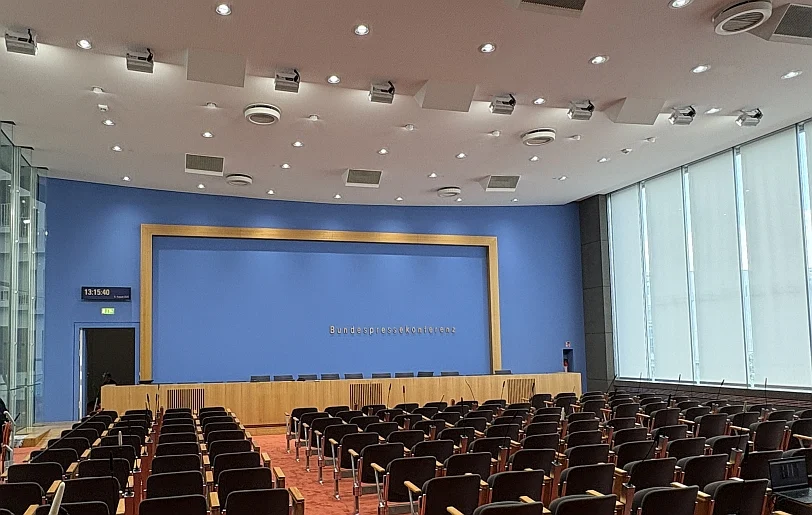
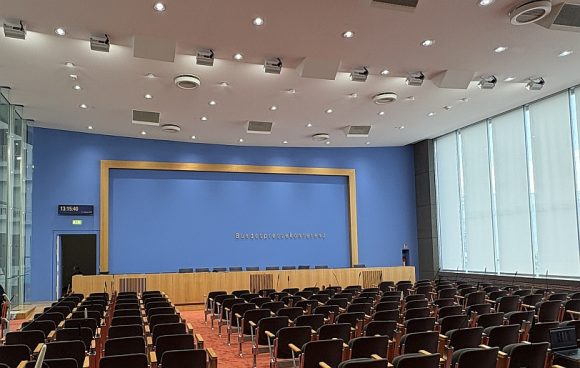
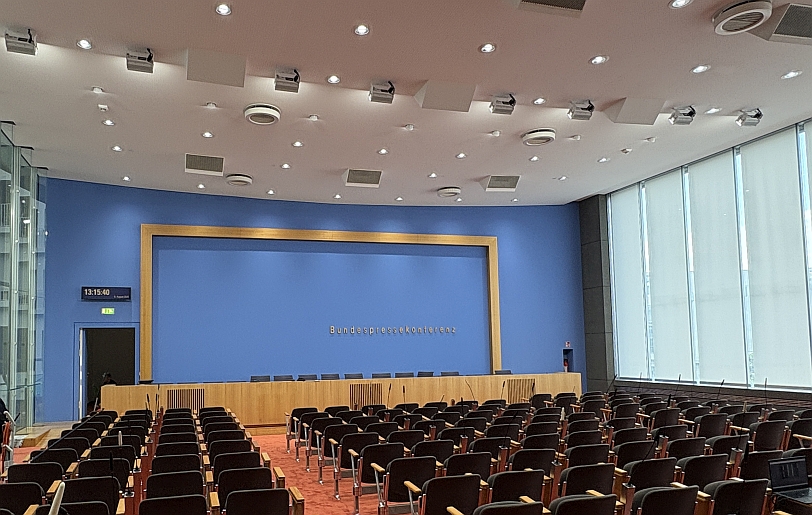
The Federal Press Conference (Bundespressekonferenz or BPK) in Berlin, one of the most significant venues for political communication in Europe, has successfully completed a total modernization of its lighting infrastructure. This ambitious project, executed through a strategic partnership between the Bavarian-based lighting specialists Feiner Lichttechnik and the Berlin-based event technology firm B2Events GmbH, represents a pivotal shift toward energy efficiency and high-definition broadcast standards. By replacing aging discharge lamp technology with state-of-the-art LED systems, the BPK has ensured that its facilities remain at the global forefront of media technology, catering to the rigorous demands of international news agencies, television broadcasters, and photojournalists.
The modernization project, which transitioned from its initial planning phases in late 2024 to full implementation in the summer of 2026, was driven by a dual necessity: the need for drastic energy reduction and the requirement for a flicker-free environment suitable for high-speed digital photography and 4K television broadcasting. The BPK, located in the heart of Berlin’s government district, serves as the primary stage where the German government’s spokesperson and federal ministers face the press. Consequently, any technical failure or visual inadequacy during these sessions would have immediate national and international repercussions.
A Legacy of Political Transparency and Technical Evolution
To understand the significance of this upgrade, one must consider the unique nature of the Bundespressekonferenz. Founded in 1949, the BPK is an independent association of parliamentary correspondents. Unlike many other nations where the government hosts the press, in Germany, the journalists host the government. This distinction is reflected in the architecture and the technical requirements of the hall. The building, which opened its doors at the turn of the millennium, originally utilized lighting technology that was considered cutting-edge for the late 1990s but had become increasingly obsolete in the era of digital sensors and sustainability mandates.
Prior to the 2026 upgrade, the main press hall relied heavily on HCI-150W metal halide discharge lamps. While these lamps provided high intensity, they suffered from several drawbacks: high heat emission, a significant carbon footprint, and a color temperature of 4,000 K, which often appeared slightly warm or "yellowish" under modern camera white-balance settings. Furthermore, as these lamps aged, their color consistency wavered, creating "patchy" lighting across the hall that required constant correction by television engineers.
The Planning Phase: Designing for the Future of Broadcast
The conceptual journey began in the final months of 2024. Feiner Lichttechnik was tasked with designing a system that would not only replace the existing fixtures but fundamentally improve the quality of light. A primary objective was the shift in color temperature. The planning team decided to move from 4,000 K to a daylight-balanced 5,700 K. This adjustment aligns the hall’s ambient light with the standard settings used by mobile news crews and provides a crisper, more neutral palette that enhances the skin tones of speakers on the podium.
During the design process, Feiner Lichttechnik identified a specific need for improved "presidency" lighting—the area where the panel of speakers and the BPK chairperson sit. Initial plans were expanded to include specialized studio fixtures that could provide soft, directional light to eliminate harsh shadows under the eyes and chins of those being interviewed, a common complaint with traditional top-down lighting.
Implementation and Technical Specifications
The physical transformation took place during the summer of 2026, a period strategically chosen to coincide with the parliamentary summer recess to minimize disruption to the daily news cycle. B2Events GmbH, utilizing their local expertise and proximity to the venue, managed the complex installation.
The technical core of the new system in the main press hall consists of 58 Electron Ronelo LED downlights, each consuming 55 W. These are supplemented by seven Electron Sorena downlights at 31 W. Together, these fixtures provide a uniform wash of light across the auditorium, ensuring that journalists asking questions from the floor are as clearly visible as the officials on stage.
For the critical task of illuminating the presidency, eight Studio Force II 12 Plus fixtures from Chroma-Q were integrated into the ceiling structure. The Studio Force II is renowned in the industry for its ability to produce high-quality variable white light, utilizing a homogenized LED engine that eliminates "mulit-shadow" artifacts. This ensures that even when multiple fixtures overlap, the shadows remain soft and natural, a vital requirement for high-definition close-up shots.
Solving the Flicker Problem: Amplitude Dimming vs. PWM
One of the most sophisticated aspects of the BPK upgrade is the method of dimming. Standard LED dimming often uses Pulse Width Modulation (PWM), which works by switching the LED on and off at high frequencies. While invisible to the human eye, PWM can cause "banding" or flickering on digital cameras, especially when photographers use high shutter speeds or when TV crews film in high frame rates for slow-motion replays.
To eliminate this risk, Feiner Lichttechnik deployed their proprietary FBox-4CC-AN-TS drivers. These drivers utilize amplitude dimming (also known as CCR or Constant Current Reduction). Instead of pulsing the power, they reduce the actual current flowing to the LED. This results in a completely flicker-free performance across the entire dimming range, from 100% down to 0.1%. This technical choice ensures that the BPK remains "future-proof" for the next generation of camera sensors and broadcast standards.

The control system was also modernized for ease of use. A Visual Productions Cuecore2 lighting controller, paired with an intuitive touchscreen interface, allows BPK staff to recall specific lighting "scenes" at the touch of a button. Whether the hall is being used for a standard press briefing, a televised debate, or a formal reception, the lighting can be adjusted instantaneously to the correct parameters.
Expansion to the Conference Center and Hauptstadt-Salon
The project’s scope extended beyond the main press hall. The entire Tagungszentrum (Conference Center) within the BPK building, including the prestigious Hauptstadt-Salon, underwent a similar transformation. Over 100 additional Electron Ronelo fixtures were installed throughout these meeting spaces.
In the secondary conference rooms, a mix of cold-white and Tunable White versions of the Ronelo fixtures was used. Tunable White technology allows the color temperature to be adjusted dynamically between warm and cool tones. This is particularly useful for long seminars or internal meetings, where the lighting can be "tuned" to support the circadian rhythms of participants—cooler, brighter light for morning focus and warmer, softer light for afternoon discussions.
Economic and Environmental Impact
The shift to LED technology has resulted in a dramatic reduction in energy consumption. By replacing 150W discharge lamps with 55W and 31W LED units, the BPK has cut its lighting energy requirements by more than 60%. When factoring in the reduced load on the building’s air conditioning systems—since LEDs emit significantly less heat than metal halide lamps—the total energy savings are even higher.
Furthermore, the operational lifespan of the new system offers substantial long-term cost benefits. Discharge lamps typically require replacement every 6,000 to 10,000 hours and suffer from significant "lumen depreciation" (dimming over time). In contrast, the high-quality LEDs installed by B2Events are rated for 50,000 hours or more with minimal loss of brightness. This reduces the frequency of maintenance work in the high-ceilinged halls, which previously required specialized lifts and labor-intensive bulb changes.
Industry Implications and Future Outlook
The successful completion of the BPK project serves as a landmark case study for the modernization of public and political institutions. As governments worldwide face pressure to meet climate targets while maintaining high-tech communication standards, the "Berlin Model" of high-CRI, flicker-free LED integration provides a clear roadmap.
Broadcasters such as ARD, ZDF, and international outlets like CNN and the BBC, who frequently broadcast from the BPK, have already noted the improved visual clarity. The move to 5,700 K has streamlined the "set-up" time for mobile crews, as the ambient light now matches their standard daylight equipment, reducing the need for heavy corrective filtering.
Feiner Lichttechnik will be showcasing the technical details and the success of the BPK project at the upcoming LEAT Con 26, scheduled for October 6-8 in Hamburg. Located at Stand L03 in Hall A1, the company plans to demonstrate the FBox driver technology and the Electron fixtures that made the flicker-free environment of the Federal Press Conference possible.
The renovation of the Bundespressekonferenz is more than just a technical upgrade; it is a commitment to the transparency of the democratic process. By ensuring that every word spoken and every gesture made in the press hall is captured with the highest possible fidelity, Feiner Lichttechnik and B2Events have reinforced the bridge between the German government and the public it serves. In an era where visual media is the primary vehicle for political discourse, the BPK is now perfectly illuminated for the challenges of the mid-21st century.
