

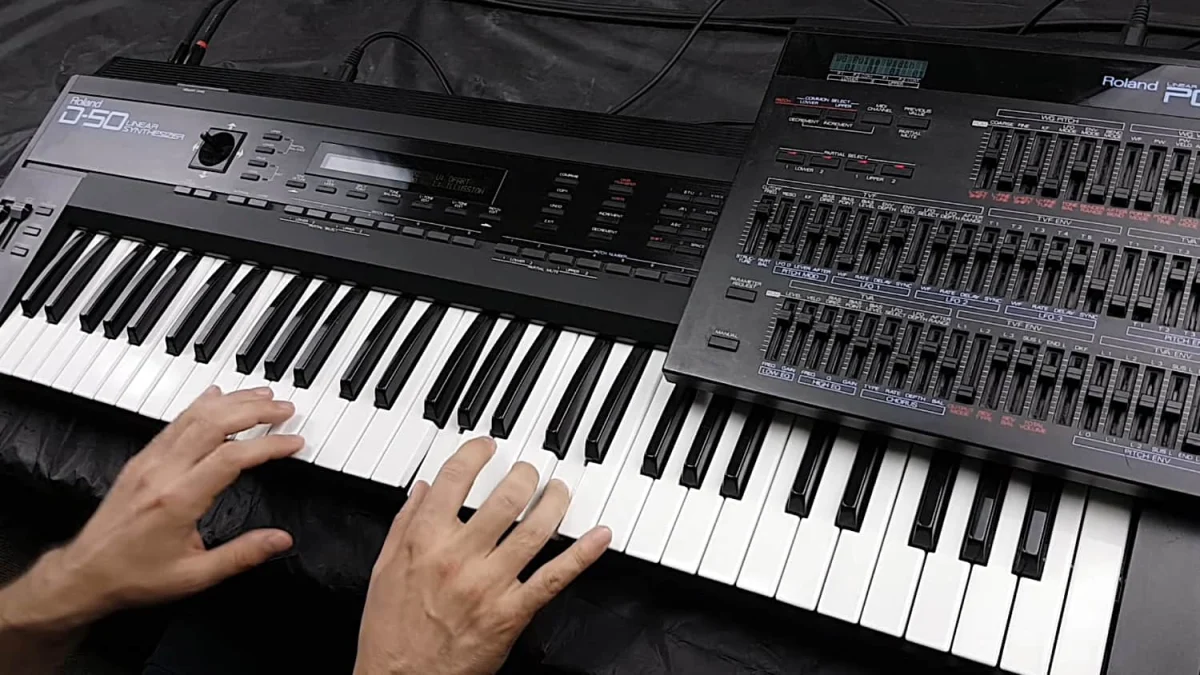
Synthesist and software developer Ian Dixon has announced the release of a comprehensive, browser-based editor and librarian specifically designed for the Roland D-50, one of the most influential synthesizers in the history of electronic music. This new tool, titled the Roland D-50 Editor Librarian, leverages modern Web MIDI technology to provide users with a streamlined, cost-free method for managing, editing, and backing up sounds directly from a web browser. By eliminating the need for specialized hardware programmers or outdated software drivers, Dixon’s application addresses a long-standing challenge for owners of vintage digital hardware: how to maintain a 1980s instrument within a 21st-century production workflow.
The Roland D-50 Editor Librarian functions as a localized Web MIDI tool. Unlike many modern applications that require user data to be uploaded to a remote server, this utility processes all patch data locally within the browser. This architectural choice ensures that users maintain complete control over their proprietary sound libraries while benefiting from the accessibility of a web-based interface. The tool supports a wide range of essential functions, including System Exclusive (SysEx) data transfers, bulk dumps, and real-time parameter editing, effectively acting as a digital bridge between the vintage synthesizer and contemporary computing environments.
The Revival of a Digital Legend
To understand the significance of Dixon’s new editor, one must consider the historical context of the Roland D-50. Released in 1987, the D-50 was Roland’s response to the dominance of the Yamaha DX7. While the DX7 relied on Frequency Modulation (FM) synthesis, which many found difficult to program, the D-50 introduced Linear Arithmetic (LA) Synthesis. This method combined short sampled transients (PCM waveforms) with digitally synthesized sustain portions. The result was a sound that was both "acoustic" in its realism and "analog" in its warmth, producing iconic patches such as "Fantasia," "Digital Native Dance," and "Living Calliope."
Despite its sonic prowess, the D-50 was notoriously difficult to program via its front panel. The hardware featured a small, non-backlit LCD and a limited number of buttons, requiring users to menu-dive through complex layers of partials and structures. While Roland released the PG-1000, a dedicated hardware programmer with physical sliders for every parameter, these units are now rare and often sell on the secondary market for prices exceeding the cost of the synthesizer itself. Dixon’s editor provides a modern, visual alternative to the PG-1000, offering a comprehensive overview of the synth’s architecture without the hardware’s physical footprint or expense.
Technical Capabilities and Web MIDI Integration
The core of the Roland D-50 Editor Librarian is its integration with the Web MIDI API. This technology allows web browsers—primarily Google Chrome and Microsoft Edge—to communicate directly with MIDI hardware connected to the computer. Because the application runs in a browser, it is cross-platform by nature, functioning on Windows, macOS, and Linux without the need for platform-specific installers.
The editor’s feature set is designed to mirror the complex internal structure of the D-50. The synthesizer organizes sounds into "Patches," each consisting of an Upper and Lower "Tone." Each Tone is further divided into two "Partials." Dixon’s editor allows users to manipulate these four partials simultaneously, providing a visual representation of the PCM samples, synthesis structures, and ring modulation settings.
Key technical features of the application include:
- SysEx Communication: The editor can read the current edit buffer of a connected D-50, allowing users to tweak sounds in real-time.
- Bulk Dump Support: Users can receive and send full banks of 64 patches, facilitating the backup of internal memory or the loading of third-party sound sets.
- Patch Library Management: The librarian function enables users to browse large collections of sound cards and custom patches quickly, searching for specific timbres without manual scrolling on the synth hardware.
- Parameter Control: The interface provides dedicated controls for filter and amp envelopes, LFOs, and the D-50’s onboard digital reverb and chorus effects.
Bridging the Gap: The Legacy of Linear Arithmetic Synthesis
The Roland D-50’s LA Synthesis was a revolutionary compromise between the memory limitations of the 1980s and the desire for realistic instrument sounds. In 1987, memory was expensive; storing full-length high-quality samples was not feasible for most consumer-grade synthesizers. Roland engineers discovered that the human ear primarily identifies a sound by its initial "attack." By using a tiny PCM sample for the attack (such as the pluck of a string or the hit of a mallet) and following it with a looped, synthesized waveform, they could create complex, evolving textures that sounded far more realistic than pure synthesis.
However, managing these "Structures"—the seven different ways the PCM and synthesized waveforms can be combined—is a visual challenge. Dixon’s editor clarifies this by displaying the signal path of the chosen structure. This transparency allows sound designers to see exactly how ring modulation or the varying combinations of oscillators are affecting the final output. For musicians who have previously relied on presets, this level of visual feedback can unlock the deeper creative potential of the D-50.
Solving Storage and Hardware Limitations
One of the primary pain points for vintage synth owners is the reliance on physical storage media. The Roland D-50 originally utilized M-256D or M-256E RAM cards to store additional sounds. These cards are prone to battery failure and are increasingly difficult to source. Furthermore, the internal memory of the D-50 is limited to 64 patches, which is a small fraction of the thousands of sounds available in the public domain.
The Roland D-50 Editor Librarian addresses this by acting as a virtual storage vault. By allowing users to import SysEx banks directly from their hard drives and "push" them to the synth’s edit buffer, the software effectively gives the D-50 an infinite memory capacity. This workflow is particularly beneficial in a studio environment, where a producer might need to audition hundreds of sounds to find the right fit for a track. Instead of manually loading banks and overwriting internal memory, the user can simply click through the librarian interface to hear the results instantly.
Security and Privacy in Browser-Based Sound Design
A notable aspect of Ian Dixon’s approach is the emphasis on local processing. In an era where "Software as a Service" (SaaS) and cloud-based subscriptions are becoming the norm, many musicians are wary of tools that require an internet connection or store data on external servers. Dixon has clarified that while the tool is accessed via a URL, the MIDI data and patch files do not leave the user’s computer.
"The Librarian is a browser-based Web MIDI tool for backing up, browsing, importing and editing D-50 sounds, without sending your patch data to the cloud," Dixon noted during the release. This privacy-centric design is particularly important for professional sound designers who may be working on proprietary sounds for film scores or commercial releases. It also ensures that the tool remains functional regardless of the developer’s future server status, as long as the browser supports the necessary MIDI standards.
The Broader Impact on the Vintage Synthesizer Community
The release of the Roland D-50 Editor Librarian is part of a growing trend of "community-driven" software development for legacy hardware. As original manufacturers move on to newer products and "Boutique" recreations (such as the Roland D-05), the responsibility for maintaining the original vintage units often falls to independent developers and enthusiasts.
Tools like Dixon’s help preserve the viability of original hardware. By making the D-50 easier to use, the editor likely increases the instrument’s longevity and market value, as it becomes a more attractive option for modern producers who are accustomed to the convenience of software plugins (VSTs). Furthermore, the free nature of the tool fosters a sense of community, encouraging users to share their own custom-created patches and banks.
Industry analysts suggest that the rise of Web MIDI will continue to revolutionize how we interact with hardware. Because it bypasses the need for complex driver installations—a common failure point for older MIDI interfaces on modern operating systems like Windows 11 or macOS Sonoma—it provides a "plug-and-play" experience that was previously impossible.
Conclusion and Availability
The Roland D-50 Editor Librarian represents a significant contribution to the electronic music community. By combining a deep understanding of 1980s synthesis architecture with modern web standards, Ian Dixon has provided a vital utility that breathes new life into a classic instrument. Whether for the veteran synthesist looking to back up decades of work or a new owner exploring LA Synthesis for the first time, this editor removes the barriers between the musician and the machine.
The application is currently available and can be accessed for free via Dixon’s website, The Digital Lifestyle. As a web-based tool, it requires no installation, though users will need a compatible MIDI interface to connect their Roland D-50 to their computer. For those looking to dive back into the lush, atmospheric sounds of the late 80s, the Roland D-50 Editor Librarian offers a modern, efficient, and powerful gateway to one of the most beloved synthesizers ever made.
