

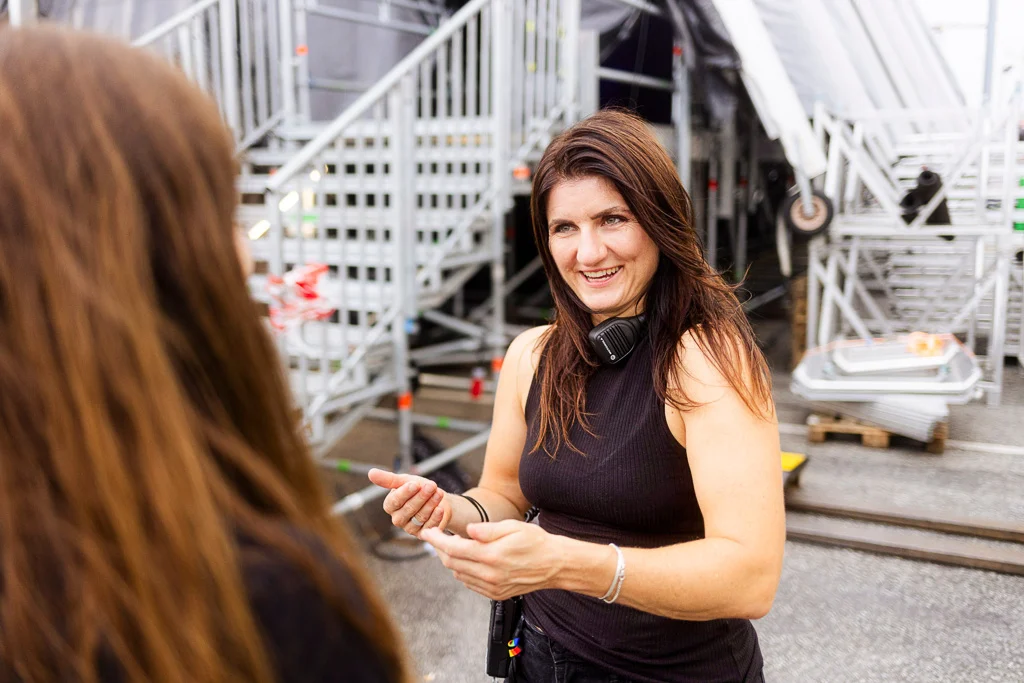
Nike Ostendarp, a seasoned mediator and conflict consultant with two decades of experience in the live entertainment sector, has brought the nuanced issues of gender dynamics and invisible power structures to the forefront of industry discourse. Having transitioned from the high-pressure world of concert booking and tour production to the specialized field of conflict resolution, Ostendarp provides a unique dual perspective on how the live music industry functions—and where it frequently falters. Her observations, rooted in nearly 20 years of navigating male-dominated environments, highlight a systemic architecture of communication and spatial dominance that often remains invisible to those who benefit from it. As the global event industry faces increasing pressure to modernize its labor practices and diversity initiatives, Ostendarp’s insights serve as a critical roadmap for organizational change.
The Chronology of a Career in the Live Circuit
The trajectory of Nike Ostendarp’s career mirrors the broader evolution of the European live music scene over the last two decades. Her entry into the industry began approximately 20 years ago through a foundational internship at a concert agency. This period was characterized by a "deep end" immersion into the mechanics of local concert business, encompassing everything from booking and production to the logistical management of thousands of shows across Hamburg’s diverse array of clubs and arenas.
During this era, the industry was defined by a rugged, "rock ’n’ roll" ethos where professional success was often measured by one’s ability to handle high-stress environments and erratic schedules. Ostendarp notes that for much of her career, she operated as the sole female presence in environments dominated by male crews and performers. In one recurring scenario, she describes standing between five metal bands, a 50-person travel party, and an entirely male technical crew, remaining the only woman present until the doors opened for the audience. At the time, this lack of representation was viewed not as an anomaly, but as the standard operating procedure of the business.
The early 2000s and 2010s in the German live scene were periods of significant growth, yet the structural hierarchy remained largely stagnant. Women were predominantly relegated to "nurturing" or supportive roles—such as artist relations, catering, and administrative assistance—while the core decision-making roles in booking and technical production remained a male enclave. Ostendarp’s ascent into these "hard" sectors of the industry placed her in a position where she was respected for her expertise, yet still subject to the subtle, pervasive undercurrents of patriarchal workplace culture.
The Invisible Architecture of Power and Space
One of the most significant contributions Ostendarp makes to the current dialogue is the concept that "space equals power." This is not merely a metaphorical observation but a physical and linguistic reality in the workplace. In her analysis, Ostendarp identifies several key areas where gender-based power imbalances manifest during professional interactions:
- Physical Presence: The unconscious tendency for men to occupy more physical space in meetings or on-site at productions.
- Speech Patterns and Volume: The frequency with which women are interrupted or have their contributions overlooked in favor of louder, more assertive male voices.
- Communication Redirection: A phenomenon where male stakeholders often bypass female leads to speak directly to other men in the room, assuming them to be the primary decision-makers.
- Visual Recognition: The tendency to maintain eye contact primarily with other men during high-stakes negotiations, effectively "invisibilizing" female experts present at the table.
Ostendarp admits that for years, she internalized these experiences as personal failings. Like many women in high-pressure industries, she initially believed she needed to be "tougher" or "more assertive" to bridge the gap. It was only through the lens of her later training in mediation that she recognized these were not individual personality clashes, but rather the reproduction of systemic patriarchal structures. This realization marks a shift from personal grievance to structural analysis, a transition that is essential for any industry-wide reform.
Statistical Context: The Gender Gap in Live Events
To understand the weight of Ostendarp’s observations, one must look at the broader statistical landscape of the live events and music industry. While comprehensive data for 2026 shows marginal improvements, historical trends highlight a persistent disparity. According to various industry reports from the early 2020s, such as those by the USC Annenberg Inclusion Initiative and European-based advocacy groups like "She Said So," women represented less than 20% of technical roles (lighting, sound, stage management) and held significantly fewer executive positions in major booking agencies compared to their male counterparts.
Furthermore, the "Gender Pay Gap in the Arts" report (2024) indicated that even when women held equivalent titles to men in event production, they were frequently compensated 15-22% less. These statistics provide the quantitative backdrop to Ostendarp’s qualitative experiences. The "locker room" atmosphere she describes—characterized by sexist humor and a "derby" (rough) social tone—acts as a cultural barrier that reinforces these statistical imbalances, making the industry less attractive to female talent and contributing to high attrition rates.
The Mediator’s Perspective: Conflict and Different Truths
Now operating as a professional mediator, Ostendarp identifies a recurring "clash of realities" that prevents progress in gender equity. In her mediation sessions, she observes a specific conflict dynamic: men often experience the industry as a meritocracy and struggle to understand structural criticism, frequently viewing it as a personal attack. This leads to a "defense mode" where systemic issues are dismissed as exaggerations.
Conversely, women and marginalized groups often feel a sense of growing frustration and anger when their lived experiences are invalidated. This creates a "vicious cycle" of communication breakdown:
- The Defense Response: Men feel unfairly blamed for a system they didn’t personally invent, leading to withdrawal or hostility.
- The Silencing Effect: Women stop reporting issues or sharing perspectives to avoid being labeled as "difficult" or "overly sensitive."
- Internalized Misogyny: Ostendarp also notes the complex role of women who, having succeeded in the current system, sometimes reproduce the same exclusionary behaviors, further complicating the path to equity.
From a mediation standpoint, the solution lies not in determining who is "right" or "wrong," but in acknowledging that two different perceptions of the same situation can exist simultaneously. Ostendarp argues that the path forward requires "conflict competence"—the ability to sit with discomfort and listen to perspectives that challenge one’s own reality.
Industry Reactions and the Path to Reform
The reaction to Ostendarp’s insights within the live business community has been mixed but increasingly attentive. Major European production houses and booking agencies have begun to implement Diversity, Equity, and Inclusion (DEI) frameworks, though Ostendarp warns that these are often "surface-level" changes. She advocates for deeper, more structural interventions.
Recommended Corporate Actions:
- Reflexive Spaces: Companies must create dedicated environments where employees can discuss power dynamics and communication styles without fear of professional reprisal.
- Leadership Accountability: Change must be driven from the top. Leaders—particularly men in executive positions—must actively monitor who is given the floor in meetings and whose expertise is being highlighted.
- Conflict Training: Incorporating mediation techniques into management training to help staff navigate the inevitable tensions that arise during cultural shifts.
Broader Implications and Future Outlook
The implications of Ostendarp’s work extend beyond the live music industry. As the global workforce moves toward more collaborative and less hierarchical models, the "soft skills" of empathy and conflict resolution are becoming essential "hard skills" for business sustainability. In the live events sector specifically, failing to address these cultural issues poses a significant risk to future growth. The industry is currently facing a talent shortage; creating an environment that is inclusive and psychologically safe is no longer just a moral imperative but a logistical necessity to attract the next generation of technicians, bookers, and producers.
Nike Ostendarp’s journey from the adrenaline-fueled backstage of metal tours to the quiet, reflective rooms of mediation serves as a metaphor for the industry’s own necessary evolution. Her call for "awareness and umsicht" (circumspection) suggests that the future of rock ’n’ roll and live entertainment lies not in the loudest voice, but in the ability to harmonize a multitude of perspectives. By moving away from the "survival of the fittest" mentality toward a model of "collaborative equity," the live business may finally be able to resolve the long-standing conflicts that have defined its backstage culture for decades.
