

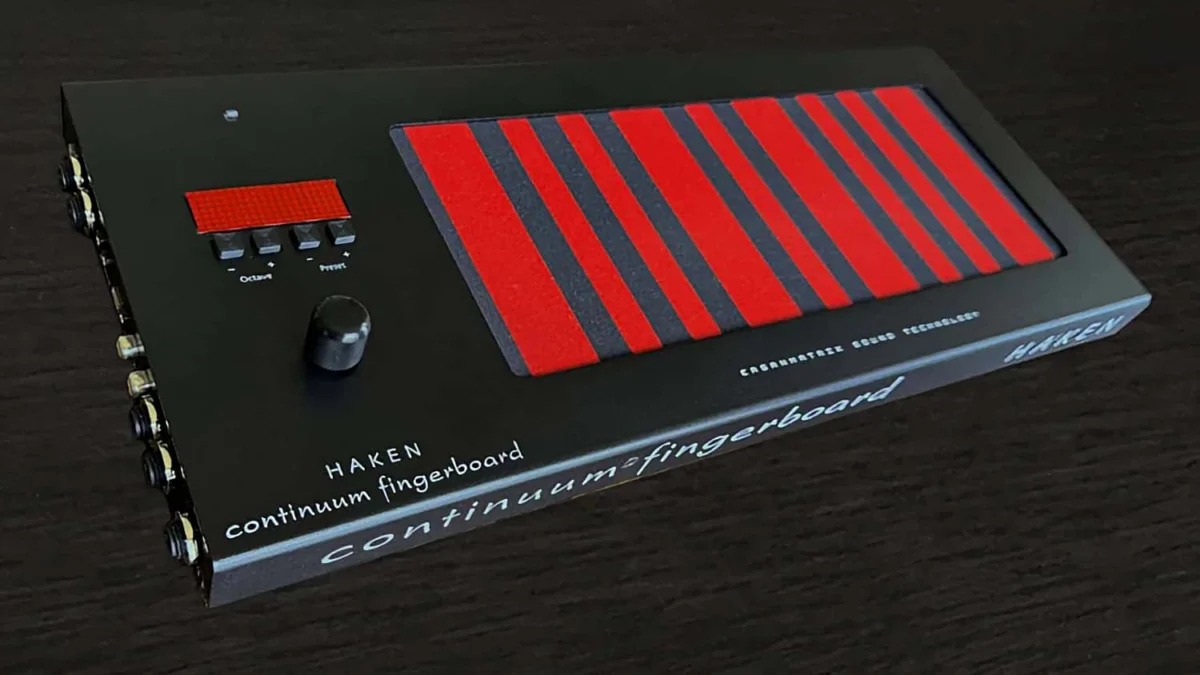
The landscape of electronic music performance has reached a significant milestone with the official introduction and review of the Haken Slim 21 Continuum, a compact iteration of the legendary Continuum Fingerboard. Long regarded by sound designers, film composers, and virtuoso performers as the pinnacle of expressive synthesis, the Haken Continuum has historically been a high-investment instrument, both in terms of financial cost and physical footprint. With the release of the Slim 21, Haken Audio seeks to democratize access to its proprietary technology, offering the full power of the EaganMatrix sound engine in a portable 21-note format priced at $1,799 USD.
The instrument’s debut has been punctuated by a comprehensive technical breakdown from renowned synthesis expert Ziv Eliraz, host of the Loopop YouTube channel. This release marks a strategic pivot for Haken Audio, moving from ultra-exclusive boutique hardware toward a form factor that fits more comfortably into modern studio environments and mobile performance rigs without compromising the "microscopic accuracy" that defines the brand.
The Genesis and Evolution of the Continuum Fingerboard
To understand the significance of the Slim 21, one must look at the four-decade trajectory of its inventor, Dr. Lippold Haken. A professor at the University of Illinois, Haken began developing the Continuum in the 1980s with the goal of creating a digital instrument that possessed the nuance and continuous pitch control of a violin or a cello. Unlike a traditional MIDI keyboard, which is quantized into semitones and relies on a binary on/off mechanism (velocity notwithstanding), the Continuum was designed as a continuous surface.
In the early 2000s, the instrument gained a cult following among elite musicians. Its reputation was further solidified through a collaboration with sound designer Edmund Eagan, who developed the EaganMatrix—a bespoke internal synthesis engine designed specifically to handle the massive data streams generated by the Continuum’s sensitive surface. The evolution from the original bulky "Full-Size" (70-note) and "Half-Size" (46-note) models to the current "Slim" series represents a refinement of both hardware manufacturing and digital signal processing.
Technical Architecture: The Power of Hall-Effect Sensing
The defining characteristic of the Slim 21 is its sensor resolution. While many modern MPE (MIDI Polyphonic Expression) controllers utilize capacitive touch or standard pressure sensors, the Haken Slim 21 employs a sophisticated array of Hall-Effect sensors. These sensors measure changes in magnetic fields with extreme precision.
According to technical specifications, the Slim 21 utilizes up to 12 independent Hall-Effect sensors per finger. These sensors track movement across three axes:
- X-Axis (Horizontal): Continuous pitch control, allowing for vibrato and glissandi that are indistinguishable from acoustic instruments.
- Y-Axis (Vertical): Position on the key, typically mapped to timbre, filter cutoff, or oscillator mix.
- Z-Axis (Pressure): Depth of touch, controlling amplitude or complex modulation matrices.
The analog output of these sensors is processed by ultra-high-speed A/D (Analog-to-Digital) converters. A single note played on the surface is the result of hundreds of thousands of samples per second, ensuring that there is no perceivable latency or "stepping" in the sound. This level of data density is what allows the Slim 21 to rival the immediacy of a physical string or air column in a woodwind instrument.
The EaganMatrix: A Mathematical Approach to Sound
The Slim 21 is not merely a controller; it is a standalone synthesizer. At its heart lies the EaganMatrix, a sound engine that deviates from traditional subtractive or FM synthesis workflows. The EaganMatrix is inspired by the modular concepts of the past but implemented through a digital matrix where every point of interaction is defined by mathematical formulas.
The engine supports a variety of synthesis methods, including:
- Physical Modeling: Simulating the vibration of strings, plates, and tubes.
- Subtractive Synthesis: Traditional oscillators and filters.
- FM (Frequency Modulation): Complex digital textures.
- Spectral Manipulation: Granular-style processing of internal sounds.
The integration between the hardware surface and the EaganMatrix is "hard-wired" in the digital domain. Because the engine knows exactly how the sensors behave, the presets (or "system presets") are curated to respond to the slightest quiver of a finger. This synergy is what differentiates the Slim 21 from using a third-party MPE controller with a standard software plugin.
Chronology of the Slim Series Development
The transition to the "Slim" form factor began several years ago as Haken Audio recognized a shift in the market. The original Continuum models were several inches thick and required heavy flight cases for transport.

- 2019-2021: Haken Audio introduces the Slim 70 and Slim 46. These models retained the full note range of the originals but reduced the chassis depth to approximately one inch. This was made possible by advancements in PCB (Printed Circuit Board) design and sensor miniaturization.
- 2022-2023: The collaboration with Expressive E resulted in the "Osmose," a keyboard-based instrument using the EaganMatrix. This introduced Haken’s technology to a wider audience but left a gap for those who preferred the continuous fingerboard surface over traditional keys.
- 2024: The announcement of the Slim 21. By reducing the note range to 21 notes (roughly two octaves), Haken Audio was able to lower the price point to under $2,000 for the first time in the company’s history.
Market Positioning and Competitive Analysis
The release of the Slim 21 comes at a time when the "Expressive Synthesis" market is more crowded than ever. However, Haken Audio maintains a unique position.
- Versus Roli Seaboard: While the Roli Seaboard offers a similar silicone-based surface, it is primarily a controller and lacks the internal DSP power of the EaganMatrix. Furthermore, professional players often cite the "squishiness" of the Roli as being less precise than the firm, fabric-covered neoprene surface of the Continuum.
- Versus Roger Linn Design LinnStrument: The LinnStrument is a highly respected MIDI controller, but it uses a grid-based system and does not include an internal sound engine of the EaganMatrix’s caliber.
- Versus Expressive E Osmose: The Osmose provides a familiar piano-style interface. However, the Slim 21 offers the "Continuum experience"—the ability to slide seamlessly between notes without the physical obstruction of individual keys.
For many professionals, the Slim 21 represents the "Goldilocks" zone: it is small enough to fit on a desk next to a computer keyboard but powerful enough to serve as the primary soloing instrument for a live performance.
Portability and Build Quality
Despite its "Slim" moniker and reduced price, the Slim 21 does not compromise on build quality. The chassis is constructed from high-grade aluminum, providing the rigidity necessary to protect the sensitive sensor array. The playing surface is covered in a durable, high-thread-count fabric that allows the finger to glide without the friction often associated with rubberized controllers.
The device features robust connectivity options, including:
- Dual 1/4" Analog Outputs: High-quality D/A converters for clean audio.
- 3.5mm Headphone Jack: For private practice and sound design.
- MIDI I/O: Traditional 5-pin DIN (via adapters) and USB-MIDI.
- i2C Port: For high-speed communication with external hardware like the CVC (Continuum Voltage Converter), which allows the Slim 21 to control modular Eurorack systems.
Broader Impact on the Music Industry
The implications of the Slim 21 extend beyond the niche community of experimental electronic musicians. In the realm of film scoring, the ability to perform realistic string swells or otherworldly textures in real-time saves hours of tedious MIDI automation. Composers can now access the "Haken sound"—heard in scores for major motion pictures and AAA video games—at a fraction of the previous entry cost.
Furthermore, the Slim 21 serves as an educational tool. Its visual and tactile feedback makes it an ideal instrument for teaching the physics of sound and the nuances of intonation. As more artists adopt the platform, the library of community-created EaganMatrix presets continues to grow, further increasing the value of the hardware.
Official Responses and Community Reception
Early adopters and beta testers have praised the Slim 21 for its "honesty" as an instrument. Unlike many digital synths that use effects to hide a lack of character, the Slim 21 is described as "naked," requiring the performer to develop technique and touch.
Ziv Eliraz’s review highlights that while the 21-note range is smaller than its predecessors, the "octave shift" buttons are intelligently implemented, allowing for quick navigation of the full pitch range. He notes that for many users, the 21-note range is sufficient for lead lines, bass parts, and complex sound effects—the areas where the Continuum shines most.
Haken Audio has expressed that the Slim 21 is a response to the "modern mobile producer." By offering a device that can be powered via a standard power supply and easily transported in a backpack, they are acknowledging that the studio of 2024 is often nomadic.
Conclusion: A New Standard for Expressive Portability
The Haken Slim 21 Continuum is more than just a smaller synthesizer; it is a distillation of forty years of research into the relationship between human gesture and digital sound. By maintaining the uncompromising sensor technology and the deep EaganMatrix engine of the flagship models, Haken Audio has created a product that is both a professional-grade tool and a gateway for a new generation of expressive performers.
At $1,799, it remains a premium purchase, but one that is justified by its unique hardware-software integration. As the music industry continues to move toward "humanizing" electronic music, instruments like the Slim 21 will likely become essential fixtures in the kits of artists who refuse to be limited by the binary nature of the traditional keyboard. The Slim 21 proves that "smaller and cheaper" does not have to mean "lesser," setting a new benchmark for what a compact synthesizer can achieve.
