

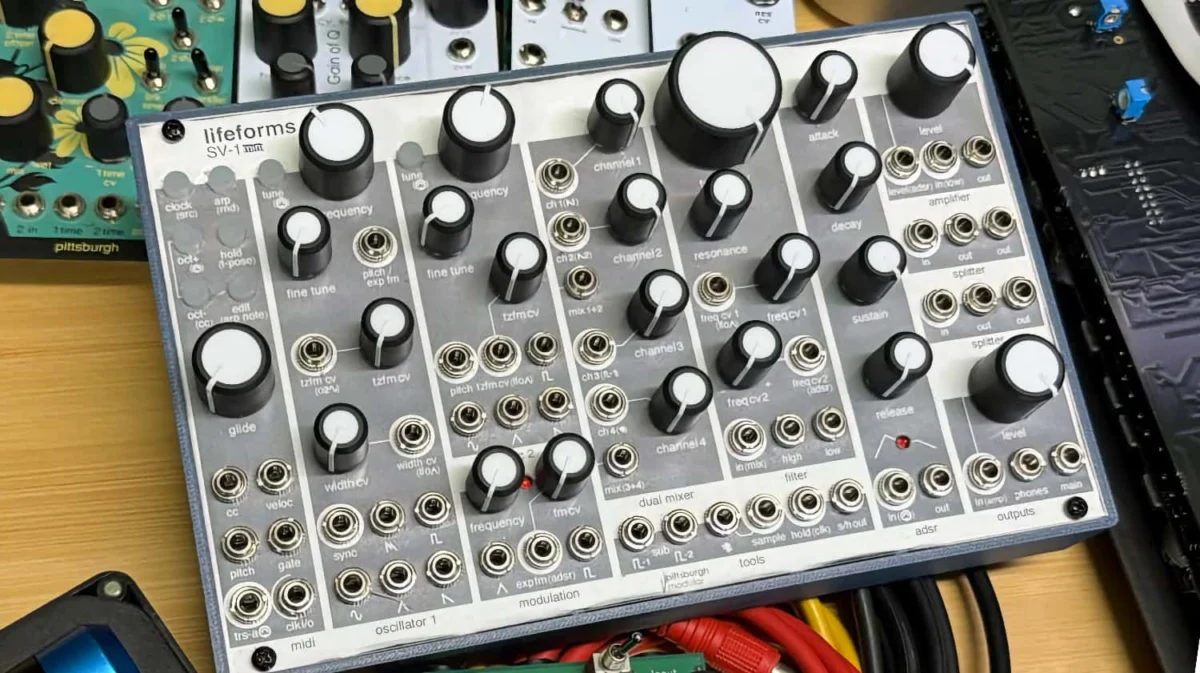
Pittsburgh Modular Synthesizers has officially announced the upcoming release of the Lifeforms SV-1 Mini, a streamlined and more affordable iteration of its flagship all-in-one Eurorack synthesizer voice. According to a statement released by the company, the new module is slated for a commercial launch in mid-January 2027, following the completion of its initial production cycle in December 2026. The announcement marks a significant strategic shift for the boutique manufacturer, as the Lifeforms SV-1 Mini will retail for $599, a substantial $200 reduction from the original SV-1’s launch price. This pricing strategy reflects an effort by Pittsburgh Modular to increase accessibility to high-end analog synthesis while maintaining the sonic integrity that established the original Lifeforms series as a cornerstone of the modular synthesis community.
The decision to revisit the SV-1 architecture comes nearly a decade after the original unit debuted at the 2016 NAMM Show. By "sharpening their pencils" and optimizing the manufacturing and engineering processes, Pittsburgh Modular aims to deliver a product that meets modern budgetary expectations without sacrificing the complex modulation capabilities and rich analog oscillators that defined the predecessor. The initial production run is limited to 300 units, a move that suggests a phased rollout to gauge market demand and manage supply chain logistics effectively in a competitive hardware landscape.
The Legacy of the Lifeforms SV-1
To understand the significance of the Lifeforms SV-1 Mini, it is essential to examine the impact of the original SV-1. When it was introduced in 2016, the Lifeforms SV-1 was marketed as a "complete synthesizer in a module." It was designed to provide a comprehensive entry point for users new to Eurorack, while offering enough depth to satisfy veteran sound designers. The original unit featured two independent, full-range oscillators, a multi-mode "Pittsburgh" filter, a four-stage envelope generator, a low-frequency oscillator (LFO), and a versatile utility section including a mixer, noise generator, and sample-and-hold circuit.
The SV-1 was lauded for its "East Coast" synthesis philosophy, emphasizing stable oscillators and subtractive filtering, yet it provided 48 patch points that allowed for "West Coast" style experimentation through frequency modulation (FM) and complex routing. By integrating these components into a single 48HP module, Pittsburgh Modular eliminated the need for beginners to navigate the complexities of power requirements and signal path compatibility across multiple separate modules. The SV-1 Mini seeks to carry this legacy forward into a new era of modular synthesis where space-efficiency and cost-effectiveness have become primary drivers for consumer adoption.
Technical Specifications and Engineering Optimizations
While full technical documentation for the "Mini" variant is still forthcoming on the official Pittsburgh Modular website, the company has confirmed that the core identity of the SV-1 remains intact. The price reduction of $200 suggests that the engineering team has successfully utilized modern component sourcing and perhaps a more compact PCB (printed circuit board) layout. In the modular world, "Mini" often denotes a reduction in horizontal pitch (HP), making the module more attractive to users with limited rack space or those utilizing small "skiff" cases.
The original SV-1 was known for its dual-oscillator design, which provided a massive sound compared to single-oscillator voices. Each oscillator offered sine, triangle, sawtooth, and pulse waves, with the second oscillator capable of being uncoupled from the primary pitch tracking to serve as a secondary LFO or a carrier for FM synthesis. If the SV-1 Mini retains these core features, it will remain one of the most powerful single-module voices on the market. Industry analysts speculate that the "sharpened pencils" mentioned by the company refer to a refined manufacturing process that potentially utilizes Surface Mount Technology (SMT) more extensively than the original 2016 production runs, which allowed for lower labor costs and higher consistency across units.
Production Timeline and Market Strategy
The timeline provided by Pittsburgh Modular indicates a rapid move from production to consumer hands. Manufacturing is scheduled to conclude by mid-December 2026, with shipping targeted for mid-January 2027. This window suggests that the company has already finalized the design and secured the necessary components, avoiding the long-term delays that have plagued the synthesizer industry in recent years due to global semiconductor shortages.
The announcement of a 300-unit first run indicates a boutique approach to the launch. By limiting the initial quantity, Pittsburgh Modular can maintain strict quality control and ensure that the first wave of users provides the necessary feedback for potential future batches. The company has also opened a dialogue with its user base regarding the implementation of a pre-order system. This level of community engagement is a hallmark of the boutique modular industry, allowing manufacturers to gauge "day-one" demand and adjust their logistical planning accordingly.

Comparative Market Analysis
The $599 price point places the Lifeforms SV-1 Mini in direct competition with several other prominent "all-in-one" synth voices and semi-modular desktop units. Currently, the Eurorack market is saturated with options ranging from budget-friendly entry-level modules to high-end, multi-thousand-dollar systems.
- The Entry-Level Gap: At $599, the SV-1 Mini sits comfortably above the "budget" tier occupied by brands like Cre8audio (with whom Pittsburgh Modular has collaborated in the past on the East Beast and West Pest) but significantly below the flagship prices of large-format modules from companies like Make Noise or Intellijel.
- Value Proposition: The $200 savings compared to the original SV-1 is a 25% price drop. In an economic environment where the cost of electronic components and shipping has generally trended upward, a price reduction of this magnitude is a notable outlier.
- Space Efficiency: If the "Mini" designation results in a smaller HP footprint, it will address one of the few criticisms of the original SV-1, which was its relatively large size for a single module. A more compact version would allow users to fit more modulation or effects modules into a standard 84HP or 104HP row.
Official Responses and Community Engagement
The reaction from the synthesizer community has been largely positive, particularly regarding the price transparency offered by the manufacturer. By explicitly stating that they "did all the math" to lower the price, Pittsburgh Modular has fostered a sense of goodwill among enthusiasts who have become accustomed to rising hardware costs.
In discussions across synthesis forums and social media, potential buyers have expressed interest in whether the SV-1 Mini will include the same high-quality 1/4-inch output and MIDI-to-CV converter found in the original. The original SV-1 was unique because it functioned not just as a module, but as a bridge between MIDI controllers and the modular ecosystem. If these features are retained in the $599 Mini version, it will likely become a recommended "first purchase" for those transitioning from software synthesizers to hardware modular systems.
Regarding the pre-order inquiry, the consensus among early adopters suggests a preference for a structured pre-order phase to secure one of the 300 units, given the high likelihood of the first run selling out quickly. Pittsburgh Modular’s decision to solicit feedback on this matter demonstrates a customer-centric business model that prioritizes the needs of the dedicated modular community.
Broader Implications for the Modular Industry
The release of the Lifeforms SV-1 Mini may signal a broader trend in the boutique electronics industry: the optimization of classic designs for a more price-sensitive market. As the Eurorack format matures, manufacturers are finding that they can revisit successful designs from five or ten years ago and apply modern manufacturing efficiencies to make them more accessible.
Furthermore, this release reinforces Pittsburgh Modular’s position as a bridge between the "boutique" and "accessible" worlds. Their collaborations with Cre8audio showed a willingness to reach a mass-market audience, but the Lifeforms series remains their premier, self-branded line. The SV-1 Mini represents a middle ground—offering the high-fidelity sound and robust build quality of the Lifeforms brand at a price point that challenges the dominance of mass-produced alternatives.
The focus on a "synth voice" module is also a strategic choice. While individual oscillators, filters, and envelopes allow for maximum flexibility, the "voice" module remains popular because it provides a guaranteed, cohesive sound right out of the box. For professional composers and performers, the reliability of a pre-configured signal path like the SV-1’s is invaluable for consistent live performance and studio workflow.
Conclusion and Future Outlook
As the industry moves toward 2027, the Pittsburgh Modular Lifeforms SV-1 Mini stands as a testament to the enduring appeal of well-engineered analog synthesis. By combining a decade of design experience with a renewed focus on value, the company is poised to reintroduce one of its most successful products to a new generation of musicians.
The coming months will be critical as the company moves toward the mid-December production deadline. Updates regarding the specific dimensions of the module, any changes to the patch point layout, and the final decision on the pre-order process are expected to be released via the Pittsburgh Modular website and official social media channels. For now, the SV-1 Mini represents a rare occurrence in the high-end audio world: a product that promises more for less, without compromising the heritage of its predecessors. With a shipping date of mid-January, the modular community will not have to wait long to see if the "Mini" can live up to the massive reputation of the original Lifeforms SV-1.
