

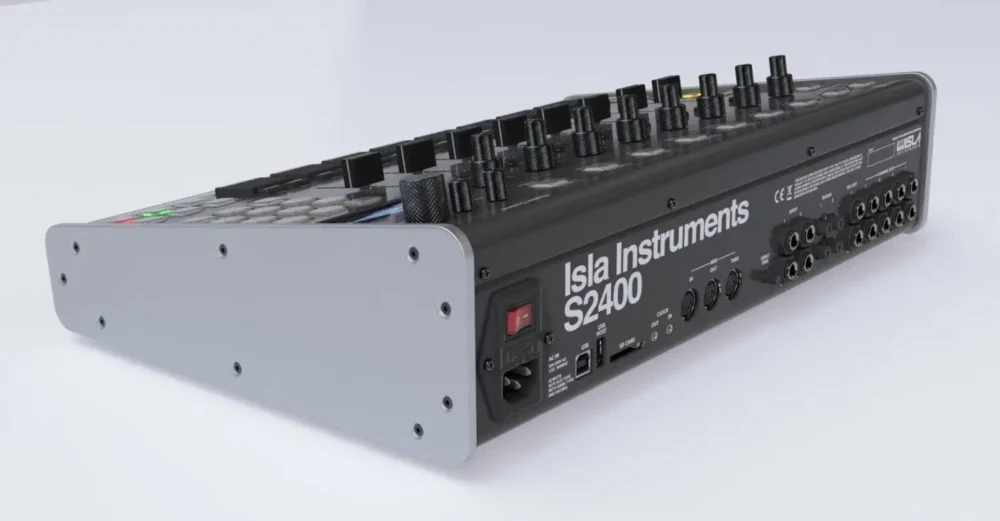
Isla Instruments LLC, the Florida-based manufacturer of high-end boutique music hardware and the developer of the critically acclaimed S2400 sampling workstation, has officially announced the permanent cessation of its business operations. The announcement, which appeared on the company’s primary digital storefront and official website, confirms that the online store is now closed to new orders. While the move initially sparked concerns within the electronic music production community regarding the future of the brand and its ongoing projects, founder Brad Holland has clarified that the dissolution of the current legal entity is a procedural necessity tied to a broader corporate transition. According to statements released by the company, the closure is a formality intended to facilitate a relocation and a subsequent rebranding under the name Isla Electronics.
The cessation of Isla Instruments LLC marks the end of a significant chapter for a company that carved out a specialized niche in the hardware sampler market. Founded on the principle of blending vintage workflow aesthetics with modern high-fidelity audio engineering, the company rose to prominence primarily through the success of the S2400. This flagship product was designed as a spiritual successor and technical evolution of the legendary E-mu SP-1200, a device that defined the sonic character of golden-era hip-hop and house music. By shuttering the LLC, Holland is effectively clearing the path for a new organizational structure that will manage future product releases and the continuation of the brand’s intellectual property.
Contextual Background and the Rise of Isla Instruments
Isla Instruments first garnered significant attention in the mid-2010s, a period characterized by a resurgence in hardware-based music production. As digital audio workstations (DAWs) became increasingly complex, a segment of the market sought tactile, dedicated hardware that prioritized workflow and "sonic soul" over infinite software menus. The company’s first major venture was the KordBot, a MIDI controller and chord generator that successfully navigated a crowdfunding campaign on Kickstarter. The KordBot demonstrated Holland’s ability to identify gaps in the market, providing tools that assisted music theory application in a hardware format.
However, it was the announcement and subsequent release of the S2400 that cemented Isla Instruments’ reputation among professional producers and enthusiasts. The S2400 was not merely a clone of the SP-1200; it was a sophisticated hybrid. It featured the classic 12-bit, 26.04kHz sampling mode that enthusiasts craved for its gritty, aliased sound, while also offering a modern 24-bit, 48kHz mode for high-fidelity applications. The inclusion of analog filters, multiple outputs, and a robust aluminum chassis made it a premium alternative to the plastic-cased samplers dominating the mass market.
Chronology of the Transition
The timeline leading to the current closure began to solidify in early 2024 as the company faced the logistical challenges of scaling operations within its existing Florida-based infrastructure. While the S2400 remained in high demand, the boutique nature of the business meant that supply chain fluctuations and the overhead of maintaining a small-batch manufacturing facility presented ongoing hurdles.
In late 2025 and early 2026, rumors began to circulate within user forums regarding a potential shift in the company’s trajectory. These rumors were fueled by a slowdown in new order fulfillment and a pivot in communication toward the development of the "Caladan," an ambitious 8-voice polyphonic hybrid synthesizer.
The formal notice of cessation appeared in March 2026. The website’s homepage was replaced with a concise statement informing visitors that Isla Instruments LLC had "permanently ceased operations." The notice explicitly stated that the online store was closed and that no new orders would be accepted. This was immediately followed by a wave of secondary-market price increases for the S2400, as users speculated on the scarcity of the hardware.
Shortly after the notice went live, Brad Holland addressed the community via social media platforms, including the Synthtopia Facebook page. He characterized the closure as a "formality" and indicated that he was in the process of relocating the business operations. His "BRB" (Be Right Back) sign-off suggested that the downtime would be temporary and that a new entity—Isla Electronics—would emerge to take over the legacy of the previous firm.
Technical Specifications and Market Position of the S2400
To understand the impact of the company’s closure, one must analyze the technical significance of its primary product. The S2400 occupied a unique position in the market, priced significantly higher than entry-level samplers from manufacturers like Akai or Roland, but lower than vintage units that often fetch upwards of $5,000 on the used market.

The S2400’s architecture featured:
- Dual Sampling Engines: Ability to toggle between "Classic" (12-bit) and "Hi-Fi" (24-bit) modes per channel.
- Physical Interface: Eight high-quality 60mm faders, which provided a tactile mixing experience rarely found in modern desktop samplers.
- Connectivity: Eight individual outputs, balanced inputs, and comprehensive MIDI/USB integration, allowing it to act as the "brain" of a studio.
- Expandability: A modular internal design that allowed for the future addition of analog filter boards and other hardware upgrades.
The S2400 was essentially a bridge between the 1980s sampling era and the 2020s digital studio. Its disappearance from the market, even if temporary, leaves a void in the high-end sampler category, as few other companies offer the same combination of analog signal paths and vintage sampling emulation.
Implications for Existing Customers and Support
One of the primary concerns following the dissolution of an LLC is the status of warranties and technical support. Isla Instruments has moved to mitigate these concerns by announcing that customer support resources and the official user forum will remain accessible. This indicates that while the commercial arm of the business is in a state of flux, the technical repository and community knowledge base will be preserved.
For existing owners of the S2400 and KordBot, the preservation of the forum is critical. Boutique hardware often relies on community-driven firmware updates and troubleshooting. By keeping these resources online, Holland is signaling a commitment to the "Isla" ecosystem, even as the legal entity behind it changes. It remains to be seen, however, how hardware repairs and component replacements will be handled during the relocation period.
Analysis of the Boutique Hardware Economic Climate
The transition of Isla Instruments LLC into Isla Electronics reflects broader trends in the boutique music technology sector. Small manufacturers often face a "plateau of scale." Once a product like the S2400 moves beyond the initial enthusiast phase and into broader adoption, the costs of maintaining an LLC, insurance, labor, and international shipping can become prohibitive without a larger corporate backbone or a more efficient geographic location.
Relocation is frequently a strategy employed by small tech firms to seek out more favorable tax environments, lower warehouse costs, or better access to component distributors. By closing the LLC and starting fresh, a founder can also restructure debt, renegotiate manufacturing contracts, and streamline the brand’s focus. The shift from "Instruments" to "Electronics" may also suggest a broadening of the product line beyond traditional musical instruments into more general audio processing or studio utility hardware.
Future Outlook: The Emergence of Isla Electronics
The next phase for Brad Holland and his team is expected to center on the launch of the Caladan synthesizer. The Caladan has been described as an expandable, multi-timbral synthesizer capable of housing various "voice cards," allowing users to customize the synth’s architecture with different analog and digital sound engines.
The successful transition to Isla Electronics will likely depend on three factors:
- Transparency: Maintaining clear communication with the existing user base to prevent the "formality" of closure from being perceived as a permanent exit.
- Logistics: The speed at which the new entity can resume shipping parts and providing service for the S2400.
- Innovation: The delivery of the Caladan, which will prove whether the new corporate structure can support the manufacturing of even more complex hardware than its predecessor.
While the "Isla Instruments" name may be retired as a legal entity, the brand’s influence on the modern hardware landscape remains significant. The S2400 proved that there was a lucrative market for high-fidelity, large-format samplers in an era of miniaturization. As the industry awaits the official unveiling of Isla Electronics, the cessation of Isla Instruments LLC serves as a case study in the volatile but resilient nature of boutique electronics manufacturing.
Further information regarding the new entity and the timeline for the resumption of commercial activities is expected to be released via the company’s social media channels and the newly established Isla Electronics digital presence in the coming months. For now, the user community remains in a state of "patient observation," as the founder navigates the complexities of moving a manufacturing operation while maintaining the legacy of one of the most respected modern samplers in the industry.
