

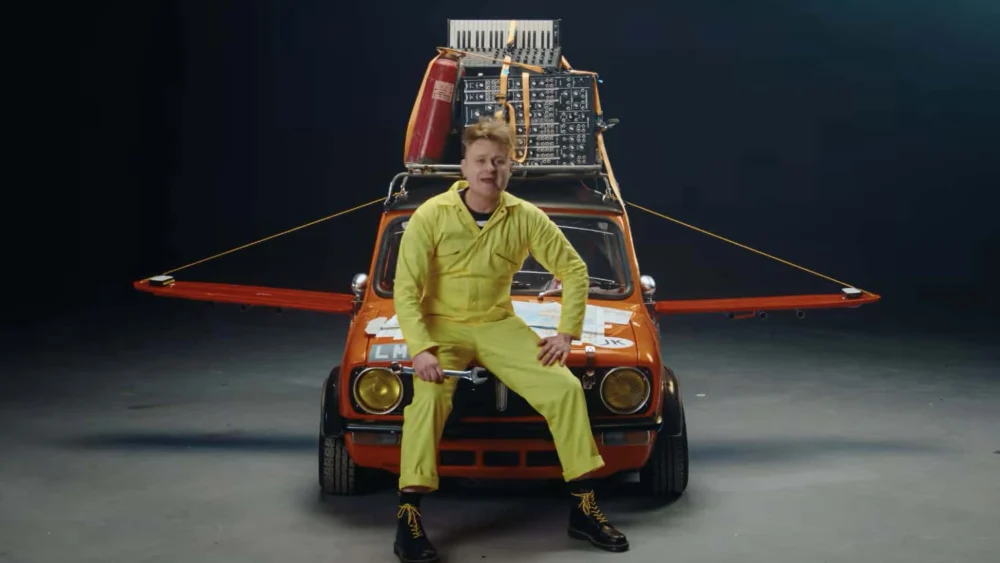
The British Broadcasting Corporation (BBC) and the European Broadcasting Union (EBU) have confirmed that Sam Battle, the prolific multi-instrumentalist and inventor known professionally as Look Mum No Computer, will represent the United Kingdom in the upcoming Eurovision Song Contest. Battle will perform his original composition, Eins, Zwei, Drei, a high-energy electronic track that merges his signature analog synthesizer aesthetic with contemporary pop sensibilities. The selection marks a significant stylistic pivot for the United Kingdom, which has historically leaned toward traditional pop vocalists and ballads. Battle, a prominent figure in the "maker" and DIY synthesizer communities, is expected to bring a unique visual and auditory experience to the international stage, utilizing custom-built hardware and experimental soundscapes.
The entry, titled Eins, Zwei, Drei (German for "One, Two, Three"), serves as a thematic exploration of modern escapism. According to official press releases and artist statements, the song addresses the "soul-crushing boredom of the nine-to-five" routine, offering a sonic narrative that transitions from the mundane realities of industrial labor into a vivid world of imagination and technological possibility. This narrative arc is mirrored in the song’s production, which features a heavy reliance on voltage-controlled oscillators, vintage drum machines, and circuit-bent hardware—elements that have defined Battle’s career as a YouTube influencer and innovator.
The Artist and the DIY Synthesis Movement
Sam Battle has spent the last decade cultivating a dedicated global following through his YouTube channel, Look Mum No Computer. With over a million subscribers, Battle has become a leading voice in the niche but rapidly growing field of synthesizer DIY (Do-It-Yourself). His work is characterized by a "punk-rock" approach to electronics, often involving the salvage of obsolete technology to create monumental musical instruments. Among his most famous creations are the "Furby Organ," a polyphonic instrument constructed from dozens of animatronic toys, and the "1,000 Oscillator Mega Drone," which garnered international media attention for its sheer scale and complexity.
Beyond his online presence, Battle is the founder of "This Museum Is (Not) Obsolete," located in Ramsgate, Kent. The museum houses a vast collection of experimental electronics, obsolete scientific equipment, and vintage musical hardware, serving as both a historical archive and a functional laboratory for his compositions. His selection for Eurovision represents a convergence of internet subculture and mainstream entertainment, highlighting the BBC’s recent strategy of selecting artists with established independent fanbases and distinct creative identities.
Eurovision Song Contest: A Legacy of Cultural Exchange
The Eurovision Song Contest is one of the longest-running and most-watched non-sporting television events in the world. Established in 1956 by the European Broadcasting Union, the contest was originally designed to test the limits of live, simultaneous broadcast technology while fostering a sense of unity among European nations in the post-war era. Over the decades, it has evolved into a massive cultural phenomenon, reaching an estimated global audience of over 160 million viewers annually.
While the contest is primarily centered in Europe, participation is open to all active members of the EBU. This includes countries outside the geographic boundaries of Europe, such as Israel, Azerbaijan, and Georgia. Australia has also been a regular participant since 2015, following an invitation to celebrate the contest’s 60th anniversary. The competition is structured into two live semifinals followed by a Grand Final. As a member of the "Big Five"—the group of countries that provide the largest financial contributions to the EBU—the United Kingdom receives automatic qualification for the Grand Final, alongside France, Germany, Italy, and Spain.
Technical Analysis of Eins, Zwei, Drei
Eins, Zwei, Drei is a departure from the polished, digital production typical of modern Eurovision entries. The track is built upon a foundation of analog sequencing, utilizing hardware that Battle often constructs or modifies himself. Musicologists and electronic music critics have noted the song’s industrial undertones, which pay homage to early 1980s synth-pop and the "Krautrock" movement of West Germany. The use of a German title is a deliberate stylistic choice, referencing the influential role of German electronic pioneers like Kraftwerk in shaping the global music landscape.
The lyrical content follows a structured progression from rhythmic, mechanical verses—representing the repetitive nature of office and factory work—to an expansive, melodic chorus. This shift is intended to symbolize the mental liberation found through creativity and the "world of dreams" mentioned in the song’s official description. For the live performance, Battle is rumored to be designing a bespoke stage rig that incorporates modular synthesizers and interactive lighting, ensuring that the technical process of music creation is visible to the audience.
The United Kingdom’s Strategic Pivot
The selection of Look Mum No Computer comes at a time of renewed interest in Eurovision within the United Kingdom. Following years of disappointing results, including several "nil points" finishes, the UK saw a dramatic reversal of fortune in 2022 when Sam Ryder secured second place with the song Space Man. This success prompted the BBC to re-evaluate its selection process, moving away from public votes in favor of internal selections conducted in partnership with professional management and industry experts.
By choosing an artist like Sam Battle, the UK is signaling a commitment to artistic authenticity and "left-field" creativity. Industry analysts suggest that the BBC is looking to replicate the success of other unconventional winners, such as Italy’s Måneskin or Portugal’s Salvador Sobral, who found victory by offering something distinct from the standard Eurovision formula. Battle’s established international tour history and his ability to engage with a tech-savvy, younger demographic are seen as significant assets in the quest for the glass microphone trophy.
Logistical Details and Global Broadcasting
The Eurovision Song Contest will take place over the course of a week, featuring two semifinals and the culminating Grand Final. While the host city changes annually based on the previous year’s winner, the production standards remain consistently high, involving state-of-the-art stage design, pyrotechnics, and augmented reality elements.
For viewers in the United States, the contest has found a permanent home on the streaming platform Peacock. This partnership has allowed the contest to expand its footprint in North America, where interest in the event has spiked following the release of the 2020 film Eurovision Song Contest: The Story of Fire Saga. The Grand Final is broadcast live, with American commentators often providing context for the complex voting system, which combines professional jury scores with a public televote from participating countries.
Impact and Industry Implications
The inclusion of a DIY synth artist in a major televised competition reflects broader trends in the music industry. As digital streaming continues to dominate consumption, there has been a parallel resurgence of interest in tactile, analog experiences. Sales of modular synthesizer components and vinyl records have reached decade-highs, suggesting a public appetite for the "authentic" sound that Battle champions.
Furthermore, the participation of Look Mum No Computer highlights the growing influence of "creator-musicians"—artists who build their careers on platforms like YouTube and Patreon before crossing over into traditional media. Battle’s journey from a shed in Kent to the Eurovision stage is a testament to the power of independent digital distribution and the democratization of music production technology.
Chronology of the UK at Eurovision
The United Kingdom joined the Eurovision Song Contest in 1957, one year after its inception. Since then, the nation has won the competition five times:
- 1967: Sandie Shaw – Puppet on a String
- 1969: Lulu – Boom Bang-a-Bang (joint winner)
- 1976: Brotherhood of Man – Save Your Kisses for Me
- 1981: Bucks Fizz – Making Your Mind Up
- 1997: Katrina and the Waves – Love Shine a Light
Following the 1997 victory, the UK entered a period of fluctuating results, often finishing in the bottom half of the leaderboard during the early 2000s and 2010s. The 2022 resurgence with Sam Ryder was followed by Mae Muller in 2023 and Olly Alexander in 2024. The selection of Sam Battle for the upcoming cycle represents the latest chapter in this ongoing effort to reclaim the UK’s status as a dominant force in the competition.
Official Reactions and Public Sentiment
Initial reactions from the Eurovision fan community, often referred to as "Eurofans," have been largely positive, with many praising the boldness of the choice. Social media discourse has focused on Battle’s potential for a visually spectacular performance, with fans speculating on which of his famous inventions might make an appearance on stage.
Representatives from the synthesizer industry have also expressed support. "Sam Battle has done more for the visibility of electronic engineering in music than almost anyone in the last decade," stated one industry analyst. "To see a modular synth rig on the Eurovision stage is a win for the entire community of builders and experimenters."
The BBC has emphasized that Battle’s entry is part of a broader commitment to showcasing the diversity of the UK’s modern music scene. A spokesperson for the broadcaster noted, "Sam Battle is a true original. His music is innovative, his energy is infectious, and ‘Eins, Zwei, Drei’ is a track that we believe will resonate with audiences across Europe and beyond. It is a celebration of British ingenuity and the spirit of creative independence."
Conclusion and Future Outlook
As the contest approaches, the focus will shift to the rehearsal process and the refinement of the live stage show. For Sam Battle, representing the United Kingdom is not merely a musical challenge but a platform to demonstrate the artistic viability of his unconventional methods. Whether Eins, Zwei, Drei secures a victory or not, the entry has already succeeded in generating a conversation about the role of technology, labor, and imagination in contemporary music.
The Eurovision Song Contest remains a vital barometer of cultural trends, and the 2024-2025 season promises to be one of the most technologically ambitious yet. With Look Mum No Computer leading the British delegation, the UK is poised to deliver a performance that bridges the gap between the history of electronic music and the future of global pop entertainment. As the lyrics of the entry suggest, the transition from the "nine-to-five" into a world of "endless possibilities" is a journey that many are eager to take, guided by the humming oscillators and flashing lights of Sam Battle’s unique musical vision.
