

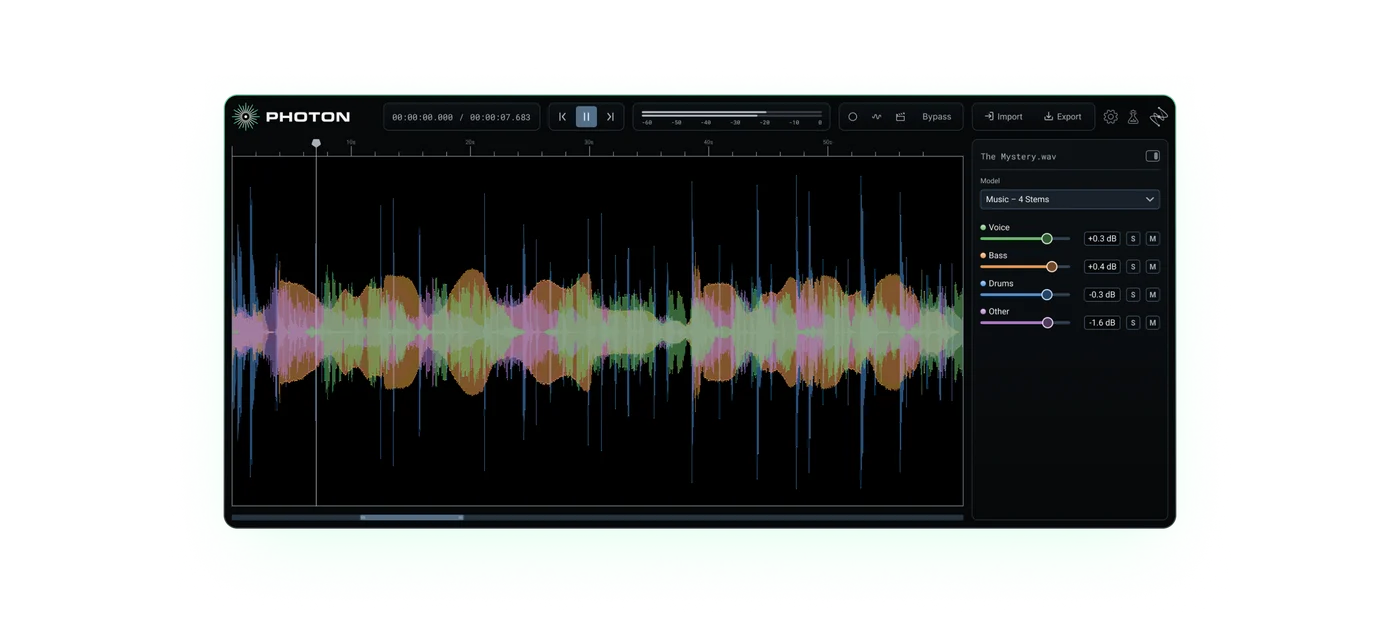
iZotope, a long-standing leader in digital signal processing and intelligent audio software, has officially announced the release of Photon, a comprehensive toolset dedicated to the burgeoning field of artificial intelligence-driven audio isolation. Developed in strategic collaboration with Boris FX—a powerhouse in visual effects and post-production software—Photon represents a significant shift in how professional audio engineers, film editors, and music producers interact with finished audio files. Unlike many contemporary AI audio tools that rely on external server clusters and cloud-based processing, Photon distinguishes itself by executing its complex computations locally on the user’s hardware, utilizing the Graphics Processing Unit (GPU) to deliver high-speed results without the privacy concerns or latency issues associated with remote data transmission.
The software arrives at a time when "de-mixing"—the process of separating a composite audio track into its individual constituent parts—has moved from a niche forensic capability to a standard requirement in music production and film post-production. Photon’s architecture is built upon 12 custom-trained machine-learning models, each optimized for specific acoustic signatures. These models are designed to handle everything from basic music stem separation to the highly complex task of isolating individual speakers in a crowded acoustic environment.
The Technological Core: Local GPU Processing and Machine Learning
The primary innovation within iZotope Photon lies in its processing philosophy. By leveraging local GPU acceleration, the software addresses a major pain point for professional studios: the need for rapid iteration. Cloud-based AI separation often involves uploading large, high-resolution audio files to a server, waiting for a queue, and then downloading the processed stems. This workflow is often incompatible with the tight deadlines of broadcast television or commercial music production. Photon’s local processing ensures that data remains on the user’s machine, maintaining security for unreleased intellectual property while providing near-instantaneous feedback.
The 12 machine-learning models included at launch are the result of extensive training on diverse datasets. These models are not generic filters; they are specialized neural networks trained to recognize the specific spectral characteristics of instruments and human speech. This includes a dedicated "Cinema 4 Stems" model, which is specifically tuned for the needs of re-recording mixers. This model can take a stereo or mono mix of a film scene and extract dialogue, music, sound effects, and ambient "room tone" into separate tracks. This allows editors to adjust the volume of a background music track that might be masking crucial dialogue, even if the original multitrack project is no longer available.
Advanced Music and Voice Isolation Capabilities
For music producers and remix artists, Photon offers a granular level of control that exceeds traditional four-stem (vocals, drums, bass, other) separation. The software includes specialized models for drum kit decomposition, allowing users to isolate the kick drum, snare, hi-hat, toms, and cymbals from a single stereo drum loop or a full mix. This level of detail is particularly valuable for modern music production, where producers often seek to replace or enhance specific elements of a vintage recording to meet modern sonic standards.
Beyond music, the "Voice Separator" model represents a breakthrough for podcasters and documentary filmmakers. The model is capable of identifying and isolating up to six distinct individual speakers from a single recording. In scenarios where multiple people are speaking over one another or where a single microphone was used to capture a roundtable discussion, Photon can parse the overlapping frequencies to create discrete tracks for each participant.
Furthermore, the software addresses the environmental challenges of field recording. Additional AI models are included for noise reduction and voice restoration. These are specifically calibrated to remove common "real-world" audio contaminants such as traffic rumble, wind gusts, excessive room reverb (echo), and general atmospheric hiss. By focusing on the restoration of the human voice, Photon positions itself as a critical tool for cleaning up "found" audio or low-quality archival recordings.
Workflow Integration and the ARA2 Standard
Recognizing that audio professionals rarely work in a vacuum, iZotope has ensured that Photon integrates seamlessly into existing production environments. While it functions as a robust standalone application—capable of processing video files and exporting them with the original visual track intact—it also ships as an ARA2 (Audio Random Access) plugin.
The ARA2 protocol is a significant advancement over traditional plugin formats like VST or AU. It allows the plugin and the Digital Audio Workstation (DAW) to exchange information about the entire audio file, rather than just the audio currently passing through the playback head. This deep integration means that users of compatible DAWs, such as Steinberg Cubase, Cockos REAPER, and Avid Pro Tools, can use Photon’s separation tools directly on the timeline. This eliminates the need for "round-tripping," or the tedious process of exporting a file, processing it in an external app, and re-importing it.
To ensure the software remains relevant as AI technology evolves, iZotope has included a "Model Manager." This utility provides users with a direct pipeline to updated processing models and new specialized algorithms as they are released. This modular approach suggests that Photon is intended to be a growing ecosystem rather than a static product.
Historical Context and Industry Evolution
The release of Photon marks another milestone in iZotope’s history of "intelligent" audio processing. Since the release of its flagship RX repair suite over a decade ago, iZotope has been at the forefront of using visual representations of sound (spectrograms) to allow for surgical editing. However, the transition from spectral editing to true AI-based stem separation represents a paradigm shift.
In the early 2020s, the industry saw the rise of open-source models like Spleeter and Demucs, which proved that AI could effectively "un-mix" music. This technology gained mainstream attention when it was used by director Peter Jackson and his team at WingNut Films to isolate John Lennon’s voice from a low-quality demo tape for the final Beatles song, "Now and Then." Photon brings this high-level capability to the general market, packaging it in a user-friendly interface that does not require knowledge of command-line interfaces or Python coding.
The partnership with Boris FX is also a notable strategic move. Boris FX is renowned for its Mocha tracking technology and Sapphire lighting effects, which are industry standards in Hollywood. By combining iZotope’s audio expertise with Boris FX’s experience in high-performance GPU computing and visual workflow, Photon bridges the gap between audio and video post-production.
Market Implications and Professional Reactions
The introduction of Photon is expected to have a ripple effect across several sectors of the media industry. For the archival and restoration sector, the ability to isolate voices from noise-heavy historical recordings provides a new way to preserve history. For the legal and forensic sectors, the voice isolation capabilities could prove vital in analyzing recorded evidence.
In the commercial music world, the implications are equally significant. Sampling, a cornerstone of hip-hop and electronic music, has traditionally been limited by the "cleanliness" of the sample. If a producer wanted a vocal line but it was buried under a loud drum beat, the sample was often unusable. Photon effectively removes these barriers, potentially leading to a new wave of creative sampling where any element of any recording can be repurposed.
Initial reactions from the professional community highlight a mix of excitement and a call for ethical standards. While the technical prowess of the software is undisputed, the ease with which stems can be created has prompted discussions regarding copyright and the rights of original performers. However, from a purely functional standpoint, engineers have praised the local processing feature, noting that it solves the "waiting game" that has plagued AI tools for the past three years.
Pricing, Availability, and System Requirements
iZotope Photon is now available for both macOS and Windows platforms. To run the software effectively, users are encouraged to have a relatively modern machine with a dedicated GPU, as the machine-learning models are optimized for hardware acceleration.
The software is positioned as a premium professional tool with a regular retail price of $349. However, to encourage early adoption and transition from other platforms, iZotope is offering an introductory promotional price of $259. This promotional window is notably long, extending through December 7, 2026, suggesting that iZotope views Photon as a long-term flagship product intended to gain a deep foothold in the professional market over the next two years.
As the industry continues to grapple with the role of artificial intelligence, Photon stands as a factual testament to the practical benefits of the technology. It does not replace the engineer; rather, it provides a set of "digital tweezers" capable of performing tasks that were physically impossible just a few years ago. With its focus on local processing, deep DAW integration, and specialized models, Photon is poised to become a standard fixture in the toolkit of the modern audio professional.
