

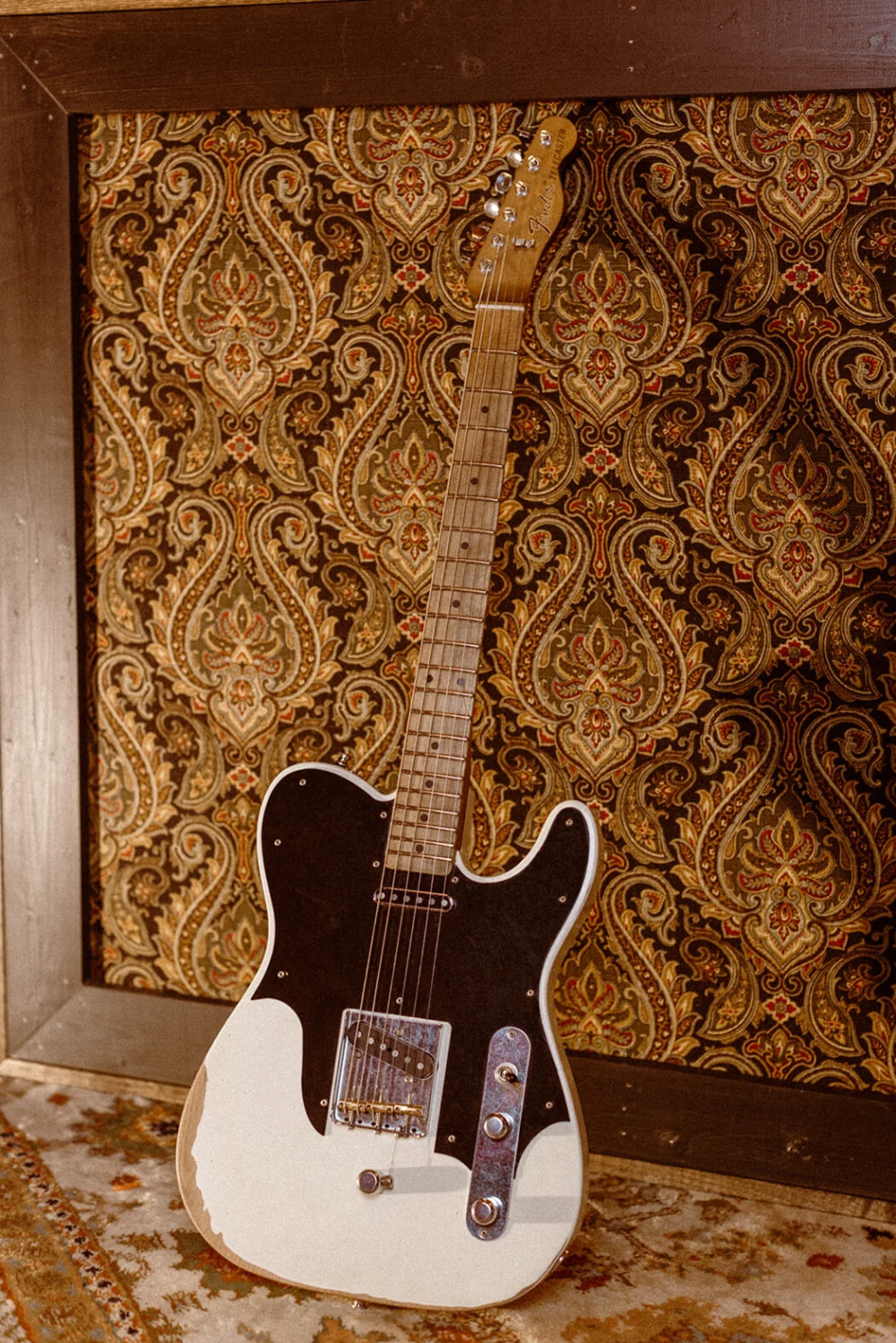
Fender, the iconic American guitar manufacturer, has officially announced the release of the John Osborne Signature Telecaster, a meticulously crafted instrument designed to replicate the unique, heavily modified, and well-traveled Telecaster belonging to John Osborne, the acclaimed guitarist of the Grammy-winning country duo Brothers Osborne. This new signature model is a testament to Osborne’s distinctive playing style and his profound connection to the Telecaster, an instrument synonymous with his melodic, expressive lead work that provides a significant edge to the band’s genre-bending sound. The launch marks a significant moment for both Fender and the country music landscape, offering players a direct link to the innovative spirit of one of contemporary music’s most influential guitarists.
The announcement of Osborne’s signature model comes as no surprise to those familiar with his prominent role in Brothers Osborne, a band that has consistently pushed the boundaries of modern country music. Formed with his brother T.J. Osborne, the duo has garnered widespread critical acclaim and a devoted fanbase through their distinctive blend of country, rock, and blues. Their sound is characterized by T.J.’s deep baritone vocals and John’s electrifying, often improvisational, guitar work. John Osborne’s Telecaster has been an undeniable cornerstone of this sound, delivering the quintessential "Tele twang" infused with dynamic bends and soulful articulation. The band has achieved multiple CMA and ACM awards, and notably, a Grammy Award for Best Country Duo/Group Performance for their track "Younger Me," solidifying their status as genre innovators. John’s instrumental prowess is a key component of their success, making his signature instrument a highly anticipated release for aspiring guitarists and established professionals alike.
The Genesis of a Unique Instrument: A Chronology of Customization
The story behind the John Osborne Signature Telecaster is not one of a pristine, off-the-shelf instrument, but rather a fascinating chronology of customization, born out of necessity and a relentless pursuit of personal expression. It begins in Osborne’s early twenties in Nashville, a pivotal time when he acquired his first main guitar: a vintage 1968 Telecaster. This acquisition was a significant investment for the burgeoning musician, requiring him to trade in nearly all of his existing gear and secure a $700 loan from his mother. "I didn’t have guitars," John recounts, emphasizing the singular importance of this instrument. "I just had this one 1968 Telecaster. So I played it on everything – every gig and every session." This singular focus forged an unbreakable bond between Osborne and his Telecaster, making it an extension of his musical identity.

The narrative then progresses to a crucial turning point during the recording of Brothers Osborne’s second album, Port Saint Joe, released in 2018. It was during this period that Osborne had his first profound introduction to the b-bender, a mechanical device that allows a guitarist to bend the B-string a full step (or more) by engaging a lever, often integrated into the strap button. A friend, the late Keith Gattis, a renowned b-bender master, lent Osborne one of his guitars for the recording sessions. "I fell in love with the b-bender," Osborne explains. "I had played b-benders a few times, just here and there, but never live or on a record. And I could not put it down. I was obsessed!" This transformative experience ignited a desire to integrate the b-bender into his own primary instrument.
Driven by this newfound obsession, Osborne embarked on a quest to modify his beloved Telecaster. Rather than altering his vintage ’68 body, he sought a more pragmatic solution. "I went looking for maybe a cheap b-bender Telecaster I could put together myself," he recalls. His search led him to a preloaded b-bender body, devoid of pickups or other electronics. This discovery set the stage for the creation of his iconic "partscaster." Osborne ingeniously transplanted the neck from his original 1968 Telecaster onto the newly acquired b-bender body. This act, seemingly audacious to vintage purists, underscored a fundamental principle for Osborne: "80-90% of a guitar is really in that neck, how it feels, how it plays – because it was really not too dissimilar to how it felt before." He then sourced pickups and other components, assembling the guitar himself. "That was the real genesis of that guitar!" he affirms, highlighting the hands-on, personal nature of its creation.
For many collectors, the idea of altering a vintage 1968 Telecaster, particularly replacing its entire body, might be considered sacrilegious. However, Osborne’s approach aligns perfectly with the foundational philosophy of Leo Fender, the visionary behind the Telecaster. Fender was a profoundly utilitarian and pragmatic inventor. His designs prioritized modularity and ease of repair, viewing guitars as tools meant to be used and adapted. Osborne articulates this perspective: "He had the idea that once the frets wear out on the guitar, you just take the neck off and you put a new neck on it – like changing a set of tires. And because of that, because of the simplistic design, it’s allowed people to modify these guitars themselves into their own personal canvas to create on." This ethos of practical modification, rather than preservation for preservation’s sake, is deeply embedded in the Telecaster’s DNA and celebrated by players like Osborne. Moreover, for those concerned about the fate of the original ’68 body, Osborne confirms its continued utility: "I still have that original ’68 body, and I actually converted it into a baritone guitar with a long conversion neck!" This further exemplifies his commitment to maximizing the potential of every component.
The Philosophy of the Signature Model: Blending Tradition and Innovation
The John Osborne Signature Telecaster is not merely a reproduction but a tribute to this evolutionary journey. Its specifications are meticulously designed to stay as close as possible to Osborne’s self-assembled instrument, while embodying his core tonal philosophy: to retain the authentic voice of a traditional Telecaster, not to supersede it. "At the end of the day, I still wanted it to be a Telecaster, not another guitar shaped like a Telecaster," John emphasizes. This commitment is evident in critical design choices, such as the three brass-barrel saddles, which are compensated for improved intonation but still embrace the inherent, charming imperfections that contribute to the Telecaster’s distinctive character. Osborne notes, "Those imperfections are what make music special. I’ve had six-saddle Teles over the years, but I start to miss that honk and spank that comes from having those brass barrels – even with six brass saddles, you lose some of that character." This insight underscores a deep understanding of how subtle design elements profoundly influence tone and playability.

This thoughtful approach extended to the guitar’s electronics. Osborne’s objective was clear: maintain the iconic Telecaster bridge pickup sound while enhancing the neck pickup for greater versatility. "I still wanted a Telecaster bridge pickup, because that is the sound," he states. For the neck pickup, his goal was to make it "a little punchier," ensuring it could "compete with a louder bridge pickup" without a significant volume drop when switching positions. He resisted the temptation to simply install a Stratocaster pickup, instead seeking a balanced solution that respected the Telecaster’s heritage. "Everyone’s favourite pickup on a Strat is the neck – we all want to pretend we’re Jimi Hendrix or Stevie Ray Vaughan, even when we’re playing a Telecaster. So I really wanted something that could speak in that way, but still retain some of the tradition of the Tele." This nuanced design ensures that the signature model offers both the classic Telecaster bite and a versatile, robust neck tone.
The Transformative Power of the B-Bender
The most distinct and perhaps revolutionary feature of the John Osborne Signature Telecaster is the integrated b-bender. For those unfamiliar, this ingenious mechanical system provides a hands-free method to bend just the B-string, mimicking the fluid glides and crying tones of a pedal-steel guitar. Typically operated by a lever connected to the guitar strap, a downward pull on the neck or body engages the mechanism, tightening the B-string behind the saddle. This allows guitarists to execute pedal-steel-like bends within chords, opening up a vast new landscape of melodic and harmonic possibilities for both lead and rhythm playing. The b-bender, originally popularized by innovators like Clarence White and Gene Parsons, has been a staple in country music for decades, yet its inclusion in a mainstream signature model by Fender introduces this powerful tool to a wider audience.
Osborne’s personal journey with the b-bender highlights its transformative potential. "When I first got the b-bender, I wanted to put on every song. I was having so much fun – it was like learning a new instrument again," he enthuses. This initial "new toy" syndrome, as he likens it to children with new playthings or guitarists with new pedals, is a common experience for musicians encountering such a game-changing tool. "When guitar players get that new pedal, it’s like, ‘this is going on every song!’ – until eventually you learn where it needs to go." This process of discovery, experimentation, and eventual integration is fundamental to a musician’s growth. For Osborne, the b-bender has evolved from a novel addition to an indispensable element of his musical expression. "Now, I don’t even really think about it anymore. It’s just part of my voice as a musician."
A significant implication of this signature model is its potential to democratize the b-bender. Osborne expresses his excitement about this prospect: "I’m really looking forward to seeing how other people use it, all the things that they will do that I couldn’t even think of." He also passionately dispels the notion that the b-bender is confined solely to country music. "The pedal steel – which is what we’re all trying to emulate with it, really – has been used on a lot of rock and pop records now, so the sound is not tied to this one genre of country. You’re able to cross over with these things. I mean, hell, Jimmy Page had some great b-bender stuff back in the day! It’s just another tool in the toolbox to create the music that you want to create." This perspective encourages players across all genres to explore the creative possibilities of this unique device, potentially sparking new sonic trends.

The Aesthetic of Authenticity: A Well-Worn Legacy
Beyond its innovative mechanics and carefully chosen electronics, the John Osborne Signature Telecaster also captures the aesthetic of a life lived on the road. The guitar features a road-worn finish, a deliberate choice that reflects Osborne’s philosophy on instruments as tools. Drawing a parallel to his formative years, he notes, "I grew up plumbing with my dad, and the tools in that toolbox are just beat to hell, because they’ve been used. Guitars are the same – you know it’s a good guitar if it’s been used!" This sentiment underscores a profound respect for instruments that bear the marks of hard work and countless hours of performance.
The road-worn finish on the signature model is not an exact one-to-one recreation of his personal instrument but aims to capture its spirit. Interestingly, the second-hand b-bender body Osborne initially found was already relic’d, adding an authentic layer to his "partscaster" from the outset. However, the thousands of hours he subsequently invested in playing the guitar added its own unique wear patterns. "But as time went on, with the thousands of hours I played that guitar, it created a lot of different wear, especially in the forearm – I really wanted to make sure that was there," Osborne adds, highlighting the personalized details that Fender has sought to integrate.
Osborne’s preference for a rough-and-ready aesthetic extends beyond mere functionality; it’s a reflection of his personality. "I’ve never really been a fan of glossy guitars – I’m not a glossy human, and I don’t really want my guitars to look glossy because it makes me look even less glossy!" he jokes. This candid remark speaks to the deep connection between a musician and their instrument, where the guitar becomes an extension of their identity. He believes that the visual aspect, while perhaps subconscious, significantly influences a player’s mindset and, consequently, their performance. "The instrument should be a bit of an extension of who you are, and it just made more sense from that perspective. Also subconsciously – it shouldn’t be about how it looks, but at the end of the day, it kind of is, because when you look at an instrument, it does put you in a mindset, and how you play is a reflection of that mindset."
Furthermore, the road-worn finish inherently suits the Telecaster’s robust nature. Osborne attests to its legendary durability: "I’ve literally thrown that guitar across the stage, and my tech picks it up, and it’s still in tune. That’s the thing about these Teles in particular – they are made to be beat up." This speaks volumes about the Telecaster’s reputation as a workhorse instrument, capable of enduring the rigors of touring and performance while consistently delivering reliable sound.

Broader Impact and Implications
The release of the John Osborne Signature Telecaster by Fender carries several significant implications for the music industry and guitar community. Firstly, it further cements Fender’s commitment to collaborating with influential artists who push musical boundaries. By recognizing Osborne’s innovative approach to the Telecaster, Fender reinforces its legacy as a brand that supports both tradition and evolution. This partnership provides Fender with an opportunity to tap into the thriving modern country and roots rock markets, attracting players who admire Osborne’s unique style and tone.
Secondly, for players, this signature model offers an accessible pathway to replicate a professional artist’s distinct sound and playing experience. The inclusion of the b-bender as a standard feature is particularly noteworthy. While b-benders have been available as aftermarket modifications, their integration into a mainstream signature model from Fender makes the technology more readily available and visible to a broader demographic. This could lead to a resurgence of interest in b-bender techniques, inspiring a new generation of guitarists to explore its creative potential across various genres, moving beyond its traditional association with country music.
Moreover, the emphasis on the "partscaster" origin story and the "road-worn" aesthetic celebrates the culture of modification and personal expression that has always been a cornerstone of the guitar community. It validates the idea that an instrument’s value isn’t solely in its pristine original condition but also in its ability to adapt and evolve with the artist. This message resonates deeply with players who see their guitars as tools for creation rather than museum pieces.
In conclusion, the John Osborne Signature Telecaster is more than just a new product; it’s a narrative encapsulated in wood and wire. It tells the story of a dedicated musician’s journey, his embrace of innovation, and his deep respect for the utilitarian spirit of the Telecaster. By offering a meticulously crafted reproduction of Osborne’s personalized instrument, Fender provides guitarists worldwide with a versatile, inspiring tool that embodies the raw, expressive power of modern country guitar and the timeless appeal of a truly iconic instrument. It’s anticipated that this new model will not only appeal to fans of Brothers Osborne but also ignite creativity in countless musicians looking to add a unique voice to their sonic palette.
