

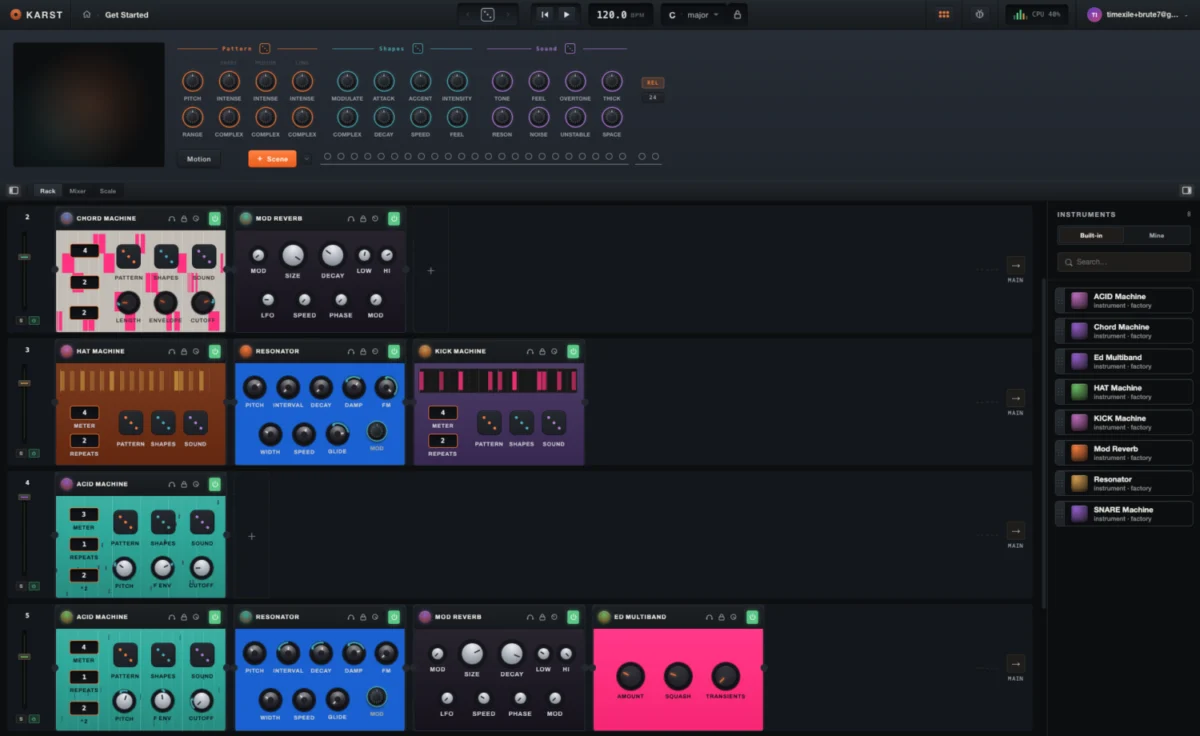
The landscape of digital music production is undergoing a fundamental shift as the boundaries between instrument design and composition continue to blur. Tim Exile, a renowned synthesist, software developer, and electronic musician, has officially unveiled a preview of Karst, a digital modular environment designed specifically for "composing with systems." This new platform represents a departure from traditional linear sequencing, offering a workflow where the act of building a sonic architecture is synonymous with the act of songwriting itself. Currently available in a private beta phase, Karst aims to bridge the gap between complex modular synthesis and intuitive musical creation, positioning itself as a central tool for the next generation of algorithmic and generative composers.
The Evolution of Systemic Composition
To understand the significance of Karst, one must examine the trajectory of music technology over the last two decades. Traditionally, music production has been divided into two distinct silos: the creation of instruments (sound design) and the arrangement of notes (composition). However, the rise of modular synthesis—both in hardware (Eurorack) and software (Max/MSP, Pure Data, and Reaktor)—has fostered a "systems-thinking" approach to music. In this paradigm, the composer does not merely write a melody; they design a set of rules, feedback loops, and probabilistic triggers that allow the music to evolve organically.
Tim Exile has long been a pioneer in this space. Known for his work with Native Instruments on acclaimed tools like "The Mouth" and "The Finger," as well as his own "Flow Machine" performance system, Exile has consistently advocated for a more fluid relationship between the performer and the machine. Karst is the culmination of this philosophy. It is described as a "digital modular," but its primary goal is not just to replicate the patches of a physical rack. Instead, it focuses on the "system" as the primary unit of composition, allowing users to build complex, self-generating musical entities that respond to input in real-time.
Technical Specifications and the Karst Ecosystem
Karst is built to be a versatile environment that functions across multiple platforms, reflecting the modern producer’s need for flexibility. The core of the system is its modular engine, which allows for the interconnection of various digital modules. While the specific list of modules is being refined during the beta process, the system is designed to handle everything from standard synthesis (oscillators, filters, envelopes) to advanced logic processing and generative sequencing.
The deployment strategy for Karst is phased, starting with a web-based environment. This browser-centric approach utilizes the Web Audio API, allowing users to access the full power of the modular engine without the need for high-end local installations during the initial testing phase. According to the developer’s roadmap, the ecosystem will eventually expand into a comprehensive suite:
- Desktop Browser Version: Available immediately to beta participants, this version allows for cloud-based saving, sharing, and collaborative exploration of systems.
- Standalone Application: Scheduled for a later release, this will provide a dedicated environment for low-latency performance and deep system integration.
- Plugin Version (VST/AU/AAX): Slated for a Q4 2026 launch, the plugin will allow Karst to live inside traditional Digital Audio Workstations (DAWs) like Ableton Live, Logic Pro, and Bitwig Studio, enabling producers to integrate their generative systems into conventional arrangement workflows.
Chronology of Development and Availability
The development of Karst has been a multi-year endeavor, rooted in Tim Exile’s desire to simplify the "spaghetti" complexity often associated with modular software. The project entered a significant milestone with the launch of its private beta.
- Pre-2024: Conceptualization and internal prototyping of the "composing with systems" engine.
- Late 2023 – Early 2024: Alpha testing with a closed group of sound designers and long-time collaborators.
- Current Phase (2024): Launch of the private beta. This phase is open to early adopters who purchase the software at a discounted rate of £69, down from the projected retail price of £99. This stage focuses on stress-testing the browser engine and gathering community feedback on the user interface and module functionality.
- 2025 – Early 2026: Continued expansion of the module library and optimization of the standalone application engine.
- Q4 2026: Official full-scale launch, including the release of the VST/AU plugin versions.
This extended timeline suggests a commitment to stability and depth, ensuring that when the plugin version arrives in 2026, it is a mature tool capable of handling the rigors of professional studio production.
Market Context and Competitive Landscape
Karst enters a market that is increasingly fascinated by "no-code" and "low-code" solutions for creativity. In the software realm, Karst faces competition from established giants and community-driven projects alike:
- VCV Rack: An open-source virtual Eurorack platform that has dominated the digital modular space. While VCV Rack focuses on mimicking the physical experience of Eurorack, Karst appears to prioritize the "systemic" and "compositional" aspects, potentially offering a more streamlined interface for those who find VCV’s 1:1 hardware emulation overwhelming.
- Bitwig Studio (The Grid): Bitwig’s internal modular environment is perhaps the closest competitor in terms of philosophy. However, Karst’s independence as a standalone system and its browser-based accessibility give it a unique edge for creators who work across different hardware environments.
- Native Instruments Reaktor: As a former developer for Reaktor, Exile’s Karst can be seen as a spiritual successor to the "Blocks" concept, but with a modern, web-forward architecture that bypasses the aging codebase of older platforms.
The pricing strategy—£69 for beta entry—is a common model in the boutique software industry. It provides the developer with necessary capital for continued R&D while rewarding early adopters with a lower price point and a direct line of communication to the development process.
Strategic Implications for the Music Industry
The emergence of Karst highlights a broader trend toward "generative" music. As artificial intelligence continues to make inroads into automated music generation, tools like Karst offer a middle ground: "human-led algorithmic composition." Instead of an AI making all the decisions, the human composer designs the logic gates and the harmonic constraints, maintaining creative agency while benefiting from the machine’s ability to explore permutations.
For professional composers, particularly those working in film, gaming, and interactive media, Karst offers a way to create "living" scores. A system built in Karst can theoretically generate endless variations of a theme, making it ideal for background environments or adaptive soundtracks that change based on player input or external data.
Furthermore, the decision to launch a browser version first is a calculated move toward democratization. By removing the barrier of expensive hardware or complex installation processes, Karst can reach a wider audience of hobbyists and students. This "low barrier to entry, high ceiling for mastery" approach is essential for any software aiming to become a standard in the creative toolkit.
Anticipated Community and Expert Reaction
While official reviews from major industry publications are pending the full release, early feedback from the synthesist community has focused on the "Exile factor." Tim Exile’s reputation for creating instruments that feel "alive" and "unpredictable yet musical" has generated significant anticipation.
Industry analysts suggest that the long lead time—projecting a 2026 plugin release—indicates that Karst is not just a collection of effects, but a foundational platform. "The challenge for any new modular environment is the ecosystem," notes one digital audio consultant. "It’s not just about the modules you ship with; it’s about how easily users can build their own and share them. If Karst can foster a community similar to the one surrounding Reaktor or VCV Rack, it could become a staple of the 2020s."
Future Outlook and Conclusion
As Karst moves through its private beta, the focus will likely shift toward the expansion of its "logic" modules—the components that allow for complex decision-making within a patch. The success of the platform will depend on its ability to balance power with usability. If the system is too complex, it remains a niche tool for power users; if it is too simple, it loses the "composing with systems" appeal that differentiates it from a standard synthesizer.
The transition from the current browser-based beta to the standalone and plugin versions in 2026 will be the ultimate test of the Karst architecture. For now, Tim Exile has provided a glimpse into a future where the distinction between the instrument and the song is no longer relevant. In this future, the composer is an architect of sound, and the "song" is a living, breathing system that exists as long as the power is turned on.
By offering a preview today, Karst invites the musical community to participate in the construction of this new workflow. At £69 for early access, it represents an investment in a specific vision of musicality—one that prizes experimentation, logic, and the beauty of the unexpected. As the digital modular space continues to evolve, Karst stands as a testament to the enduring appeal of the "system" as the ultimate creative partner.
