

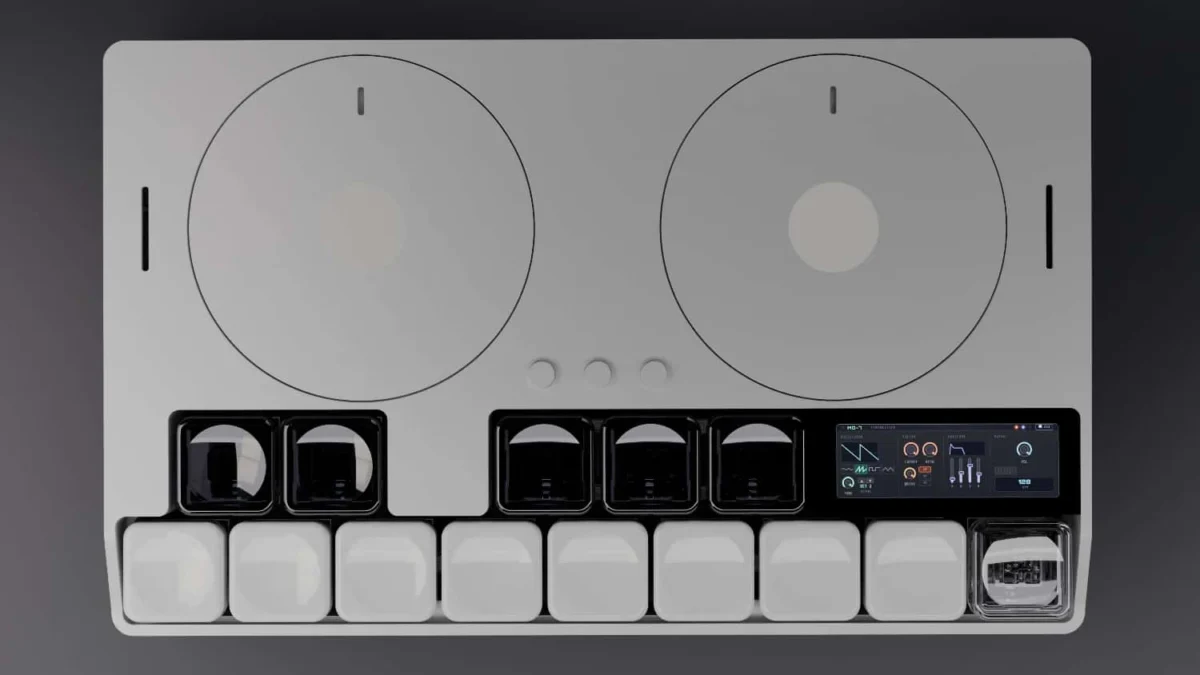
Mach Devices has officially announced the upcoming release of the MD-7, a compact hardware synthesizer that seeks to redefine the user experience of portable electronic instruments through the integration of motorized haptic feedback technology. Positioned as a "pocket synthesizer," the MD-7 distinguishes itself from a crowded market of miniature sound modules by focusing on the physical relationship between the musician and the machine. Scheduled for a general release in September 2026, the device is priced at $399 USD, targeting both professional sound designers and enthusiasts who prioritize tactile precision in a mobile format. The instrument combines a traditional subtractive synthesis engine with a modern, open-source firmware platform, offering a level of customization rarely seen in consumer-grade portable hardware.
A New Paradigm in Tactile Control: Motorized Haptic Discs
The centerpiece of the MD-7’s hardware interface is its dual rotary control system, which utilizes motorized haptic feedback discs. Unlike standard potentiometers or infinite rotary encoders found on most contemporary synthesizers, these discs are capable of generating physical sensations that correspond to the parameters being adjusted. Through the use of variable resistance, the MD-7 can simulate the feel of different mechanical components. For instance, when navigating a menu or selecting a waveform, the discs can provide stepped detents, giving the user a physical "click" sensation for each selection.
Furthermore, the technology allows for the implementation of virtual limits. In a traditional analog synthesizer, a knob physically stops at its minimum and maximum values. In many digital "pocket" synths, encoders spin infinitely, requiring the user to monitor a screen to see when a value has reached its peak. The MD-7’s haptic motors can programmatically create a "hard stop" or a "wall" at the end of a parameter range, such as a filter cutoff or volume level, effectively bridging the gap between digital versatility and analog physicality. This tactile feedback is intended to allow musicians to perform adjustments by feel, reducing the reliance on visual confirmation during live performances or complex studio sessions.
Technical Specifications and Synthesis Engine
Underneath its innovative control surface, the MD-7 houses a robust subtractive synthesis engine. Subtractive synthesis, the foundation of iconic electronic music sounds since the 1960s, involves the use of oscillators to generate harmonically rich waveforms which are then shaped by filters and envelopes. The MD-7 includes a variety of oscillator shapes, a multimode filter—capable of low-pass, high-pass, and band-pass operations—and a standard ADSR (Attack, Decay, Sustain, Release) envelope generator.
To facilitate composition, the device is equipped with a 16-step sequencer and a dedicated drum looper. The sequencer allows users to program melodic patterns and rhythmic sequences on the fly, while the drum looper provides a rhythmic foundation for layering sounds. This combination makes the MD-7 a self-contained production tool, capable of generating complete musical ideas without the need for external hardware.
The internal digital signal processing (DSP) is designed to be high-fidelity, ensuring that despite its small footprint, the MD-7 produces a professional-grade audio signal. The inclusion of a 3.5mm headphone output ensures compatibility with standard monitoring equipment, while the dual USB-C architecture provides a modern solution for power and data management. One USB-C port is dedicated strictly to power, while the second serves as a multi-functional interface for audio transmission, MIDI communication, and even compatible USB microphone input, allowing for external sampling or vocal processing.
The Open-Source Philosophy and Community Integration
In a move that has garnered significant interest from the developer community, Mach Devices has committed to making the MD-7 an open-source platform. The company plans to release the firmware, including the DSP engine, the modulation system, and the sequencer code, to the public. This decision aligns the MD-7 with a growing movement in the music technology industry toward "open hardware," where users are encouraged to modify, improve, and share their own versions of the device’s software.

By providing an open-source platform, Mach Devices ensures the longevity of the MD-7. Users are not limited to the factory settings or the manufacturer’s update cycle. Instead, a community of developers can create custom oscillator types, unique filter algorithms, or entirely new sequencing modes. This level of transparency is particularly appealing to the "maker" subculture and educators who use synthesizers as a medium for teaching digital signal processing and computer science. The potential for third-party "skins" or alternative firmware builds could transform the MD-7 from a single instrument into a versatile hardware host for various synthesis methods, including FM (Frequency Modulation) or granular synthesis.
Chronology of Development and Market Context
The journey toward the MD-7’s September 2026 release began several years prior, as Mach Devices sought to address the "tactile deficit" in the portable synthesizer market. Historically, the portable market has been dominated by devices like the Teenage Engineering Pocket Operator series, the Korg Volca line, and the Roland Boutique series. While these devices are celebrated for their sound quality and portability, they often rely on small, sometimes fragile plastic knobs or touch-capacitive strips that lack the mechanical gravity of full-sized studio gear.
Mach Devices first teased the concept of haptic-assisted synthesis in early 2025, showcasing prototypes that used industrial-grade motors to simulate the resistance of vintage Moog or ARP potentiometers. Throughout 2025 and early 2026, the company refined the form factor, moving from a laboratory-style enclosure to the sleek, pocket-friendly design revealed in recent promotional materials. The decision to price the unit at $399 places it in the mid-range of the portable market—higher than the entry-level "toy" synths but significantly more affordable than boutique handheld workstations like the OP-1 Field.
Industry Analysis: Implications of Haptic Technology in Music
The introduction of haptic feedback into the synthesizer market represents a significant technological milestone. While haptics have become standard in smartphones (simulating home button presses) and video game controllers (providing immersive vibrations), their application in musical instruments has remained largely experimental. The MD-7 is one of the first commercial efforts to bring high-resolution force feedback to a mass-market synthesizer.
Industry analysts suggest that this technology could have profound implications for accessibility. For visually impaired musicians, the ability to "feel" the state of a synthesizer—knowing exactly where a filter is set or when a sequencer step is active through physical resistance—removes a major barrier to entry. Furthermore, in the context of professional performance, haptic feedback allows for "blind" operation, enabling an artist to maintain eye contact with an audience or other performers while making precise sonic adjustments.
The $399 price point is seen as a strategic move to capture a segment of the market that values "heirloom" quality in digital devices. By combining a premium tactile experience with an open-source framework, Mach Devices is positioning the MD-7 not just as a gadget, but as a long-term tool for creative expression.
Future Outlook and Availability
As the September 2026 release date approaches, Mach Devices is expected to launch a series of developer workshops and beta-testing programs to seed the open-source community. The company has indicated that the initial production run will be available through their official website and select boutique music retailers worldwide.
The success of the MD-7 will likely be measured by the robustness of its community-driven software ecosystem. If the open-source community embraces the platform, the MD-7 could become a standard for portable synthesis, much like the Monome or the Organelle before it. For now, the music technology world remains focused on the "coming soon" status of the device, waiting to see if the promise of a motorized, haptic future will resonate with the needs of modern musicians. With its blend of haptic innovation, subtractive synthesis power, and developer-friendly architecture, the MD-7 stands as a testament to the evolving landscape of electronic musical instruments, where the boundary between the physical and the digital continues to blur.
