

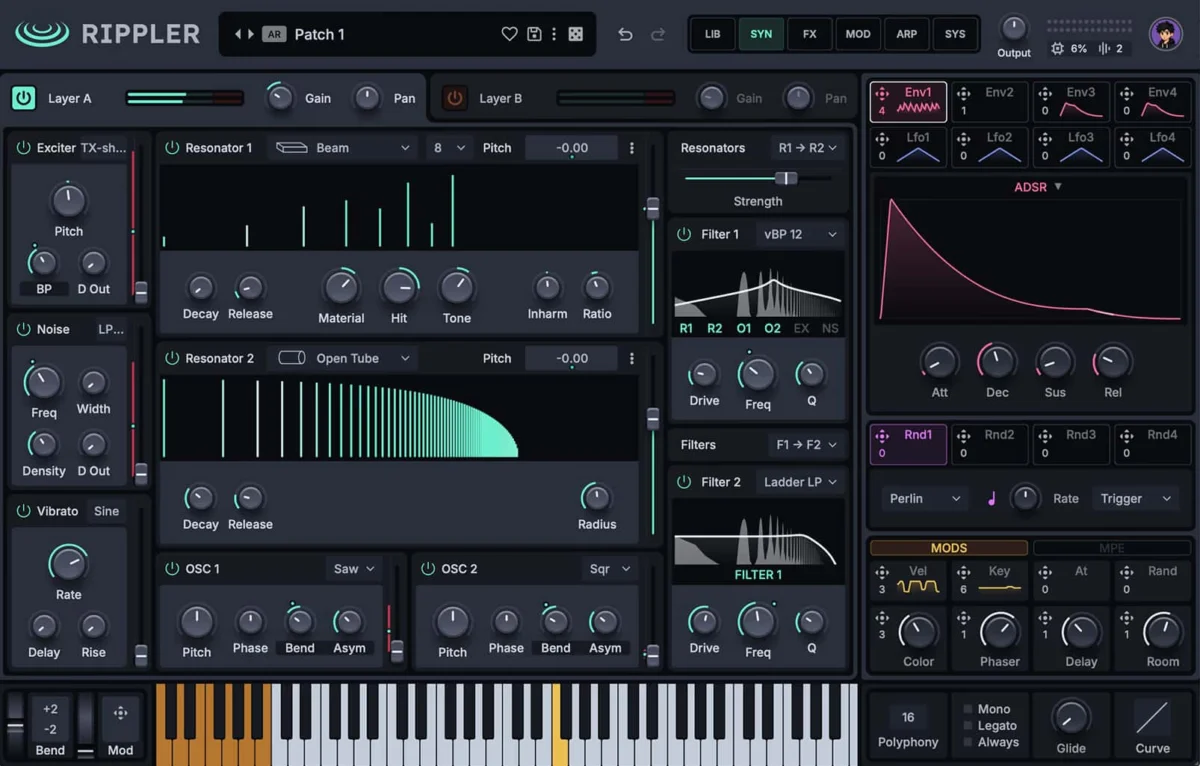
The software instrument developer reFX, widely recognized in the music production industry for its flagship ROMpler Nexus, has officially announced the release of Rippler, a sophisticated software synthesizer that integrates modal and subtractive synthesis. Unlike traditional sample-based instruments that rely on pre-recorded audio data, Rippler utilizes complex mathematical models and banks of resonators to generate sound in real-time. This release marks a significant expansion of the reFX product line, offering sound designers and electronic musicians a tool focused on organic, physically modeled textures and highly reactive synthesis architectures.
Rippler is built upon a dual-layer engine where each layer functions independently or in tandem to create harmonically rich timbres. The core of the instrument’s sound generation lies in its bi-directional energy coupling between resonators. This design allows for a dynamic exchange of acoustic energy, simulating the way physical materials—such as wood, metal, or glass—interact when struck, plucked, or bowed. By moving away from static samples, reFX aims to provide a more "living" sound that responds fluidly to MIDI input and modulation.
Technical Architecture and Synthesis Methodology
The fundamental design of Rippler centers on modal synthesis, a branch of physical modeling that decomposes the sound of an object into its constituent resonant modes. In a physical context, when an object is excited by an external force, it vibrates at specific frequencies determined by its shape, material, and mass. Rippler replicates this process digitally by using an "exciter" (which can be a noise source or a specialized oscillator) to trigger a bank of resonators.
Each of the two synthesis layers in Rippler features its own set of resonators, which can be routed in either parallel or serial configurations. In a parallel routing setup, the excitation signal hits both resonators simultaneously, allowing for the layering of different material characteristics, such as a metallic "ping" layered over a wooden "thud." In serial routing, the output of the first resonator acts as the input for the second, creating complex feedback loops and harmonic transformations that are difficult to achieve with standard subtractive synthesis alone.
Beyond the modal core, Rippler incorporates traditional subtractive synthesis elements. This includes high-quality oscillators for additional harmonic reinforcement, multi-mode filters for tonal shaping, and a comprehensive suite of modulation sources including LFOs and envelopes. This hybrid approach ensures that while the synth can produce avant-garde, physical-modeling sounds, it remains capable of delivering the classic leads, pads, and basses expected in modern electronic music production.
Historical Context and Development Timeline
The release of Rippler occurs during a period of renewed interest in physical modeling and modal synthesis within the digital audio workstation (DAW) ecosystem. While subtractive synthesis has dominated the market since the 1970s, and FM synthesis saw a peak in the 1980s, physical modeling remained computationally expensive for many years. Early examples, such as the Yamaha VL1 in the mid-1990s, demonstrated the potential for realistic acoustic emulation, but it is only with the advent of modern high-speed processors that complex modal banks could be implemented in software without overwhelming the CPU.
reFX has a long-standing history in the VST plugin market, dating back to the early 2000s with the release of the Vanguard synthesizer. However, for the past decade, the company’s focus has been largely dedicated to the expansion and refinement of Nexus. The introduction of Rippler represents a strategic pivot or expansion back into "true" synthesis—where the user has control over the fundamental building blocks of the sound rather than manipulating pre-recorded waveforms. This move places reFX in direct competition with other specialized synthesis developers who focus on physical modeling, such as Madrona Labs or Applied Acoustics Systems (AAS).
The development of Rippler likely spanned several years, involving the refinement of the resonator algorithms to ensure they remained stable even under extreme modulation. The inclusion of features such as MIDI Polyphonic Expression (MPE) support suggests that the development team prioritized modern expressive standards, catering to a growing demographic of performers using controllers like the Roli Seaboard or the LinnStrument.

Advanced Features and Expressive Control
One of the standout features of Rippler is its comprehensive support for modern MIDI standards. The instrument is fully compatible with MPE, which allows for per-note control of parameters such as pitch bend, pressure, and timbre. In a modal synthesizer, MPE is particularly effective; a producer can vary the "damping" or "brightness" of a resonator for each individual note in a chord, mimicking the nuanced performance of a string ensemble or a percussionist.
In addition to MPE, Rippler includes:
- Micro-tuning and MIDI Tuning Systems: The software supports various non-Western scales and custom tuning files. This is a critical feature for composers working in microtonal music or traditional folk styles that do not adhere to the standard 12-tone equal temperament.
- Audio Input Routing: Users can route external audio signals into Rippler’s resonator system. This transforms the synthesizer into an advanced effect processor, where an external vocal or drum loop can be used as the "exciter" to trigger the resonators, resulting in vocoder-like effects or resonant "ghost" textures.
- Integrated Effects Suite: The instrument features high-quality delay, reverb, and distortion modules designed to complement the modal engine. These effects are integrated into the modulation matrix, allowing for time-based effects that evolve alongside the synth patches.
Industry Implications and Market Analysis
The launch of Rippler at a promotional price of $99 USD (regularly $129) positions it as a mid-tier professional tool. In the current market, software synthesizers generally fall into two categories: "workhorse" synths like Xfer Records Serum or Vital, and "specialty" synths like Rippler. By focusing on modal synthesis, reFX is targeting a niche that values unique sonic signatures over generic utility.
Industry analysts suggest that the shift toward physical modeling reflects a broader trend in music production toward "organic" electronic music. As listeners become accustomed to the perfect, often sterile sounds of digital oscillators, there is an increasing demand for instruments that exhibit the imperfections and non-linearities of the physical world. Rippler’s ability to simulate the physics of vibration provides a level of "acoustic realism" that is often missing from traditional virtual analog synthesizers.
Furthermore, the inclusion of audio input routing suggests that reFX is looking to capture the "sound design" market as much as the "music production" market. Film and game composers often require tools that can mangle audio in musical ways, and a resonator bank is one of the most effective methods for creating cinematic textures and otherworldly atmospheres.
Official Response and User Feedback
While official statements from reFX have focused on the technical prowess of the resonator engine, early feedback from the beta-testing community and industry professionals has highlighted the instrument’s interface and ease of use. Despite the underlying complexity of modal synthesis, Rippler features a streamlined UI designed to prevent "parameter paralysis."
The preset showcase released alongside the instrument demonstrates a wide range of capabilities, from plucked metallic bells and woody marimbas to aggressive, distorted leads that utilize the subtractive filters. Sound designers have noted that the "bi-directional energy coupling" allows for a level of interplay between layers that feels more cohesive than simple layering in other multi-engine synths.
Conclusion and Future Outlook
reFX Rippler represents a significant technological milestone for a company that has long been the gatekeeper of the "ROMpler" genre. By delivering a deep, mathematically driven synthesis engine, reFX is providing its user base with a new level of creative autonomy. The instrument’s combination of modal and subtractive techniques, paired with modern necessities like MPE and micro-tuning, ensures its relevance in a rapidly evolving digital landscape.
As the music industry continues to blur the lines between acoustic and electronic sound, tools like Rippler will likely become staples in the kits of producers looking to push the boundaries of traditional sound design. The current introductory pricing suggests reFX is eager to achieve rapid adoption among its existing customer base while attracting new users who may have previously overlooked the brand in favor of more "tweakable" synthesis platforms. Rippler is available for download immediately through the reFX website, compatible with major DAWs on both Windows and macOS platforms.
