

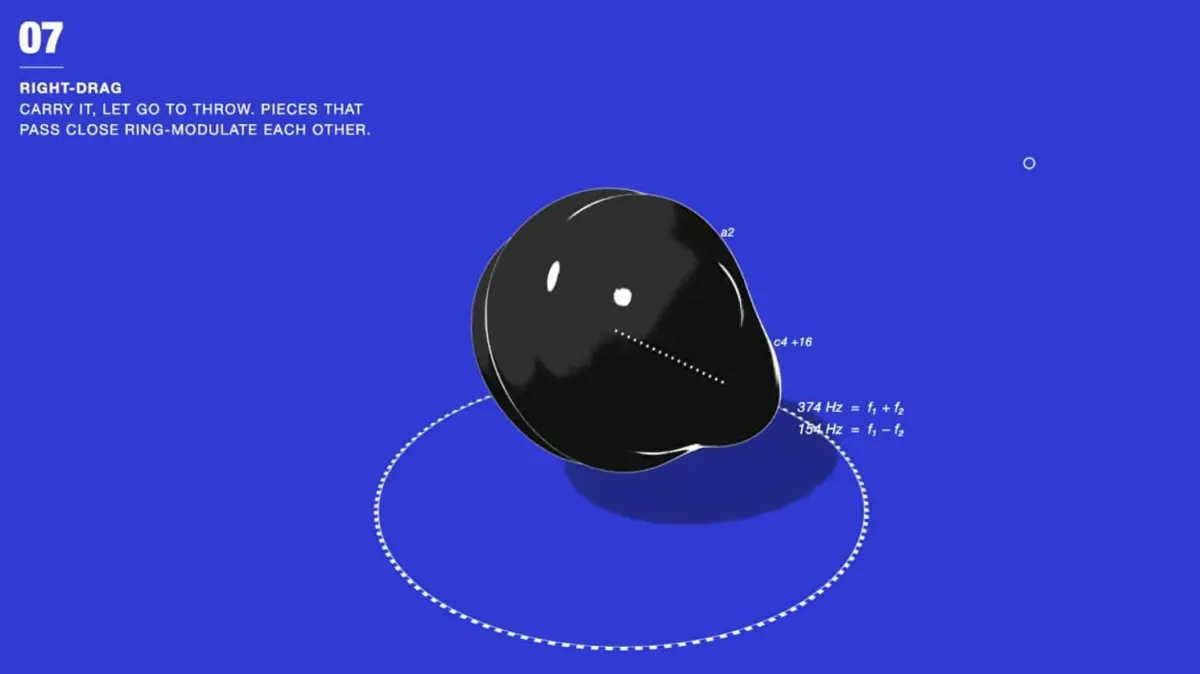
The digital synthesis landscape has witnessed a significant shift with the introduction of BLOT, an experimental software instrument developed by Laboratory 0 that departs from traditional knob-and-slider interfaces in favor of a tactile, geometry-driven approach to sound design. By utilizing modal synthesis as its primary engine, BLOT allows users to generate complex auditory textures by manipulating a virtual "lump" of matter on the screen, where the physical properties of the visual object—its size, shape, and temperature—directly dictate the resulting harmonic output. This release represents a move toward more organic, physical-modeling-based synthesis in the software domain, providing musicians and sound designers with a tool that bridges the gap between digital precision and the unpredictable nature of physical vibration.
The Mechanics of Geometric Sound Generation
At the core of BLOT’s architecture is the concept of modal synthesis, a method of sound generation that simulates the vibration of physical objects. Unlike subtractive synthesis, which filters harmonically rich waveforms, or additive synthesis, which stacks sine waves, modal synthesis decomposes sound into its constituent modes of vibration. In BLOT, every segment of the on-screen "matter" acts as a modal resonator. These resonators consist of eight damped oscillators, which are automatically tuned according to the size and proportions of the geometric piece.
The software utilizes just-intonation ratios based on a MIDI root note to ensure that the resulting tones maintain a harmonic relationship rooted in mathematical purity rather than the compromises of equal temperament. Smaller pieces of matter within the interface naturally produce higher-frequency rings, while larger sections generate deeper, resonant tones. The dispersion of these modes—how bright they appear and how long they sustain—is governed by the specific contours and "heat" of the shape. This heat parameter serves as a dynamic variable, influencing the saturation and drive of the oscillators, effectively simulating the way physical materials respond to energy input.
Interaction and Physical Modeling Techniques
BLOT distinguishes itself through its interactive gestures, which mimic physical interactions with a malleable substance. The software interprets different mouse or touch movements as distinct excitation methods:
- Plucked Waveguides: By pulling a "tendril" from the main body of matter, the user creates a waveguide string. The pitch of this string is determined by its physical length on the screen, simulating the behavior of a plucked instrument where tension and length dictate frequency.
- Formant Filtering: Pressing a "dent" into the matter transforms that specific area into a formant filter. Much like a human mouth or a resonant chamber, the position and depth of the dent determine the vowel-like qualities of the sound, allowing for vocaloid textures and organic filtering.
- Fragmentation and Fusion: Cutting a piece of matter causes its modes to split into two distinct pitches, creating complex polyphonic interactions. Conversely, when two pieces are brought into proximity, they exhibit ring modulation, and upon physical contact, they fuse back into a single entity, merging their harmonic profiles.
- Friction and Excitation: The matter can be excited through various means, including a "slow breathing" noise floor, percussive strikes, or friction generated by sweeping over the surface. When the matter reaches a high thermal state, it produces "droplets"—short, high-pitched tones that rise in frequency as they burst, mimicking the sound of boiling liquid or crackling energy.
Advanced Signal Processing and Thermal Dynamics
Beyond the initial sound generation, BLOT incorporates a sophisticated signal chain designed to handle the high dynamic range of modal resonances. The software features a four-times oversampled multiband saturator. As the user "rubs" the matter, increasing its internal heat, the drive saturates the signal. At extreme levels, a feedback comb filter tuned to the MIDI root note takes over, preventing harsh digital clipping while adding a thick, resonant character to the output.
The instrument also features "Memory," an eight-line feedback delay network (FDN). This component captures the history of the matter’s vibrations, allowing the sound to evolve and persist even after the initial excitation has ceased. This creates a sense of acoustic space and temporal depth rarely found in standard digital oscillators.
Laboratory 0 has included two distinct engines within the software to cater to different sound design needs. The "Default" engine maintains a clean, crystalline output until the user intentionally overloads or heats the matter. In contrast, the "Intense" engine applies heat and drive to every cut and strike, causing the virtual matter to crackle and distort with minimal input, making it suitable for industrial, aggressive, or highly textured sonic palettes. A "Pause" function further enhances the experimental nature of the tool, freezing the geometry in place while allowing the audio engine to continue processing the current state of vibration.
Historical Context and Technical Lineage
The release of BLOT is situated within a long history of physical modeling and modal synthesis research that dates back to the 1970s and 80s. Pioneers such as Karplus and Strong developed algorithms for plucked string synthesis, while researchers at institutions like IRCAM (Institut de Recherche et Coordination Acoustique/Musique) explored the decomposition of acoustic signals into modal structures.
Modal synthesis became a hallmark of high-end hardware in the 1990s, most notably with the Yamaha VL1 and the Korg Prophecy, which sought to replicate the nuances of wind and string instruments. However, these technologies were often computationally expensive and hidden behind complex menus. BLOT represents the modern democratization of these concepts, utilizing the increased processing power of contemporary computers to provide a visual, real-time interface that removes the mathematical barriers to entry for the average musician.
The use of just-intonation in BLOT also aligns with a growing movement in the electronic music community toward microtonal and non-Western tuning systems. By basing the resonators on the harmonic series rather than the standard 12-tone equal temperament, Laboratory 0 provides a more resonant and naturally "consonant" sound that mirrors the physics of acoustic instruments like bells, gongs, and lithophones.
Implications for the Sound Design Industry
Industry analysts and sound designers have noted that BLOT represents a significant departure from the "virtual analog" trend that has dominated the VST (Virtual Studio Technology) market for decades. While many developers focus on replicating the circuitry of vintage synthesizers, Laboratory 0 is part of a smaller cohort of developers—alongside companies like Madrona Labs and Incredible Tools—that prioritize new methods of interaction.
The "geometry-as-patch" philosophy suggests a future where sound design is less about replicating a signal path and more about sculpting a digital object. This has profound implications for film scoring and game audio, where organic, evolving textures are often preferred over static synth leads. The ability of BLOT to transition from a clean, bell-like tone to a distorted, crackling mass of noise via "friction" and "heat" provides a level of expressive performativity that is difficult to achieve with standard automation curves.
Availability and Accessibility
In an unconventional move for a tool of this technical complexity, Laboratory 0 has made BLOT available as a free download via the Gumroad platform. This decision reflects a broader trend in the experimental music software scene, where developers often prioritize the proliferation of new ideas and community feedback over immediate commercial gain. By lowering the barrier to entry, Laboratory 0 ensures that BLOT can be adopted by a wide range of creators, from professional foley artists to hobbyist electronic musicians.
The software is currently available for download, though users are encouraged to support the developer to ensure continued updates and the potential for future ports to different operating systems or plugin formats. As an experimental tool, BLOT is expected to undergo further iterations as the user base explores the limits of its modal engine.
Conclusion
Laboratory 0’s BLOT stands as a testament to the ongoing innovation within the field of digital signal processing. By turning the act of synthesis into a tactile, visual experience, it challenges the traditional workflows of music production. Its combination of modal resonators, waveguide strings, and formant filters—all governed by a unique geometric interface—offers a glimpse into a more physical and intuitive future for electronic music. As musicians continue to seek sounds that feel "alive" and responsive, tools like BLOT provide the necessary bridge between the calculated world of software and the chaotic, resonant world of physical matter.
