

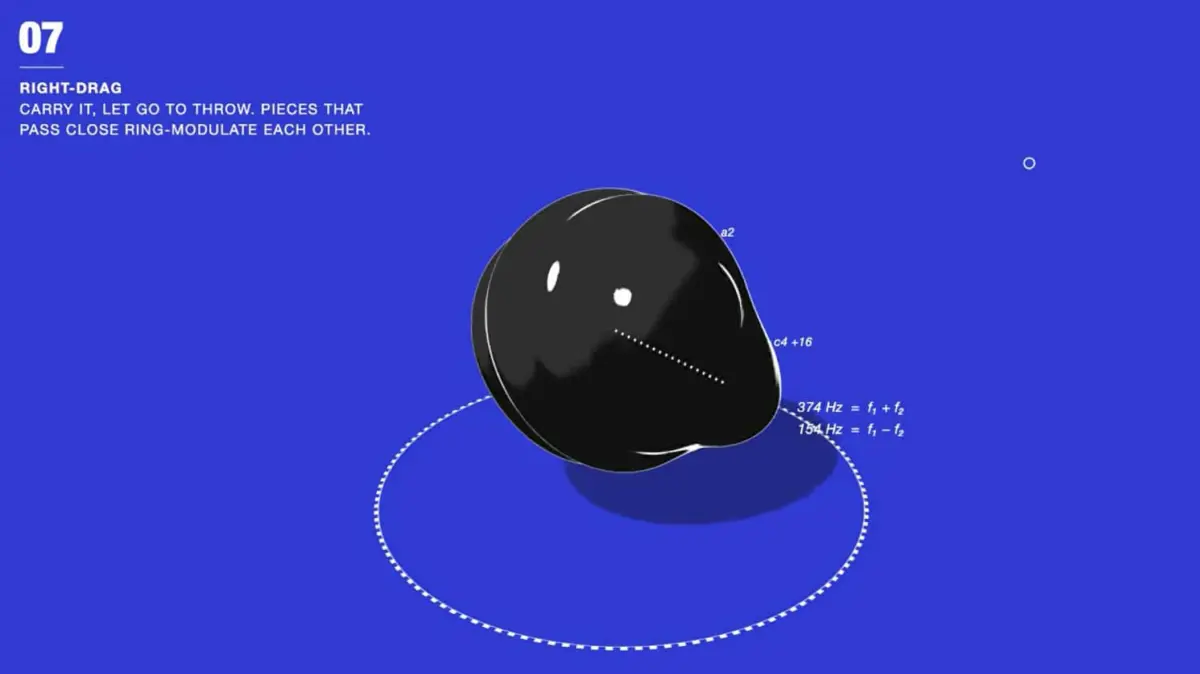
The digital music production landscape has seen a significant shift toward tactile and visual interaction with the release of BLOT, an experimental software synthesizer from Laboratory 0. Moving away from the traditional paradigm of oscillators, filters, and envelope generators controlled by knobs and sliders, BLOT introduces a synthesis environment where sound is sculpted through the manipulation of virtual matter. This modal synthesizer leverages physical modeling techniques to allow users to shape sound by interacting with a geometric "lump" on screen, where the physical properties and dimensions of the visual object dictate the resulting harmonic content and timbre.
The Architecture of Modal Synthesis in BLOT
At the core of BLOT lies modal synthesis, a branch of physical modeling that simulates the vibration of objects. Unlike subtractive synthesis, which removes frequencies from a complex waveform, or additive synthesis, which stacks sine waves, modal synthesis focuses on the resonant modes of a structure. In BLOT, every segment of the on-screen "matter" acts as a modal resonator. These resonators consist of eight damped oscillators, which are automatically tuned based on the size of the visual piece.
The software utilizes just-intonation ratios derived from the MIDI root note to ensure that the resonances remain harmonically coherent. Smaller visual fragments produce higher pitches, while larger sections resonate at lower frequencies. This direct correlation between visual scale and acoustic frequency provides an intuitive interface for sound design, where "building" a sound becomes a literal process of geometric construction. The spread of these modes, their brightness, and their decay times (ring duration) are determined by the specific shape and "heat" of the virtual matter.
Interactive Sound Generation and Manipulation
BLOT distinguishes itself through its excitation methods. In physical modeling, a resonator requires an exciter to produce sound—much like a violin string requires a bow or a drumhead requires a strike. BLOT employs four primary excitation types:
- Breathing Noise: A slow, organic noise source that provides a constant, airy excitation to the matter.
- Strikes: Percussive impulses triggered by MIDI input or user interaction, simulating a mallet or hammer.
- Friction: Sound generated by sweeping over the virtual matter, mimicking the texture of rubbing a physical surface.
- Droplets: When the virtual matter "runs hot," it generates short, high-pitched tones that rise in frequency as they "burst," adding a granular, bubbling quality to the texture.
The user interface allows for complex structural changes that have immediate sonic consequences. Pulling a "tendril" from the main body of matter transforms that section into a plucked waveguide string, with its pitch determined by the length of the extrusion. Creating a "dent" in the matter transforms that area into a formant filter, essentially functioning as a mouth where the position and depth of the indentation set the vowel characteristics of the sound. Furthermore, the software allows for the "cutting" of pieces, which causes the modes to split into distinct pitches, or the fusion of pieces, where separate resonators merge back into a singular harmonic entity.
Advanced Signal Processing and Thermal Dynamics
Beyond the initial synthesis stage, BLOT incorporates a sophisticated signal chain designed to add grit, space, and movement. A central concept in the software is "heat." As the user "rubs" the virtual matter through mouse or touch interaction, the matter heats up, causing the modes to stretch and the drive of each piece to saturate.
To handle the high-intensity harmonics generated during these states, Laboratory 0 has implemented a 4× oversampled multiband saturator. This component is coupled with a feedback comb filter tuned to the MIDI root, which takes over when the signal approaches clipping levels. This ensures that even at extreme settings, the distortion remains musical and harmonically related to the fundamental pitch.
Spatial and temporal depth are managed by the "Memory" module, an eight-line feedback delay network (FDN). This module captures the history of the matter’s vibrations, allowing for lush reverbs and complex rhythmic echoes. Users can choose between two primary engines: the "Default" engine, which maintains a clean signal path until the matter is physically stressed or overloaded, and the "Intense" engine. The latter applies heat and drive to every interaction, including cuts and strikes, and introduces a "crackling" artifact to hot pieces, simulating the sound of cooling metal or fracturing glass. A "Pause" function allows users to freeze the visual state of the matter while the audio continues to resonate, providing a tool for static drone creation and granular-style exploration.
Historical Context and Development Timeline
The release of BLOT marks a continuation of the evolution of physical modeling synthesis, a field that gained prominence in the 1990s with the development of the Karplus-Strong algorithm and the subsequent work of researchers at Stanford University’s Center for Computer Music and Acoustics (CCRMA). While early physical modeling synths like the Yamaha VL1 were restricted by the processing power of their era, modern DSP (Digital Signal Processing) allows for the real-time simulation of complex, multi-modal objects.
Laboratory 0 has developed BLOT during a period of renewed interest in "organic" digital synthesis. This movement, often referred to as "New School" synthesis, seeks to move away from the sterile precision of traditional digital oscillators in favor of unpredictable, non-linear systems. The development of BLOT follows a trajectory seen in hardware modules like Mutable Instruments’ Elements and software like Madrona Labs’ Kaivo, both of which emphasize the relationship between an exciter and a resonant body.
Technical Specifications and Availability
BLOT is currently available as a free download through Laboratory 0’s Gumroad portal. This distribution model aligns with a growing trend among independent developers who offer experimental tools to the community to foster innovation and gather user feedback for future iterations.
Technical Highlights:
- Synthesis Type: Modal Synthesis / Physical Modeling.
- Resonators: 8 damped oscillators per piece.
- Tuning: Just-intonation ratios based on MIDI root.
- Saturation: 4× oversampled multiband saturator with feedback comb filtering.
- Delay System: 8-line feedback delay network.
- Control: Full MIDI support for root note and striking.
- Compatibility: Available for standard digital audio workstation (DAW) environments.
Market Reception and Industry Analysis
Industry analysts and early adopters in the electronic music community have noted that BLOT represents a significant departure from "safe" commercial synthesizer design. By removing traditional labels and focusing on a physics-based metaphor, Laboratory 0 encourages a "discovery-based" workflow.
"The move toward visual-tactile synthesis is a response to the saturation of the VST market with emulations of 1970s analog hardware," says an independent DSP consultant. "Tools like BLOT treat the computer as a unique medium rather than a mirror of the past. By using oversampling and feedback delay networks in a free tool, Laboratory 0 is lowering the barrier to entry for high-end experimental sound design."
The inclusion of just-intonation is also a notable choice, as it diverges from the standard equal temperament used in most Western music. This allows the synthesizer to produce "pure" intervals that resonate more naturally within the modal simulation, resulting in a sound that is often described as "glassy," "metallic," or "crystalline."
Broader Implications for Digital Instrument Design
The implications of BLOT extend beyond its immediate use as a sound design tool. It serves as a case study in "embodied interaction" within software. As touchscreens and gesture-based controllers become more prevalent in music production, the demand for software that responds to "shaping," "rubbing," and "stretching" is expected to grow.
Furthermore, the "Intense" engine’s simulation of heat and structural failure points toward a future where digital instruments possess "organic" limits. Just as a physical guitar string can be pushed to the point of snapping or a wooden resonator can crack under pressure, BLOT’s matter-based system introduces a level of consequence to user interaction that is often missing from digital tools.
In conclusion, Laboratory 0’s BLOT stands as a sophisticated fusion of physics-based mathematics and creative interface design. By offering the tool for free, the developers have provided the global music community with a powerful engine for exploring the boundaries of modal synthesis, physical modeling, and interactive audio. As musicians continue to seek sounds that bridge the gap between the synthetic and the natural, BLOT provides a compelling glimpse into the future of digital instrument architecture.
