

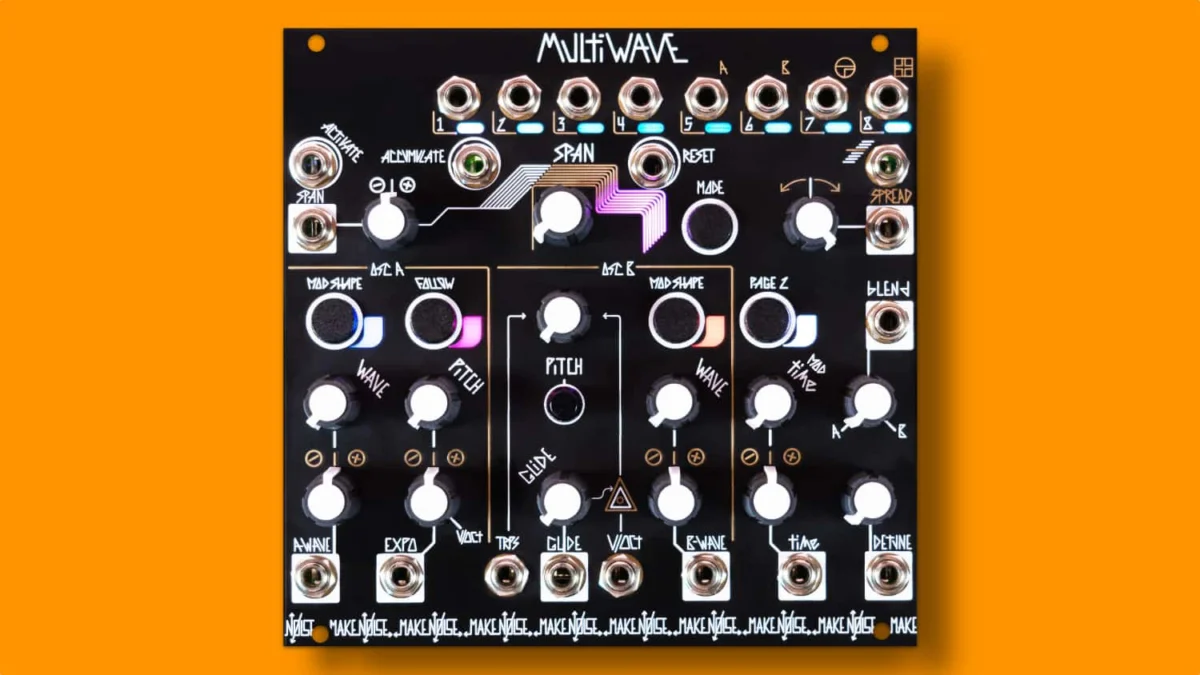
The Asheville-based modular synthesizer manufacturer Make Noise has officially released a suite of firmware updates for its digital New Universal Synthesizer System (N.U.S.S.) product line, introducing critical feature enhancements and stability improvements to the MultiWAVE, PoliMATHS, and MultiMod modules. This release represents a significant step in the evolution of the N.U.S.S. ecosystem, a series of modules designed to bridge the gap between complex digital processing and the tactile, voltage-controlled workflow of traditional Eurorack systems. By addressing specific user feedback and expanding the sonic capabilities of these units, Make Noise continues to solidify its position as a leader in "West Coast" synthesis philosophy, characterized by experimental signal paths and non-traditional sound generation.
The updates, categorized under version numbers 4.3.5 for MultiWAVE, 1.7.3 for PoliMATHS, and 0.7.5 for MultiMod, provide users with expanded modulation shapes, improved utility functions, and refined power-up routines. These enhancements are particularly relevant for professional sound designers and live performers who rely on the precision of digital modules within the often-unpredictable environment of a modular rack.
MultiWAVE Firmware Version 4.3.5: Advanced Modulation and Microtonality
The MultiWAVE module, known for its multifaceted approach to wavetable and digital oscillation, receives one of the most substantial functional upgrades in this cycle. The primary addition is the "Cross Mod" modulation shape, visually indicated to the user by a new lime green color state on the module’s interface. In previous iterations, MultiWAVE relied heavily on internal low-frequency modulation shapes to scan through wave positions. With version 4.3.5, the Cross Mod setting allows the oscillator to receive wave position modulation directly from the secondary oscillator.
This transition to audio-rate scanning transforms the module’s output, allowing for complex sideband generation and timbral shifts that were previously difficult to achieve without external patching. By scanning the wavetable at audio frequencies, the MultiWAVE can produce harmonically rich, FM-like (Frequency Modulation) textures that maintain the core character of the selected wavetable while adding a layer of grit and complexity characteristic of high-end digital synthesis.
Equally significant is the introduction of Scala file support. The MultiWAVE can now load up to eight Scala files (.scl), which are the industry standard for defining custom musical scales and microtonal tunings. This update addresses a growing demand within the modular community for "just intonation" and non-Western tuning systems. By allowing for custom quantization scales, Make Noise has moved the MultiWAVE beyond the constraints of twelve-tone equal temperament, enabling composers to explore historical, ethnic, and experimental tunings with digital precision. This feature is expected to appeal to avant-garde musicians and academic researchers who utilize modular systems for microtonal exploration.
PoliMATHS Firmware Version 1.7.3: Enhanced Signal Routing and Utility
The PoliMATHS module, which serves as a sophisticated function generator and logic center within the N.U.S.S. framework, has been updated to version 1.7.3. The core of this update is the addition of DC offsets to the module’s Strength control. While this might appear to be a minor technical adjustment, its practical implications for signal routing are profound.
In the modular synthesis world, a DC offset provides a constant voltage that can shift a signal’s range. By integrating this into the Strength control, Make Noise has enabled the PoliMATHS to function as a rudimentary mixer when paired with QXG (Quad X-Fade/Gate) modules via the system’s internal chain cables. When the Strength control is turned into its negative region without activating the PoliMATHS’ core functions, the normalled offsets allow the connected QXG channels to "drone."
This allows users to create sustained soundscapes without the need for an external gate or envelope trigger, whether the source is a MultiWAVE oscillator or an external audio signal patched into the inputs. Furthermore, the update allows for "unlocked" tremolo effects when the oscillation controls are increased, and provides a strategic "ducking" mechanism. By activating specific PoliMATHS channels, users can now programmatically reduce the volume of specific QXG outputs, a technique commonly used in electronic music production to create space for kick drums or lead elements within a dense mix.
MultiMod Firmware Version 0.7.5: Technical Refinements and Power Stability
The MultiMod module, a versatile modulation and delay unit, receives its version 0.7.5 update, focusing on timing accuracy and system stability. A key change involves the Channel Index output, which has been recalibrated to handle audio signals more effectively. Historically, the Channel Index output was primarily designed for control voltage (CV) and struggled to interpret high-frequency audio sources.
The new firmware implements an internal envelope follower on this output. This allows the module to derive gates and timing information from delayed signals based on their transients. For performers using the MultiMod as an audio delay, this means the module can now "read" the rhythm of the incoming audio and generate synchronized pulses, making it much easier to integrate the delay’s timing with other rhythmic elements in the rack.
In addition to these functional changes, version 0.7.5 addresses several technical "bugs" reported by the user community. These include fixes for Rate and Time inconsistencies within the Random shape settings and a correction for a display error involving the Square LFO when in bipolar output mode. Crucially, the update alters the module’s start-up routine. Modular systems with high power consumption or "heavy module loads" can sometimes experience power-up failures or "latch-up" issues where digital modules fail to initialize correctly. The revised routine ensures a more robust initialization process, protecting the hardware and ensuring reliability during live performances.
Chronology and Context: The Rise of the N.U.S.S. Ecosystem
The development of these firmware updates follows a long-term strategy by Make Noise to evolve its product line from purely analog designs to a hybrid digital-analog ecosystem. The N.U.S.S. project represents the culmination of years of research into digital signal processing (DSP) hardware that maintains the "organic" feel of analog voltage control.
Make Noise, founded by Tony Rolando in 2008, initially gained fame with modules like the MATHS and the DPO (Digital Programmed Oscillator), which became staples of the Eurorack format. However, as the modular market matured, the limitations of purely analog circuitry in terms of complex logic and wavetable storage became apparent. The N.U.S.S. modules were introduced to provide a "universal" digital platform where the hardware could be reconfigured or enhanced via software, effectively extending the lifespan of the equipment.
The timeline of these specific updates suggests a responsive development cycle. Following the initial launch of the MultiWAVE and its sister modules, users in online forums and professional studios began identifying edge cases—such as the power-up issues on large racks or the desire for microtonal support. Make Noise’s decision to bundle these updates together indicates a concerted effort to standardize the performance across the entire N.U.S.S. line.
Broader Impact on the Modular Synthesizer Market
The release of these updates highlights a significant trend in the music technology industry: the shift toward "software-defined hardware." Unlike traditional analog modules, which are fixed in their functionality from the moment they leave the factory, digital modules like those in the N.U.S.S. line are living platforms.
The addition of Scala support in the MultiWAVE, for instance, is not just a feature update; it is an expansion of the module’s musical identity. By supporting microtonality, Make Noise is acknowledging a niche but influential segment of the synthesizer community that is moving away from Western standard tuning. This move likely puts pressure on other digital module manufacturers to provide similar levels of customization.
Furthermore, the improvements to the PoliMATHS and MultiMod demonstrate a focus on "utility-per-HP" (Horizontal Pitch, the unit of measurement for module width). In a modular rack, space is at a premium. By allowing the PoliMATHS to double as a mixer and the MultiMod to act as a more intelligent transient detector, Make Noise is providing users with more functionality without requiring additional rack space. This efficiency is a key selling point in the modern Eurorack market, where enthusiasts often struggle to fit complex signal chains into portable cases.
Official Responses and Installation
While Make Noise typically maintains a minimalist approach to corporate communications, the release of the accompanying video demonstration serves as the official statement of intent. The company emphasizes that these updates are designed to "unlock" the latent potential already present in the hardware. Technical support teams have advised users to follow the installation instructions carefully, as digital firmware updates in a modular environment require precise voltage levels and audio-interface configurations to ensure successful data transfer.
The firmware updates are available immediately and free of charge. Users can download the necessary files and access detailed installation manuals through the official Make Noise technical site. The process typically involves playing a specialized audio file into the module’s input, a common method for updating Eurorack digital hardware that avoids the need for USB ports on the faceplates, thereby preserving the aesthetic and structural integrity of the modules.
Conclusion and Future Outlook
The version 4.3.5, 1.7.3, and 0.7.5 updates for the New Universal Synthesizer System represent a maturing of the platform. By refining the interaction between modules and expanding the creative boundaries of digital oscillation and modulation, Make Noise has reinforced the value proposition of the N.U.S.S. line. As modular synthesis continues to grow in popularity among both hobbyists and professional film composers, the ability to provide stable, feature-rich, and customizable digital tools will be the defining factor for manufacturers in the coming decade. These updates ensure that the MultiWAVE, PoliMATHS, and MultiMod remain at the forefront of contemporary sound design.
