

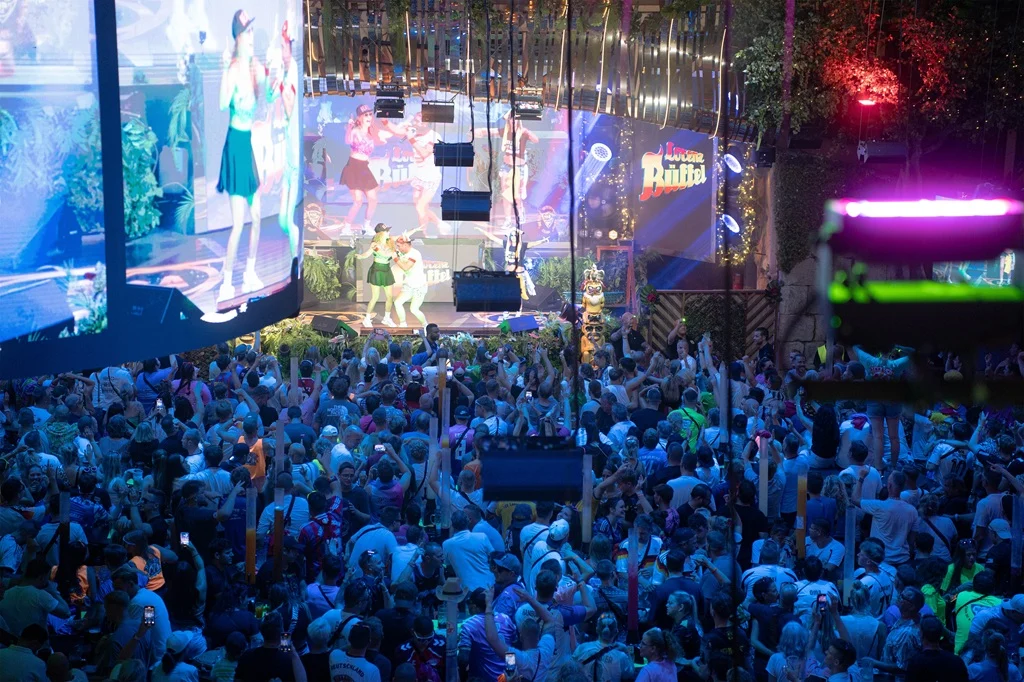
The MegaPark Mallorca, an iconic fixture of the Playa de Palma nightlife circuit, has officially unveiled a comprehensive overhaul of its acoustic infrastructure, transitioning from a traditional high-output central PA system to a sophisticated decentralized installation powered by Meyer Sound. This strategic move marks a significant shift in the venue’s operational philosophy, prioritizing high-fidelity, controlled sonic distribution over raw volume—a direct response to the long-standing challenges of external noise emissions that have historically strained relations between the venue and the surrounding residential and hotel communities. As one of Europe’s largest open-air club complexes, MegaPark’s decision to integrate Meyer Sound’s ULTRA Family, 2100-LFC low-frequency control elements, and Galileo GALAXY processors represents a landmark case study in balancing the demands of high-energy tourism with the stringent environmental regulations of the Balearic Islands.
The Challenge of Acoustic Containment in Playa de Palma
For decades, the MegaPark has served as a central hub for international travelers, hosting a relentless schedule of live performances, DJ sets, and large-scale themed parties. However, the venue’s architectural layout—characterized by its semi-open structure—presented a recurring nightmare for acoustic engineers. Traditional sound reinforcement strategies typically rely on a "Main PA" setup, where large line arrays or point-source clusters are positioned at the front of a stage to project sound across a vast area. In an environment like Playa de Palma, this approach often results in "spill," where sound energy travels far beyond the intended audience, reflecting off nearby buildings and penetrating residential zones.
Local authorities in Mallorca have intensified their focus on noise pollution in recent years, implementing the "Ley de Ruido" (Noise Law) which mandates strict decibel limits at the perimeter of entertainment venues. For MegaPark, the objective was no longer just about being the loudest club on the strip; it was about achieving a "contained intensity." The goal was to provide a punchy, immersive experience for the thousands of guests inside the venue while ensuring that the sound pressure levels (SPL) dropped off sharply at the exit gates.
Technical Strategy: The Decentralized Approach
The cornerstone of the new installation is a decentralized architecture. Instead of pushing sound from a single point across the entire venue, the engineering team distributed dozens of smaller, highly accurate loudspeakers throughout the space. By placing the sound sources closer to the listeners, the system can maintain high perceived loudness and clarity at lower overall output levels. This proximity reduces the need for the high-gain projection that typically causes environmental noise complaints.
Daniel Morales, the lead sound engineer at MegaPark, emphasized that the previous system lacked the surgical control required for such a complex space. The new Meyer Sound ecosystem, anchored by the ULTRA Family, allows for "zonal management." Each section of the club—from the high-energy dance floors to the more refined VIP lounges—is treated as an independent acoustic environment, yet all are synchronized through a unified digital backbone.
System Components and Zonal Breakdown
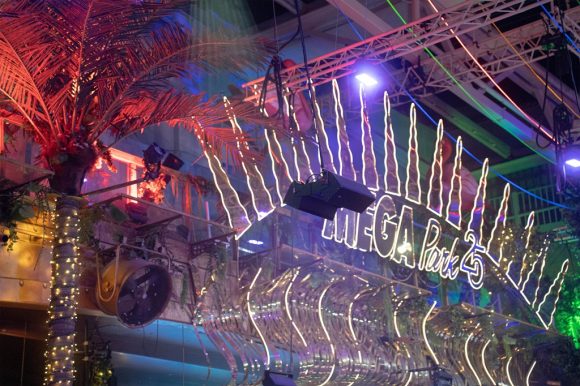
The installation is divided into three primary zones, each tailored to specific acoustic requirements and guest behaviors.
1. The "Mega In" Entrance Area
As the first point of contact for guests, the entrance area requires a balance of welcoming ambiance and high-energy anticipation. To achieve this, the team installed eight ULTRA-X40 loudspeakers and two ULTRA-X23 compact speakers. These are supported by two 2100-LFC low-frequency control elements. The ULTRA-X40, known for its rotatable horn and concentric driver configuration, provides a wide, consistent coverage pattern that ensures no "dead spots" as guests move through the entry corridors. A Galileo GALAXY 408 processor manages the alignment and equalization for this zone, ensuring a seamless transition into the main venue.
2. The Main MegaPark Area
The heart of the complex, where headline DJs and live acts perform, demanded the most robust configuration. Here, the team deployed a staggering 52 ULTRA-X23 loudspeakers. The ULTRA-X23 is a compact version of the ULTRA family, yet it maintains the same sonic signature and high power-to-size ratio. By utilizing such a large number of units, the engineers were able to create a "canopy of sound" over the primary party floor.
This zone is bolstered by two 2100-LFC units, Meyer Sound’s latest advancement in low-frequency technology. The 2100-LFC features a single 21-inch driver and a powerful Class D amplifier, designed to deliver linear, undistorted bass even at extreme levels. The management of this massive array of speakers is handled by four Galileo GALAXY 408 processors, which utilize advanced FPGA-based processing to maintain phase coherence across the entire floor.
3. The VIP Zones
In the VIP areas, the focus shifts from raw energy to premium audio quality. The requirements here are for a sophisticated, high-fidelity experience that allows for conversation while still feeling connected to the main event. The installation includes 16 MM-4XP miniature self-powered loudspeakers and four MM-10XP subwoofers. The MM-4XP is prized for its ability to disappear into the architecture while delivering the "Meyer Sound" studio-quality frequency response. These are powered by three MPS-488X power supplies, which deliver both DC power and balanced audio over a single cable, simplifying the installation in the aesthetically sensitive VIP lounges.
The Role of AVB and Digital Networking
A critical component of the MegaPark overhaul is the use of Audio Video Bridging (AVB) technology. AVB is a set of IEEE standards that allows for the transport of high-quality audio over a standard Ethernet network with extremely low latency and high reliability.

In a decentralized system of this scale, traditional analog cabling would be prohibitively expensive and prone to signal degradation and interference. By using an AVB-based structure, the MegaPark team can route audio to any speaker or group of speakers with the click of a mouse. Daniel Morales noted that AVB was the "enabling factor" for the project. It allows the technical team to monitor the health of every single driver in the building and make real-time adjustments to the delay and EQ of individual zones. This level of granularity is what enables the venue to keep sound focused on the patrons and away from the neighbors.
Chronology of the Transformation
The planning for the new system began in late 2024, following a series of acoustic audits that identified the limitations of the existing setup. Throughout the 2025 off-season, Meyer Sound’s technical teams worked closely with local integrators to map the venue using MAPP 3D, Meyer Sound’s system design and prediction tool.
MAPP 3D allowed the engineers to virtually place loudspeakers within a 3D model of MegaPark and predict exactly how the sound waves would interact with the walls, floors, and—most importantly—the open air above the club. This predictive modeling was essential in determining the exact mounting angles for the 52 ULTRA-X23 units to ensure that energy was directed downward into the crowd rather than upward into the atmosphere.
The physical installation took place over four months, concluding just before the 2026 season opening. The system underwent rigorous testing, including late-night "noise stress tests" monitored by independent acoustic consultants to verify compliance with local decibel ordinances.
Broader Implications for the Global Nightlife Industry
The MegaPark project serves as a significant indicator of where the global nightlife industry is heading. For years, the "arms race" in club sound was defined by who had the biggest subwoofers and the most imposing speaker stacks. However, as urban density increases and local governments become less tolerant of noise pollution, venues are being forced to innovate.
The shift toward decentralized, networked audio systems like the one at MegaPark suggests that the future of clubbing lies in "precision audio." By investing in high-end, controllable technology, venues can actually increase the quality of the experience for their guests while decreasing their environmental footprint. This "sustainability in sound" is likely to become a requirement for venues operating in major tourist hubs like Ibiza, Mykonos, and Las Vegas.
Furthermore, the integration of Meyer Sound’s 2100-LFC demonstrates a move toward more efficient low-frequency management. Low-frequency energy is the hardest to contain, as bass waves can travel through solid structures and over long distances. The 2100-LFC’s ability to provide high-impact bass with a high degree of linearity means that the "thump" felt on the dance floor is less likely to become a "rumble" in a hotel room three blocks away.
Conclusion and Future Outlook
As the 2026 season progresses, the feedback from both guests and the local community has been overwhelmingly positive. Guests report a more "immersive" and "clear" soundstage, where vocals and high-frequency details are crisp regardless of where they stand in the venue. Meanwhile, the reduction in external complaints suggests that the decentralized strategy is working as intended.
The MegaPark Mallorca installation proves that high-energy entertainment and environmental responsibility are not mutually exclusive. Through the application of advanced digital networking, precision-engineered loudspeakers, and meticulous acoustic planning, one of the world’s most famous party spots has successfully reinvented its sound for a new era.
For industry professionals looking to see the technology in action, Meyer Sound will be showcasing its latest solutions, including the components used in the MegaPark project, at the upcoming LEAT Con 26 in Hamburg. From October 6–8, 2026, the company will be located in Hall A1, Stand A17, where technical experts will be available to discuss the evolution of decentralized audio and the future of large-scale venue reinforcement.
