

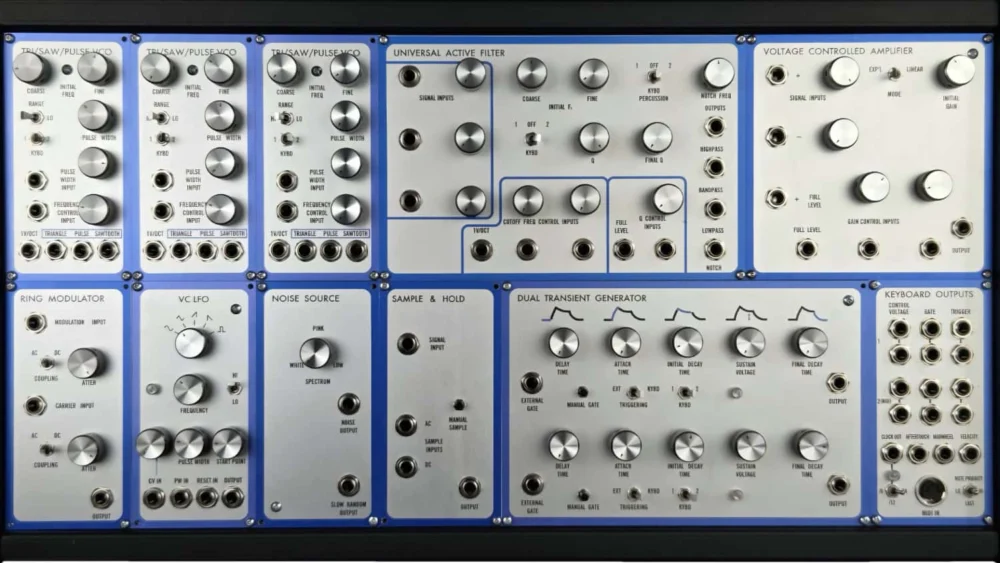
Mos-Lab, a boutique manufacturer renowned for its meticulous dedication to vintage synthesizer recreations, has officially announced the availability of its E-mu Modular replica, a project designed to bring the sonic architecture of one of history’s most exclusive instruments back to the forefront of electronic music production. Described as a faithful interpretation of the legendary E-mu modular system originally conceived in the early 1970s, this new release represents years of research and engineering by Mos-Lab founder Sébastien Moumon. By targeting the exact technical specifications and aesthetic nuances of the original hardware, Mos-Lab aims to provide contemporary musicians and sound designers with access to a system that has, for decades, remained out of reach for all but the most well-funded collectors and institutional archives.
The original E-mu modular system holds a hallowed place in the pantheon of electronic instruments. Introduced in 1973 and produced in limited quantities until 1981, the system was the brainchild of Dave Rossum and Scott Wedge, the founders of E-mu Systems. Unlike the more common Moog or ARP systems of the era, the E-mu Modular was known for its exceptional stability, innovative feature set, and high manufacturing standards. It was an instrument that prioritized precision, a trait that allowed it to become a staple in high-end university studios and the private collections of electronic pioneers. With the debut of the Mos-Lab replica, the industry sees a revival of this "scientist’s synthesizer," offered in preconfigured systems and individual modules.
A Legacy of Innovation: The Historical Context of E-mu Systems
To understand the significance of the Mos-Lab replica, one must look at the trajectory of E-mu Systems during the 1970s. When Dave Rossum and Scott Wedge started the company in Santa Clara, California, their goal was to improve upon the existing limitations of modular synthesis. At the time, voltage-controlled oscillators (VCOs) were notoriously prone to pitch drift caused by temperature fluctuations. E-mu solved many of these issues with superior circuit designs, eventually leading to the development of the SSM (Solid State Microtechnology) chips that would power the polyphonic revolution in the late 70s, including the Sequential Circuits Prophet-5.
The E-mu Modular was never a mass-market product. Estimates suggest that only around 100 systems were ever built, making it significantly rarer than the Moog Modular or the Buchla 200 series. Its disappearance from the market in 1981 coincided with E-mu’s pivot toward digital sampling technology and the launch of the Emulator, which fundamentally changed the company’s direction. Because so few original units exist, the Mos-Lab recreation serves as a vital piece of industrial preservation, allowing the specific "E-mu sound"—often described as cleaner and more versatile than its contemporaries—to be explored by a new generation.
Technical Specifications and System Configurations
Mos-Lab has structured its offering to cater to different levels of modular integration, providing two primary preconfigured systems alongside the option for custom builds. The company has emphasized that every detail, from the physical layout of the panels to the internal component selection, has been executed to respect the spirit and technical rigor of the original 1973 designs.
The Main System
The flagship offering is the Main System, priced at €6,340. This configuration is designed to be a comprehensive synthesis workstation, capable of complex patch programming and high-fidelity sound generation. It typically includes the full range of essential E-mu modules, such as the 2100 series oscillators, which were famous for their wide tracking range and stability. The Main System is housed in a robust cabinet that mirrors the industrial aesthetic of the 1970s, featuring the iconic blue-and-grey color scheme and high-quality knobs that defined the E-mu user experience.

The Top System
For those seeking a more compact entry point or an expansion to an existing setup, Mos-Lab offers the Top System for €3,620. This configuration focuses on the core elements of the E-mu signal path, providing the essential filtering and modulation capabilities that made the original system famous. Despite its smaller footprint, the Top System maintains the same internal voltage standards and signal integrity as the larger counterpart.
Individual Modules and Customization
Recognizing the diverse needs of the modern modular community, Mos-Lab has also made individual modules available for purchase, with prices starting at €130. This allows users of other 5U (large format) modular systems to integrate E-mu’s unique filter topologies and oscillator designs into their existing workflows. Mos-Lab has also indicated that they are open to custom system configurations, allowing buyers to tailor the module count and type to their specific sonic requirements.
Engineering Excellence and Sonic Character
The primary challenge in recreating a system as complex as the E-mu Modular lies in the sourcing of components. Many of the original transistors and integrated circuits used by Dave Rossum in the 1970s are long out of production. Mos-Lab’s commitment to a "faithful interpretation" implies a deep dive into modern equivalents that match the electrical characteristics of the vintage parts.
Sonically, the E-mu system is distinguished by its filters. The original E-mu 2100 series VCF (Voltage Controlled Filter) was known for a resonance that didn’t thin out the low end as much as the classic Moog ladder filter. This resulted in a "weighty" yet precise sound that became a hallmark of the E-mu brand. By replicating these circuits with modern precision, Mos-Lab ensures that the replica doesn’t just look like a museum piece but performs with the reliability expected of a 21st-century studio tool.
Market Reception and Industry Impact
The announcement has generated significant buzz within the synthesizer community, particularly among aficionados of large-format modular gear. While the Eurorack format has dominated the market for the last decade due to its portability and lower price points, there has been a resurgence of interest in 5U systems. These larger systems offer a more tactile, ergonomic experience, with larger knobs and 1/4-inch jacks that many professional engineers prefer for studio use.
Industry analysts suggest that Mos-Lab’s move into the E-mu ecosystem fills a specific void in the market. While Moog and Buchla have seen various official and third-party recreations, the E-mu Modular has remained largely untouched by the "clone" market due to its complexity and the rarity of the original schematics. Mos-Lab’s reputation for quality—built on their previous recreations of Moog and Kobol systems—provides the necessary credibility to handle such a prestigious legacy.
Official Statements and Production Philosophy
In a statement accompanying the launch, Mos-Lab expressed the emotional and technical weight of the project. "Every detail has been carefully considered to respect the spirit, sonic character, and technical rigor of the original E-mu Systems designs," the company noted. "We are delighted to finally share this completed project."

This philosophy of "technical rigor" is what separates Mos-Lab from mass-market manufacturers. Each system is often hand-assembled or produced in small batches, ensuring a level of quality control that mirrors the artisanal approach of E-mu Systems’ early years. For Sébastien Moumon, this is clearly more than a commercial venture; it is an act of historical restoration.
Chronology of the E-mu Modular Era
The timeline of the E-mu Modular is a story of rapid innovation followed by a sudden shift in technology:
- 1971-1972: Dave Rossum and Scott Wedge begin developing synthesizer circuits while students.
- 1973: E-mu Systems is officially incorporated, and the E-mu Modular system is introduced. It debuts features like the first polyphonic keyboard for a modular system.
- 1974-1979: The system gains a reputation as the "Rolls Royce" of synthesizers. E-mu licenses its sub-module designs to other companies, including Solid State Microtechnology (SSM).
- 1980: The rise of digital technology begins to overshadow analog modular systems.
- 1981: Production of the E-mu Modular officially ceases as the company shifts focus to the Emulator sampler.
- 2020-2024: Mos-Lab undergoes intensive research and development to prototype the E-mu replica.
- 2025: Mos-Lab officially opens orders for the completed E-mu Modular replica systems.
Broader Implications for Electronic Music
The availability of an E-mu Modular replica has implications that extend beyond the niche world of modular collectors. It represents a broader trend in the music industry where the "analog vs. digital" debate has been replaced by a hybrid reality. Producers today often use software for sequencing and recording but rely on high-end analog hardware for the primary sound source to achieve a level of harmonic complexity that digital oscillators sometimes struggle to replicate.
Furthermore, the E-mu system’s return highlights the enduring legacy of Dave Rossum’s engineering. Even as modern synthesis continues to evolve into granular, wavetable, and AI-driven territory, the fundamental building blocks of voltage control established in the 1970s remain the gold standard for sound quality. By making these circuits available again, Mos-Lab ensures that the specific innovations of E-mu Systems—such as their ultra-stable oscillators and unique filtering paths—will continue to influence the textures of modern film scores, ambient music, and experimental electronic genres.
As of the current release, the Mos-Lab E-mu Modular is available for order directly through the manufacturer’s website. Given the boutique nature of the production, lead times are expected to vary based on demand, but the availability of both preconfigured systems and individual modules suggests a flexible rollout intended to accommodate both serious collectors and those looking to add a touch of E-mu magic to their existing setups. For the first time in over forty years, the blue-paneled giant of the West Coast synthesis scene has returned to the studio.
