

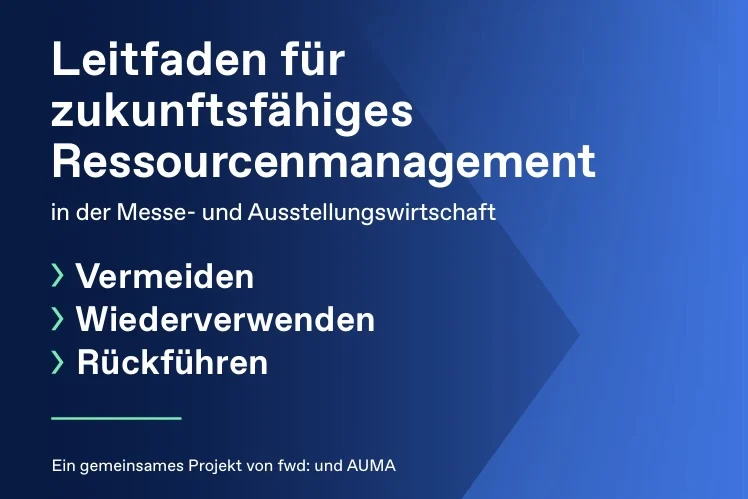
The global exhibition and trade fair industry is entering a transformative era as sustainability shifts from a peripheral corporate social responsibility goal to a central operational mandate. In response to escalating regulatory requirements and a collective industry push toward carbon neutrality, the Association of the German Trade Fair Industry (AUMA) and the Federal Association of the Event Industry (fwd:) have officially released a groundbreaking joint publication. Titled "Sustainable Resource Management in the Trade Fair and Exhibition Industry: Avoid – Reuse – Recycle," the guide serves as a strategic blueprint for organizers, exhibitors, and service providers to navigate the complexities of material efficiency and circularity. This collaboration marks a significant milestone in the German event sector’s efforts to align with the European Green Deal and the evolving Ecodesign for Sustainable Products Regulation (ESPR).
As the world’s leading destination for international trade fairs, Germany hosts approximately two-thirds of the world’s flagship events in various sectors. The scale of these operations involves massive logistical undertakings, including the construction of temporary structures, the transport of goods, and the management of large-scale visitor flows. Historically, the "linear" model of exhibition construction—where materials are purchased, used for a few days, and then discarded—has been a primary environmental concern. The new guidelines aim to dismantle this model by providing actionable frameworks that prioritize resource conservation at every stage of the event lifecycle, from initial conceptual design to post-event material recovery.
The Regulatory Landscape and the Drive for Transparency
The release of these guidelines is timely, coinciding with a tightening of European environmental legislation. While temporary exhibition structures are not currently classified as a standalone product category under the European Ecodesign Regulation, the materials used to build them—such as timber, aluminum, steel, textiles, and plastics—are increasingly subject to stringent transparency and recyclability requirements. The AUMA and fwd: publication translates these high-level legal directives into practical industry standards. By doing so, it ensures that German companies remain competitive in a global market where "green" credentials are becoming a prerequisite for participation.
The European Union’s focus on the "Digital Product Passport" and material traceability means that every component of a trade fair stand may eventually need to be accounted for in terms of its carbon footprint and end-of-life potential. The new guide prepares the industry for this reality by advocating for "Material Transparency." This involves documented proof of where materials originate and how they can be reintroduced into the production cycle after the event concludes. This shift is not merely about waste management; it is about rethinking the value of materials as assets that should be preserved rather than expenses to be disposed of.
A Three-Pillar Strategy: Avoid, Reuse, and Recycle
At the core of the new guidelines is a hierarchical approach to resource management, often referred to as the waste hierarchy but tailored specifically for the unique demands of the exhibition floor.
-
Avoid: The most effective way to reduce environmental impact is to eliminate the need for new resources entirely. The guide encourages designers and exhibitors to question the necessity of every element. This includes moving toward digital signage to reduce printed PVC banners, utilizing modular stand systems that require fewer bespoke parts, and optimizing logistics to reduce the physical volume of materials transported.
-
Reuse: The exhibition industry has long utilized rental furniture and modular wall systems, but the new guidelines push for a much deeper integration of reuse. This involves the "design for disassembly" principle, where exhibition stands are engineered to be easily taken apart and reassembled at multiple events without loss of structural integrity or aesthetic quality. The guide highlights the economic benefits of this approach, noting that while the initial investment in high-quality, reusable components may be higher, the long-term savings in material and disposal costs are substantial.
-
Recycle: For materials that cannot be reused, the focus shifts to high-quality recycling. The guidelines provide technical advice on selecting materials that are genuinely circular. For example, instead of using composite materials that are difficult to separate, the industry is encouraged to use mono-materials. The goal is to ensure that when a carpet is pulled up or a wooden panel is retired, it can be returned to a specialized facility to be processed into new raw materials, thereby closing the loop.
Practical Tools for Implementation and Global Reach
One of the most notable aspects of the AUMA and fwd: collaboration is its focus on practical application. Recognizing that the trade fair industry relies on a vast network of international exhibitors and small-to-medium-sized enterprises (SMEs), the organizations have included a suite of tools designed to lower the barrier to entry for sustainable practices.
The publication includes comprehensive checklists that allow project managers to audit their resource use in real-time. Perhaps most significantly, it offers a "One-Pager" summary translated into 14 international languages. This reflects the global nature of German trade fairs, ensuring that international exhibitors from Asia, the Americas, and elsewhere can understand and comply with the local sustainability standards. Additionally, the guide provides standardized templates for tenders and procurement contracts. These templates include specific "green clauses" that companies can use when hiring stand builders or caterers, ensuring that sustainability requirements are legally binding and clearly defined from the start of a project.
Industry Leadership and Expert Perspectives
The development of the guide was a collaborative effort involving experts from across the event spectrum. Marko Roscher, Sustainability Officer at fwd:, emphasized that the industry’s future depends on its ability to integrate these practices into the planning phase. According to Roscher, "Circular economy does not begin at the end of the dismantling process; it begins in the planning and conception phase." This perspective shifts the responsibility from the waste management crews to the architects and marketing directors who envision the exhibition presence in the first place.
Barbara-Maria Lüder, Manager of Law, Taxes, Technology, and Sustainability at AUMA, echoed these sentiments, highlighting the dual nature of trade fairs as both economic engines and platforms for innovation. "Trade fairs are platforms for innovation and economic development. Therefore, it is crucial that their implementation is also designed to be future-proof," Lüder stated. She noted that the guide proves that high-quality, impactful brand presentations do not have to be sacrificed in the name of sustainability. On the contrary, a commitment to resource efficiency often leads to more creative and technologically advanced booth designs.
Economic Context and the Path to 2030
The economic stakes for the German trade fair industry are immense. In a typical year, trade fairs in Germany attract over 10 million visitors and hundreds of thousands of exhibiting companies. The sector contributes billions of euros to the national GDP and supports tens of thousands of jobs in hospitality, transport, and construction. However, the industry is also under pressure from corporate clients who are now required to report on their Scope 3 emissions—indirect emissions that occur in their value chain, including their participation in trade fairs.

By providing a standardized way to measure and reduce resource use, AUMA and fwd: are helping exhibitors meet their own corporate sustainability targets. If an exhibitor can prove that their stand was built using 90% reusable materials and that all waste was diverted from landfills, they can report these successes in their annual ESG (Environmental, Social, and Governance) disclosures. This makes participating in German trade fairs more attractive to global corporations that are under intense scrutiny from investors and regulators.
The industry has set ambitious targets for the coming decade. Many major German exhibition grounds, such as those in Berlin, Frankfurt, Munich, and Cologne, have pledged to become carbon-neutral by 2040 or earlier. Achieving these goals requires a complete overhaul of how waste is handled on-site. The new guidelines are a critical step toward the industry’s "Net Zero Carbon Events" initiative, a global movement aimed at aligning the events industry with the targets of the Paris Agreement.
Broader Implications and Future Outlook
The impact of this guide is expected to ripple far beyond the borders of Germany. As international organizers observe the success of these standardized resource management practices, it is likely that similar frameworks will be adopted across the European Union and eventually in major exhibition hubs like Dubai, Las Vegas, and Shanghai. The emphasis on multi-lingual communication and practical templates sets a new benchmark for how industry associations can lead the charge in environmental transformation.
Looking ahead, the next challenge for the industry will be the integration of "Circular Design" into the education of event professionals and exhibition architects. The AUMA and fwd: guide provides the technical foundation, but the cultural shift toward a circular mindset will require ongoing training and a willingness to experiment with new materials, such as bio-based composites and 3D-printed structures made from recycled ocean plastic.
In conclusion, the partnership between AUMA and fwd: represents a proactive and pragmatic response to the greatest challenge of the 21st century. By providing the trade fair industry with a clear, documented path toward resource efficiency, they are ensuring that the "live" event experience remains relevant, responsible, and resilient in an increasingly eco-conscious world. The guide is now available for download on the official websites of both organizations, offering a vital resource for any professional committed to the sustainable future of the exhibition economy.
