

The landscape of live event technology reached a new milestone at the LEaT con exhibition in Hamburg, where a collaborative effort between industry leaders resulted in a record-breaking video processing demonstration featuring a staggering 530 million pixels. Orchestrated by Analog Way and its partners, the "530 Megapixel Link Experience" served as a rigorous proof of concept, pushing the limits of current FPGA-based image processing and multi-screen management. While high-resolution displays are becoming commonplace in the pro-AV sector, the sheer scale of this installation—boasting a canvas size that effectively doubles the internal resolution of the renowned Las Vegas Sphere—represents a significant leap forward in signal distribution and real-time rendering.
The project was born from an ambitious technical question posed by Lukas Falgenhauer and Thilo Neiss of Analog Way: could the theoretical limits of the LivePremier series be realized in a live, high-pressure environment? By linking four Aquilon C-Max units, the team aimed to demonstrate that massive pixel densities could be managed with the same stability and low latency required for mission-critical broadcasts and large-scale corporate events. The result was a seamless 530,841,600-pixel canvas, managed by a single unified control interface, providing a glimpse into the future of ultra-high-definition visual experiences.
Technical Architecture: The Power of the Linked Aquilon Cluster
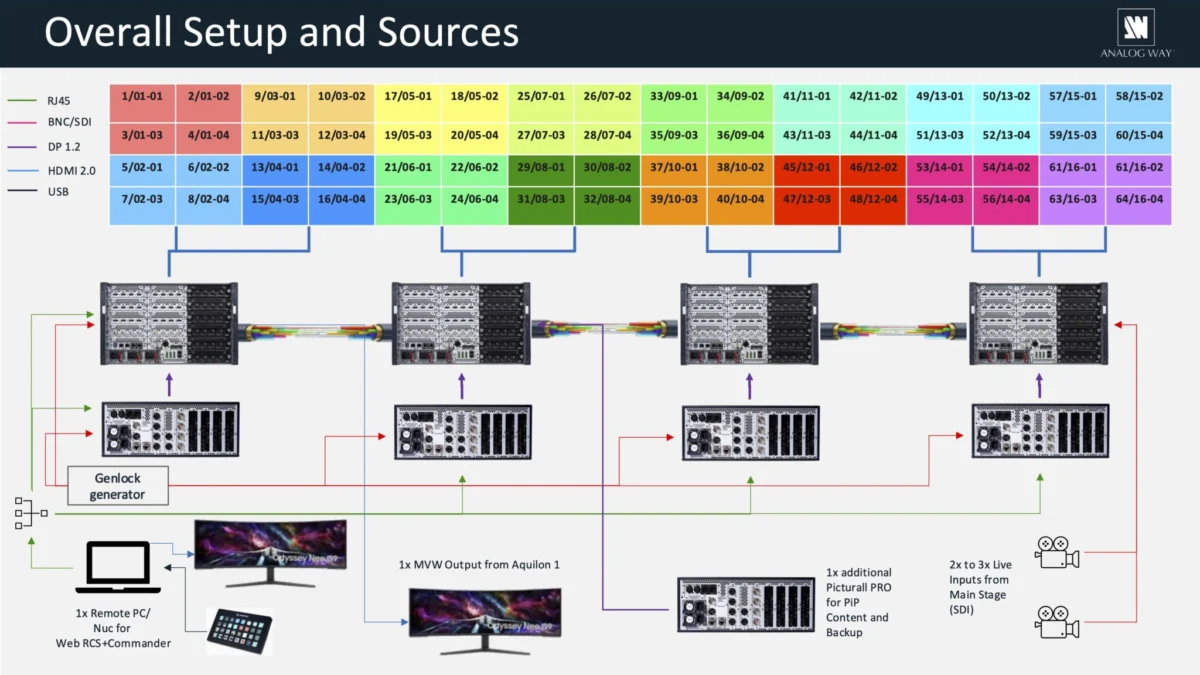
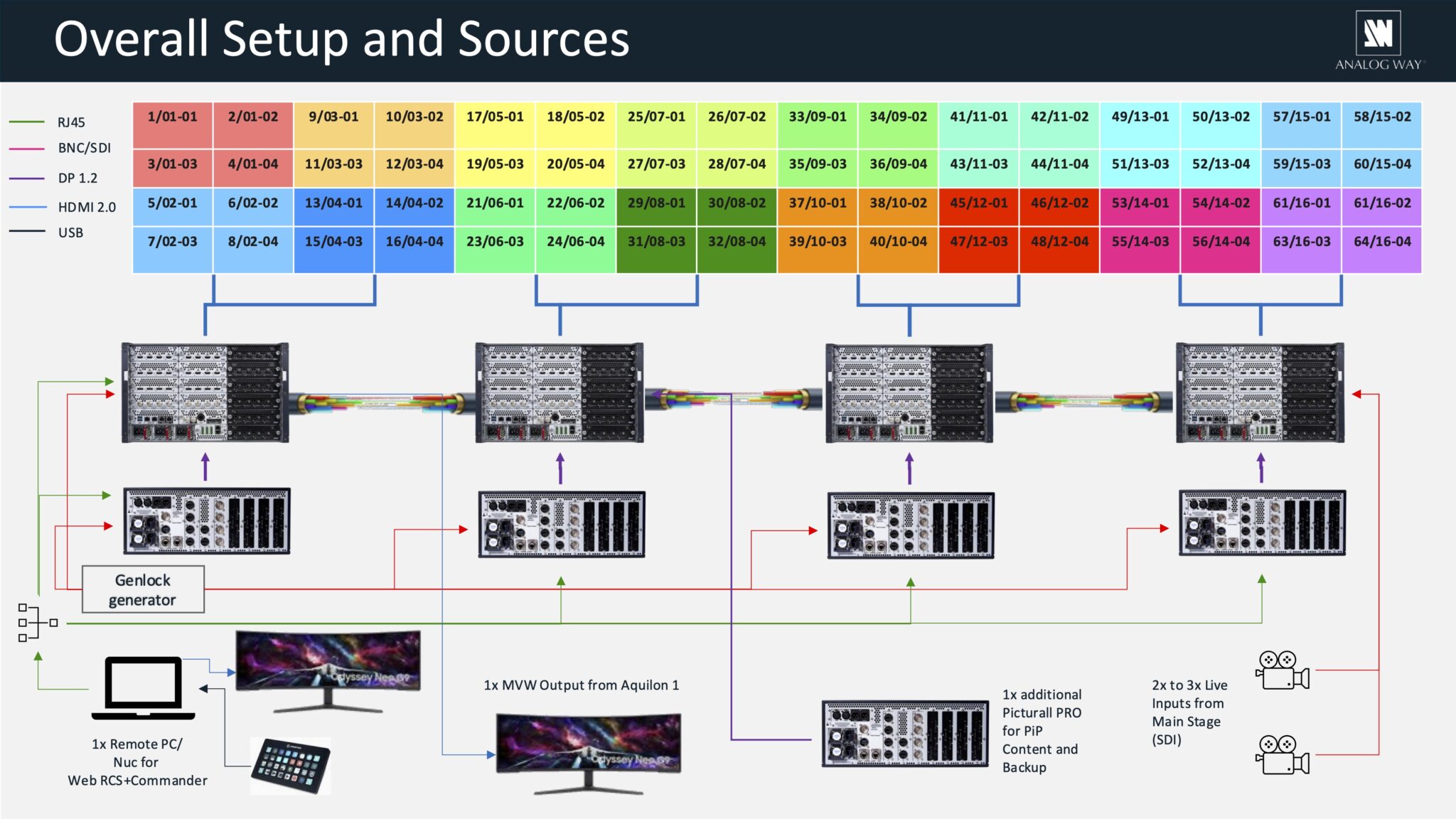
At the heart of the installation were four Analog Way Aquilon C-Max processors, the flagship units of the LivePremier ecosystem. To manage a canvas of this magnitude, the units were interconnected using a sophisticated fiber-optic ring topology. This link was achieved via 24 individual 40GbE QSFP+ modules, creating a high-bandwidth backbone that allowed the four separate chassis to behave as a single, massive processing entity.
From an operational standpoint, this clustering transformed the hardware into a unified system featuring 132 inputs and 80 outputs. Despite the complexity of the underlying hardware, the entire system was controlled via a single IP address through the WebRCS (Remote Control Software) interface. This allowed operators to manage sources, layers, and presets across the entire 530-megapixel surface as if they were working on a standard 4K screen.
The internal processing power of the Aquilon C-Max is built on FPGA (Field Programmable Gate Array) architecture, which is critical for maintaining the ultra-low latency of a single frame. In the 530MP setup, each of the four units utilized four Video Processing Units (VPUs), each capable of managing up to 160 megapixels. Additionally, two Image Processing Units per chassis provided 24 4K still image slots, ensuring that even static backgrounds maintained the highest possible visual fidelity without taxing the primary video processors.
Scaling Beyond the Sphere: A Comparative Analysis of Resolution
To put the 530-megapixel achievement into perspective, one must look at the current gold standard of immersive displays: the Las Vegas Sphere. The interior LED screen of the Sphere is widely reported to feature a 16K x 16K resolution, which totals approximately 256 million pixels. The LEaT con installation effectively doubled this pixel count, providing a canvas of 530.8 million pixels.
While the Sphere is a permanent architectural installation designed for immersive cinema and live performances, the Analog Way demonstration was a temporary setup designed to prove that such resolutions could be deployed flexibly using off-the-shelf professional rental equipment. This has profound implications for the touring industry and temporary high-end installations, where the ability to scale processing power to match extreme resolutions is becoming a competitive necessity.
The signal chain for the LEaT con setup was designed to handle 10-bit 4:4:4 color depth and High Dynamic Range (HDR) content at 60Hz. This ensures that the visual quality is not compromised even as the scale increases, a common pitfall in systems that rely on heavy compression or lower bit-depths to manage high bandwidth.
Hardware Logistics and the Role of Strategic Partnerships
Executing an installation of this scale required significant logistical coordination, particularly regarding the display surface. Initially, the team planned to use 16 8K-resolution displays to create the canvas. However, due to the project occurring during the peak event season, sourcing 16 identical 8K units proved difficult.
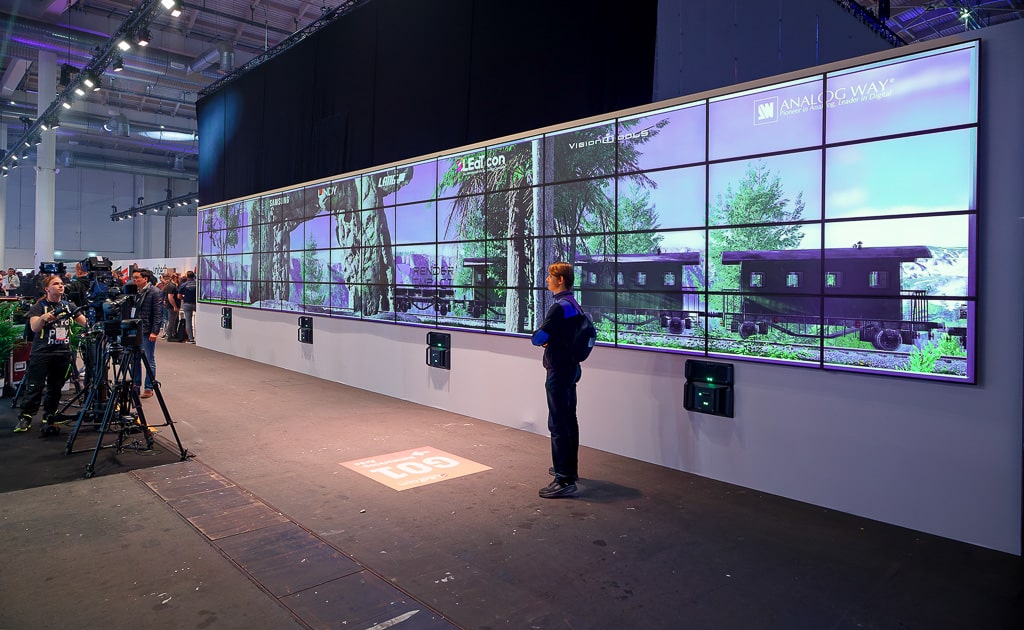
In a strategic pivot, the team collaborated with Samsung to utilize 64 UHD (4K) 43-inch displays instead. This change actually increased the complexity of the signal distribution, requiring 64 individual outputs from the Aquilon cluster. The displays were arranged in a 16 x 4 grid, creating a massive, continuous wall of pixels. Samsung’s ability to provide high-consistency displays on short notice was a critical factor in the project’s success, ensuring that color and brightness remained uniform across the entire 64-screen array.
Content delivery was handled by Analog Way’s Picturall PRO MKII media servers. Four servers were dedicated to providing the high-resolution background content, while a fifth server managed Picture-in-Picture (PiP) layers and a live SPX ticker. The background content was delivered as 15360 x 8640 (16K) video files per server, which were then synchronized via Genlock. Interestingly, the fiber link between the Aquilon chassis proved robust enough to maintain synchronization between the processors themselves without requiring external Genlock, though it was utilized for the servers to ensure frame-perfect playback.
Creative Integration: The Steam Engine and Live 10K Scaling
A high-resolution canvas is only as impressive as the content it displays. To demonstrate the system’s ability to handle moving objects across a massive pixel space, the creative agency RenderImpact by SPI produced a custom animation of a steam locomotive. The locomotive traveled across the entire 64-display grid, serving as a "stress test" for synchronization. Any lag or tearing in the signal processing would have been immediately visible as the train crossed the boundaries between different processors and screens.
Furthermore, the demonstration showcased the system’s real-time scaling capabilities. Live Full-HD camera feeds from the LEaT con Mainstage were brought into the system and displayed as PiP layers. These feeds were dynamically upscaled to 10K resolution in real-time as they "flew" across the 530MP canvas. The FPGA-based scaling algorithms ensured that even when enlarged to such an extreme degree, the images remained sharp and free of artifacts, maintaining the professional standard required for live broadcast environments.
Layer Management and Internal Resource Allocation
One of the primary challenges of managing 530 megapixels is the allocation of processing resources for layers. In the LivePremier architecture, a layer that can move anywhere on the canvas must have resources reserved across all participating processors. To optimize this, Analog Way utilizes a "Region" based management system.
By dividing the massive canvas into smaller virtual regions, operators can dramatically increase the number of available layers. For instance, if the canvas is not divided, the system provides a limited number of "global" layers (four mix layers or eight split layers) that can scale across the entire 530MP surface. However, by defining regions—typically aligned with 8K bandwidth boundaries—the system can support up to 128 split layers or 64 mix layers.
This flexibility is crucial for complex shows where different parts of a screen might require different levels of interactivity. The system’s "Virtual VPU" linking allows a layer to transition seamlessly from one region to another. As a layer crosses a boundary, the processing is handed off from one VPU to the next without any visual interruption or tearing, a testament to the precision of the internal timing and data distribution.
Industry Implications and the Path Forward
The "530 Megapixel Link Experience" at LEaT con 24 was more than a mere technical exercise; it was a demonstration of the scalability required for the next generation of visual communication. As corporate clients and entertainment venues move toward "canvas-based" thinking—where the display is no longer a fixed aspect ratio but a custom-shaped digital environment—the ability to link multiple processors into a single, cohesive system becomes paramount.
Industry analysts suggest that the demand for such high-resolution processing will continue to grow in sectors such as:
- Virtual Production: Where LED volumes require massive pixel densities to maintain "in-camera" realism.
- Experience Centers: Where immersive, high-resolution environments are used for brand storytelling.
- Large-Scale Broadcast: Where multi-screen studio backdrops require the integration of live feeds and high-resolution graphics.
The success of this project also highlights the importance of the relationship between manufacturers and end-users. By inviting operators and technicians to interact with the 530MP setup, Analog Way gathered valuable feedback on UI/UX requirements for massive systems. Discussions on the show floor often centered on how control consoles must evolve to manage hundreds of layers and how to simplify the workflow for such complex signal chains.
Ultimately, the LEaT con demonstration proved that the barriers to managing half a billion pixels have been dismantled. Through the combination of high-speed fiber interconnects, powerful FPGA processing, and strategic hardware partnerships, the "Link Experience" established a new benchmark for what is possible in the realm of live video technology. As the industry moves toward 16K and beyond, the lessons learned in Hamburg will serve as a roadmap for the future of large-scale visual displays.
