

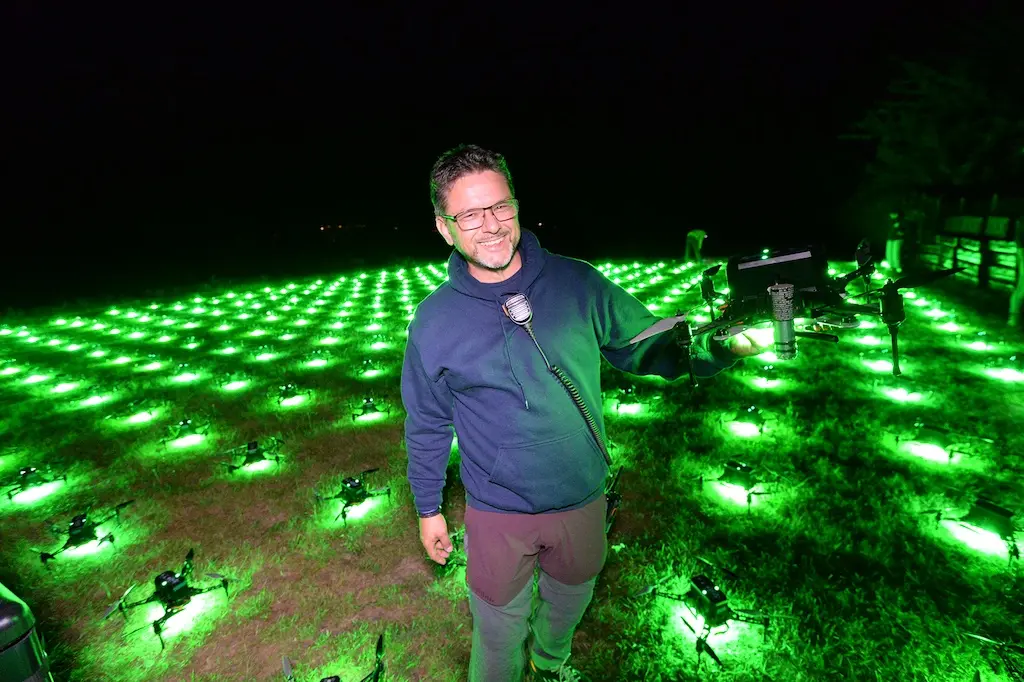
The landscape of modern entertainment and event technology is witnessing a significant shift as traditional pyrotechnics and static light displays give way to the dynamic possibilities of unmanned aerial vehicles. Peter Smiatek, a prominent figure in the global drone display industry, has officially announced the founding of SMIA Technology GmbH & Co. KG. Based in Rietberg, North Rhine-Westphalia, the new studio is dedicated to the creation of high-end drone shows and complex spatial aerial staging. This move represents a strategic consolidation of Smiatek’s extensive international experience, aiming to transform how brands, festivals, and municipalities utilize the sky as a canvas for storytelling.
The establishment of SMIA Technology comes at a time when the demand for sustainable and technologically advanced entertainment solutions is at an all-time high. By focusing on the intersection of precision engineering and artistic choreography, Smiatek intends to move the industry beyond the "pixel-art" phase—where drones simply form two-dimensional logos or shapes—toward a more fluid, three-dimensional cinematic experience.
A Foundation Built on International Expertise
Peter Smiatek is not a newcomer to the world of aerial performance. His professional trajectory over the past decade has been defined by his role as a lead pilot and technical coordinator for the Verge Aero system, one of the world’s most sophisticated drone show platforms. For more than seven years, Smiatek was at the helm of some of the most high-profile productions across Europe, the United States, and the Middle East.
His portfolio includes large-scale deployments at the Wacken Open Air, one of the world’s largest heavy metal festivals, where the integration of technology and music is paramount to the audience experience. He was also instrumental in the aerial displays for the DATEV Challenge Roth, a premier triathlon event, and high-capacity productions at the Berlin Olympiastadion. These venues require not only technical proficiency but also a deep understanding of safety protocols and the logistical complexities of operating in highly regulated airspaces.
Smiatek’s decision to launch SMIA Technology is a direct response to the evolving needs of the event industry. After years of executing visions for other entities, the founder noted that the timing was ideal to introduce a brand that prioritizes a unique creative philosophy. "After seven years on international productions, the right time has come for me to make my experience and my own design standards visible under my own brand," Smiatek stated during the launch. He emphasized that SMIA stands for the fusion of technology and art, aiming for displays that are significantly more than just "glowing dots in the sky."
Breaking Barriers: The 2025 Pyro-Drone Milestone
One of the most significant achievements already associated with the SMIA name occurred in 2025 in Rietberg. Under Smiatek’s leadership, the team successfully executed Germany’s first officially approved pyro-drone show. This was a landmark event for the German aviation and entertainment sectors, as it required navigating a complex web of regulatory approvals from the Luftfahrt-Bundesamt (LBA) and local public safety authorities.
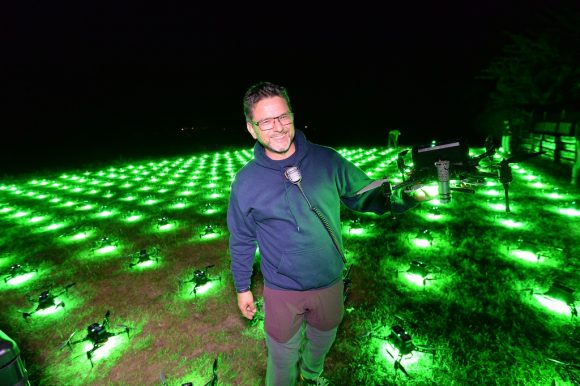
Pyro-drones represent the next frontier in aerial entertainment, combining the precision of drone flight with the visceral impact of pyrotechnics. Unlike traditional fireworks, which are launched from the ground and follow a ballistic trajectory, pyro-drones allow for "cold" or "hot" pyrotechnic effects to be triggered at specific coordinates in 3D space. This allows for a level of synchronization with music and choreography that was previously impossible. The success of the Rietberg show proved that SMIA Technology possesses the technical rigor and safety management systems necessary to satisfy the "Specific" category requirements of European Union drone regulations (EASA), which govern higher-risk operations involving hazardous materials and large crowds.
Technical Philosophy: The Sky as a Three-Dimensional Stage
The core differentiator for SMIA Technology lies in its approach to spatial design. While many drone show providers focus on "flat" imagery—essentially using drones as floating LEDs to recreate 2D logos—SMIA focuses on the "spatial aerial" aspect. This involves treating the sky as a true three-dimensional volume.
The studio’s creative process emphasizes:
- Fluid Transitions: Moving away from static "slide-show" transitions to continuous, choreographed movements where drones maintain a narrative flow.
- Musical Synchronicity: Utilizing advanced time-code synchronization to ensure that every movement and color change is perfectly aligned with an audio score.
- Volumetric Shapes: Creating complex 3D structures that can be viewed from multiple angles, ensuring that the show is effective for large, dispersed audiences rather than just those in a "sweet spot" in front of the display.
SMIA’s production capabilities are designed to be scalable, catering to a wide range of budgets and venue sizes. The company offers shows ranging from several hundred drones for intimate corporate events or city festivals to four-digit drone swarms for major international spectacles. This scalability is supported by the Verge Aero technology stack, which allows for rapid deployment and high levels of redundancy, ensuring that the failure of a single unit does not compromise the integrity of the overall performance.
Market Context and Environmental Implications
The rise of companies like SMIA Technology is inextricably linked to the broader "green" transition in the global events industry. Traditional fireworks, while culturally significant, are increasingly scrutinized for their environmental impact. They release particulate matter (PM2.5 and PM10), heavy metals, and perchlorates into the air and water, and the resulting noise pollution can be distressing to local wildlife and domestic animals.
In contrast, drone shows offer a "clean" alternative. They are reusable, produce zero direct emissions during the show, and generate minimal noise. For cities and corporations with strict Environmental, Social, and Governance (ESG) mandates, drone displays provide a way to deliver high-impact entertainment without the ecological footprint of pyrotechnics.
Furthermore, the data-driven nature of drone shows offers brands a higher degree of precision. A logo rendered by 500 drones is identical to the corporate brand guidelines in a way that a firework explosion can never be. This level of brand safety and visual accuracy is a major selling point for the marketing agencies and global brands that SMIA Technology aims to serve.

Regulatory and Safety Frameworks in Germany
Launching a drone show company in Germany involves navigating some of the strictest aviation laws in the world. Since the implementation of the EU-wide drone regulations, operators must undergo rigorous certification processes. SMIA’s expertise in this area is a significant competitive advantage.
To operate swarms of hundreds or thousands of drones, a company must possess an Operational Authorization (OA) or a Light UAS Operator Certificate (LUC). This involves detailed SORA (Specific Operations Risk Assessment) filings, which cover everything from technical fail-safes (like geofencing and flight termination systems) to ground safety protocols (buffer zones and crowd management). Smiatek’s history as a lead pilot ensures that SMIA is built on a culture of safety-first aviation, a necessity for securing permits in densely populated European urban centers or at high-profile venues like the Berlin Olympiastadion.
Future Outlook: The Intersection of Art and Automation
As SMIA Technology establishes its footprint in Rietberg, the company is looking toward a future where aerial displays are integrated into the very fabric of large-scale public events. The goal is to move beyond the "novelty" phase of drone technology. Industry analysts suggest that as hardware costs decrease and software automation improves, drone shows will become a standard feature of the "experience economy."
The focus for SMIA in the coming years will likely involve expanding the boundaries of what is possible with drone-mounted payloads. Beyond LEDs and pyrotechnics, the industry is experimenting with lasers, smoke generators, and even kinetic elements. By positioning itself as a "studio" rather than just a hardware provider, SMIA is emphasizing the importance of the creative director’s role in the process.
The target audience for SMIA—festivals, brands, cities, and agencies—is currently seeking ways to differentiate themselves in a crowded media landscape. The ability to "own the sky" for 10 to 15 minutes provides a level of undivided attention that is rare in the digital age. With Peter Smiatek’s proven track record and the company’s focus on 3D spatial innovation, SMIA Technology is poised to become a key player in the next generation of European event production.
In conclusion, the launch of SMIA Technology GmbH & Co. KG marks a professional milestone for Peter Smiatek and a significant development for the German event technology sector. By combining years of international "field" experience with a fresh artistic vision and a breakthrough in pyro-drone certification, the Rietberg-based firm is setting a new standard for what can be achieved at the intersection of flight and light. As the industry moves away from traditional methods toward digital, sustainable alternatives, SMIA’s focus on the sky as a three-dimensional stage positions it at the forefront of the modern aerial revolution.
