

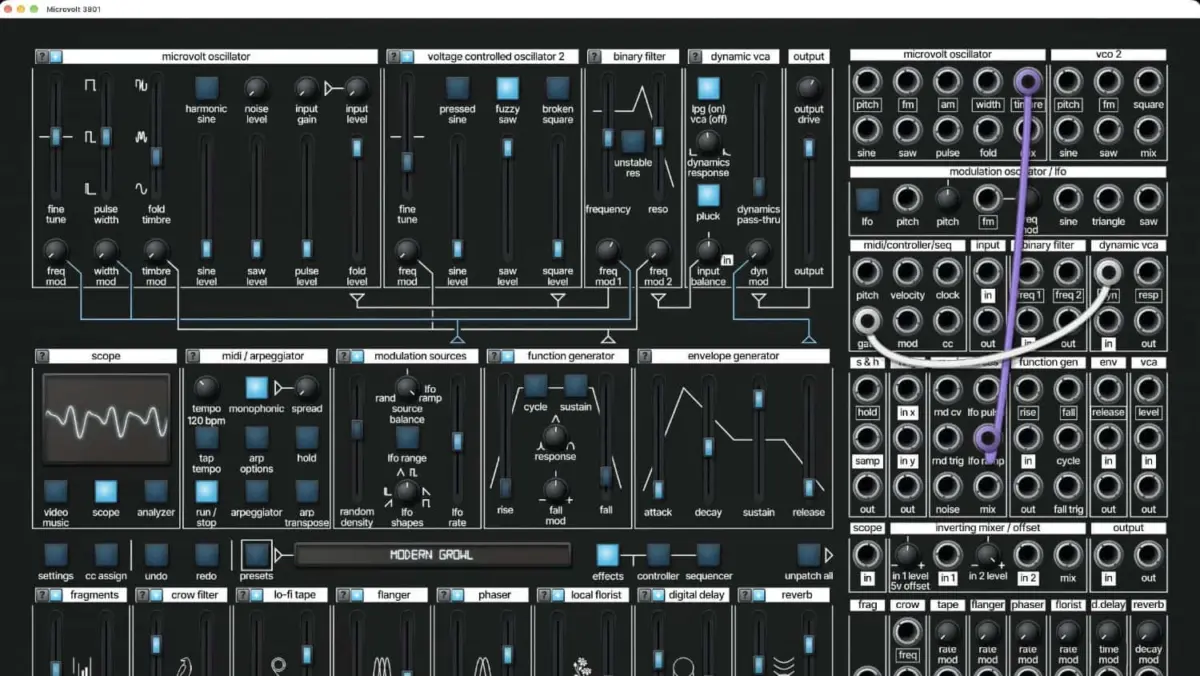
The Microvolt 3901 represents a significant milestone for Pittsburgh Modular as the company officially transitions its acclaimed hardware architecture into the digital domain, offering a sophisticated software emulation of the original Microvolt 3900 semi-modular synthesizer. This new release, available for macOS and Windows with an iOS version on the horizon, is not merely a direct port of the hardware predecessor but serves as an expanded ecosystem that integrates several modules from Pittsburgh Modular’s extensive Eurorack catalog. By combining the distinctive "West Coast" synthesis philosophy with the convenience of a modern digital audio workstation (DAW) environment, the Microvolt 3901 aims to provide musicians with a versatile tool for both traditional melodic composition and avant-garde sound design.
Evolution of the Microvolt Architecture
The journey to the Microvolt 3901 began in 2018 with the release of the Microvolt 3900, a hardware unit that garnered praise for its unique approach to subtractive and additive synthesis. Unlike traditional "East Coast" synthesizers that rely primarily on resonant filters to shape sound, the Microvolt series utilizes wavefolding and low-pass gates—techniques pioneered by Don Buchla—to create complex harmonic textures. The transition to software allows Pittsburgh Modular to overcome the physical limitations of the original hardware, such as monophonic operation and fixed signal paths.
In the digital iteration, the 3901 introduces polyphonic capabilities, a feature that was physically impossible in the compact desktop format of the 3900. This expansion allows users to apply the aggressive, harmonically rich character of the Microvolt engine to chords and complex pads. Furthermore, the software environment enables the integration of additional virtual modules, effectively turning the synthesizer into a self-contained modular laboratory.
Technical Specifications and Core Features
The Microvolt 3901 is built around a virtual analog engine designed to replicate the non-linearities and organic instabilities of hardware circuitry. The synthesizer features a multi-mode oscillator capable of generating a wide variety of timbres through its unique "Dynamic Folder" section. This wavefolder adds harmonic complexity by "folding" the peaks of the waveform back onto itself, creating metallic and percussive tones that are difficult to achieve with standard oscillators.
One of the most critical components of the Microvolt 3901 is the "Function Generator," a versatile modulation source that can act as an envelope generator, a low-frequency oscillator (LFO), or even a secondary oscillator. In the software version, this module has been refined to offer more precise control over the rise and fall times, allowing for intricate rhythmic patterns.
The signal path concludes with the "LPG" (Low Pass Gate) module. Unlike a standard VCF (Voltage Controlled Filter), the LPG mimics the natural decay of acoustic instruments by simultaneously controlling frequency content and amplitude. This results in the "plucky" sound signature that has become a hallmark of Pittsburgh Modular’s design aesthetic.
Virtual Patching and Modular Integration
A central feature of the Microvolt 3901 is its interactive patching interface. Users can route audio and control-voltage (CV) signals between various modules using virtual patch cables. This system encourages experimentation, allowing for the creation of complex feedback loops and cross-modulation setups that go beyond the capabilities of fixed-architecture synthesizers.
To enrich the user experience, Pittsburgh Modular has included virtual versions of several modules from their Eurorack line. These additions provide extra layers of modulation, utility, and signal processing. The inclusion of these modules means that the 3901 acts as a bridge for users who may be curious about modular synthesis but are not yet ready to invest in physical hardware. The visual feedback provided by the virtual cables helps clarify the signal flow, making it an educational tool as much as a creative one.
Pricing, Availability, and System Requirements
The Microvolt 3901 is currently available for purchase through the Pittsburgh Modular website. The full version is priced at $69, positioning it as a competitive option in the crowded market of virtual analog synthesizers. For users who wish to test the software before committing to a purchase, the company offers a seven-day free trial with full functionality.
Compatibility includes:
- macOS: Available as a standalone application and as a plugin (VST3, AU, AAX). It is optimized for both Intel and Apple Silicon (M1/M2/M3) architectures.
- Windows: Available as a standalone application and as a plugin (VST3, AAX), compatible with Windows 10 and 11.
- iOS (Coming Soon): An iPad version featuring AUv3 support is currently in development. This will allow mobile producers to integrate the Microvolt 3901 into mobile DAWs like Logic Pro for iPad and AUM.
Market Context and Industry Implications
The release of the Microvolt 3901 reflects a broader trend in the music technology industry where boutique hardware manufacturers are increasingly digitizing their hardware legacies. Companies such as Moog, Arturia, and Softube have successfully demonstrated that there is a high demand for accurate software emulations of classic hardware. By entering this space, Pittsburgh Modular is expanding its brand reach to a demographic of producers who work primarily "in the box."
From a market perspective, the $69 price point is strategic. It sits significantly lower than the cost of the original hardware—which retailed for approximately $600—making the unique "Pittsburgh sound" accessible to a much wider audience. Analysts suggest that this move could also serve as a gateway, leading software users to eventually explore the company’s physical Eurorack modules.
User Experience and Professional Feedback
Early feedback from the synthesizer community has highlighted the software’s ability to capture the "unruly" nature of the original hardware. While digital synthesizers are often criticized for being too clean or clinical, Pittsburgh Modular has reportedly spent considerable development time ensuring that the virtual oscillators and filters exhibit the saturation and "grit" associated with analog components.
Professional sound designers have noted that the addition of polyphony transforms the Microvolt from a specialized lead and bass machine into a comprehensive workstation for cinematic textures. The ability to save and recall presets—a feature notoriously absent from most semi-modular hardware—is another significant advantage cited by touring musicians and studio professionals who require fast workflows.
The Future of the Microvolt Series
The announcement of the upcoming iPad version suggests that Pittsburgh Modular is committed to a multi-platform strategy. As mobile devices become more powerful, the distinction between desktop and mobile production continues to blur. The inclusion of AUv3 support for the iPad version will be a critical factor for its success, as it allows for multiple instances of the synthesizer to run within a single mobile project.
Furthermore, the modular nature of the 3901’s software architecture leaves the door open for future expansions. It is plausible that Pittsburgh Modular could release additional module packs, allowing users to further customize their virtual racks with emulations of other classic or discontinued hardware from the company’s history.
Impact on the Modular Synthesis Community
The Microvolt 3901 serves as an important entry point for those intimidated by the complexity and cost of physical modular systems. By providing a "sandbox" environment where mistakes cost nothing and cables never run out, Pittsburgh Modular is demystifying West Coast synthesis. This pedagogical aspect is bolstered by the software’s clear layout and the inclusion of a comprehensive manual that explains the theory behind the Dynamic Folder and Function Generator.
In conclusion, the Pittsburgh Modular Microvolt 3901 is more than a simple emulation; it is an evolution of a design philosophy that prioritizes character and experimentation. By bringing the Microvolt architecture to macOS, Windows, and eventually iOS, the company has ensured that its unique sonic footprint will continue to influence electronic music for years to come. Whether used as a standalone tool for sound design or integrated into a complex DAW-based production, the 3901 offers a blend of vintage inspiration and modern functionality that meets the demands of contemporary musicians.
