

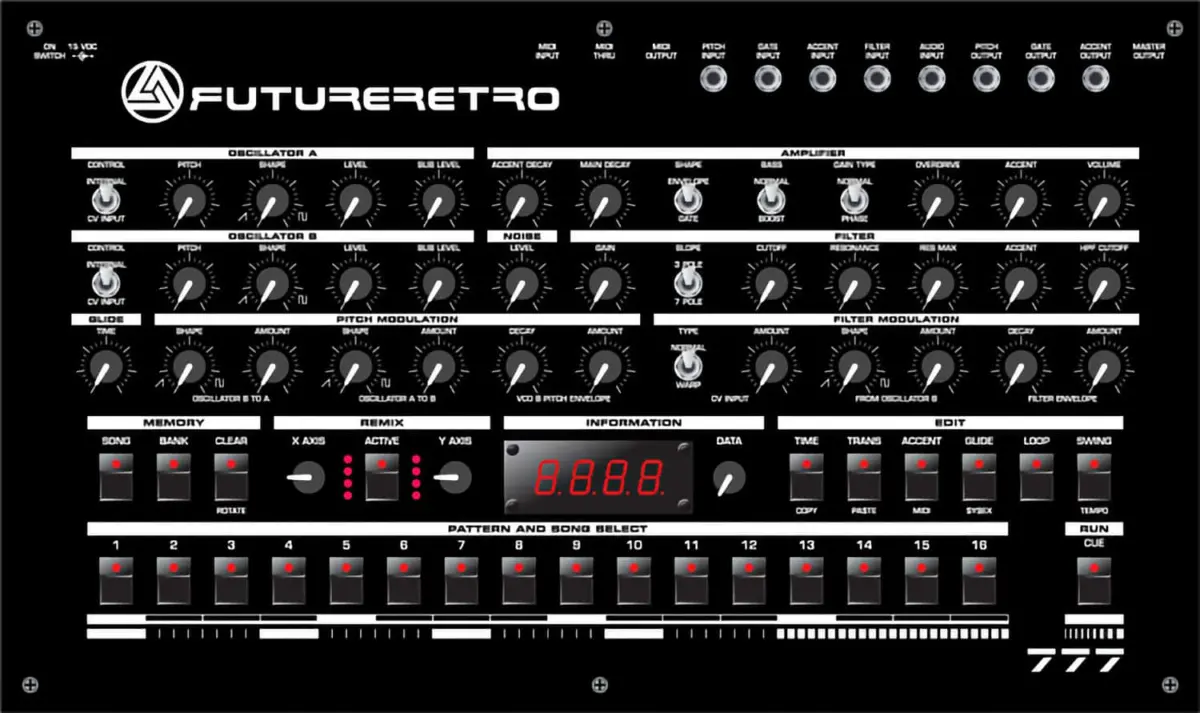
Synthesist Nathan King, widely recognized in the electronic music community under the moniker Zafrosoundz, has released a comprehensive head-to-head sound comparison between the original Future Retro 777 and its newly released modern reissue. This side-by-side evaluation serves as a critical touchstone for sound designers and electronic musicians who have long regarded the 777 as one of the most versatile and aggressive monophonic analog synthesizers ever produced. Originally inspired by the Roland TB-303, the Future Retro 777 carved out its own distinct legacy in the late 1990s and early 2000s, offering a level of sonic flexibility that far exceeded the limitations of the hardware that inspired it. As the reissue hits the market after a two-decade hiatus, the industry is closely examining whether the new unit retains the "magic" of the original discrete circuitry while integrating the stability and connectivity required by modern studio workflows.
The Historical Context of the Future Retro 777
To understand the significance of this comparison, one must look back at the landscape of electronic music hardware in the mid-to-late 1990s. During this era, the "Acid House" sound, defined by the squelching resonance of the Roland TB-303, was undergoing a massive resurgence. However, original 303 units were becoming increasingly rare and expensive. This vacuum led to the "clonewars," a period where various manufacturers attempted to replicate the 303’s signature sound.
Future Retro, founded by Jered Flickinger, entered this market with a different philosophy. Rather than creating a mere carbon copy, Flickinger designed the 777 to be an "evolutionary" bassline synthesizer. Launched in 1999, the 777 featured a much more robust synthesis engine than the 303, including two oscillators, a sub-oscillator, and a multi-pole filter that could switch between 3-pole and 7-pole slopes. Its aggressive, industrial character quickly caught the attention of major touring acts. The unit became a staple in the rigs of The Chemical Brothers, The Crystal Method, and Nine Inch Nails. Richie Hawtin, a pioneer of minimal techno, also utilized the 777 to push the boundaries of repetitive, hypnotic sequences.
Despite its success, production eventually ceased as the company moved on to other designs like the Revolution and the XS. For nearly twenty years, the 777 existed only on the secondary market, where prices often soared well above its original retail value, fueled by its reputation for having a "huge" sound that could cut through any mix.
Technical Specifications and Sound Engine Evolution
The comparison provided by Nathan King highlights the nuances of the 777’s internal architecture. At its core, the Future Retro 777 is a monophonic analog synthesizer that utilizes a digital sequencer to control its analog voices. The sound engine is famous for its "overdrive" capabilities and its unique filter characteristics.
One of the primary points of interest in the reissue is the fidelity of the analog signal path. The original 777 was praised for its raw, almost unpredictable harmonic distortion when the resonance was pushed to its limits. In King’s comparison, the reissue demonstrates a nearly identical frequency response, suggesting that the modern components used in the 2024/2025 production runs have been meticulously calibrated to match the original’s discrete transistor-based design.
Key technical features shared by both the original and the reissue include:
- Dual Oscillators: Unlike the single-oscillator TB-303, the 777 provides two independent oscillators with sawtooth and square waveforms, allowing for detuning and thick, chorused basslines.
- Sub-Oscillator: An additional sub-oscillator provides foundational low-end weight, a feature that solidified the 777’s place in industrial and big-beat genres.
- Cross-Modulation: The ability for one oscillator to modulate the other allows for bell-like tones, metallic clangs, and complex FM-style textures that are impossible on standard bass synths.
- The Filter: The 777’s filter is its crown jewel. The 3-pole (18dB/octave) setting provides a classic, rubbery acid sound, while the 7-pole (42dB/octave) setting offers a steep, aggressive cutoff that creates incredibly sharp, percussive transients.
The Modern Reissue: Enhancements and Sequencer Updates
While the sound engine remains faithful to the 1999 original, the reissue introduces several quality-of-life improvements that address the demands of contemporary producers. The most significant updates are found within the digital sequencer and the unit’s connectivity.
The original 777 sequencer was lauded for its "remix" functions—features that allowed users to non-destructively alter patterns in real-time. The reissue builds upon this by expanding the internal memory and improving the resolution of the sequencing logic. Furthermore, the modern version includes updated MIDI implementation and USB connectivity, allowing for easier integration with Digital Audio Workstations (DAWs) and modern clocking systems.
In his video analysis, Nathan King notes that the tactile feel of the reissue remains consistent with the original. The knobs and switches provide the same resistance, which is crucial for performers who use the 777 as a live instrument rather than a "set-and-forget" studio module. The reissue’s build quality appears to justify its premium positioning in the market, utilizing a rugged metal chassis that mirrors the durability of the vintage units.
Market Analysis and Pricing
The Future Retro 777 reissue is currently available for $1,599.99 USD. This price point places it firmly in the boutique hardware category. In an era where many manufacturers are focusing on low-cost, mass-produced analog clones priced between $200 and $500, Future Retro is targeting a different demographic: the professional musician and the dedicated hardware enthusiast.
The $1,600 price tag reflects the cost of high-quality components, domestic assembly (where applicable), and the specialized nature of the 777’s circuitry. When compared to the fluctuating prices of vintage 777 units—which can often reach $2,000 to $2,500 on platforms like Reverb or eBay depending on condition—the reissue offers a compelling value proposition. It provides the same legendary sound with the added security of a manufacturer’s warranty and modern reliability.
Industry analysts suggest that the return of the 777 is part of a broader trend of "premium nostalgia." As the market becomes saturated with inexpensive digital emulations, there is a growing segment of the consumer base willing to pay a premium for "heavyweight" analog gear that offers a unique sonic signature and a physical, hands-on interface.
Chronology of the Future Retro 777
The journey of the 777 from a 90s cult classic to a modern reissue follows a timeline of innovation and persistence:
- 1996: Future Retro is founded by Jered Flickinger, focusing on high-end sequencing and synthesis.
- 1999: The Future Retro 777 is officially released. It is immediately adopted by leading electronic artists for its aggressive sound.
- 2000-2005: The 777 becomes a staple of the "Big Beat" and "Techno" scenes.
- Mid-2000s: Production of the 777 ends as Future Retro shifts focus to new designs like the Revolution (a circular sequencer synth).
- 2022-2023: Future Retro undergoes a transition in ownership and leadership. New management expresses interest in reviving the most requested designs from the company’s catalog.
- September 2024: Official announcement of the 777 reissue, featuring the original analog signal path with an updated digital control system.
- Late 2024/Early 2025: Nathan King and other early adopters begin publishing head-to-head comparisons, confirming the sonic consistency of the new units.
Broader Impact and Implications for Electronic Music
The reintroduction of the Future Retro 777 has implications that extend beyond the gear-enthusiast community. It signals a shift in how legacy hardware is maintained. By bringing back a design that was once considered "unobtainable," Future Retro is democratizing access to a specific palette of sounds that helped define an era of electronic music.
Furthermore, the comparison by Nathan King serves as a testament to the longevity of well-designed analog circuits. The fact that a design from 1999 can still sound contemporary and "cutting-edge" in 2025 speaks to the timeless nature of the 777’s architecture. For the modern producer, the 777 offers a way to escape the "in-the-box" sound of software plugins, providing a level of harmonic complexity and physical interaction that is difficult to replicate digitally.
As the electronic music industry continues to evolve, the Future Retro 777 stands as a bridge between the analog foundations of the past and the high-tech production environments of the future. With its return, a new generation of artists can now explore the "3-pole/7-pole" madness that once fueled the world’s biggest dance floors and industrial stages. The $1,599.99 investment represents not just the purchase of a synthesizer, but the acquisition of a piece of electronic music history, now refined for the 21st century.
