

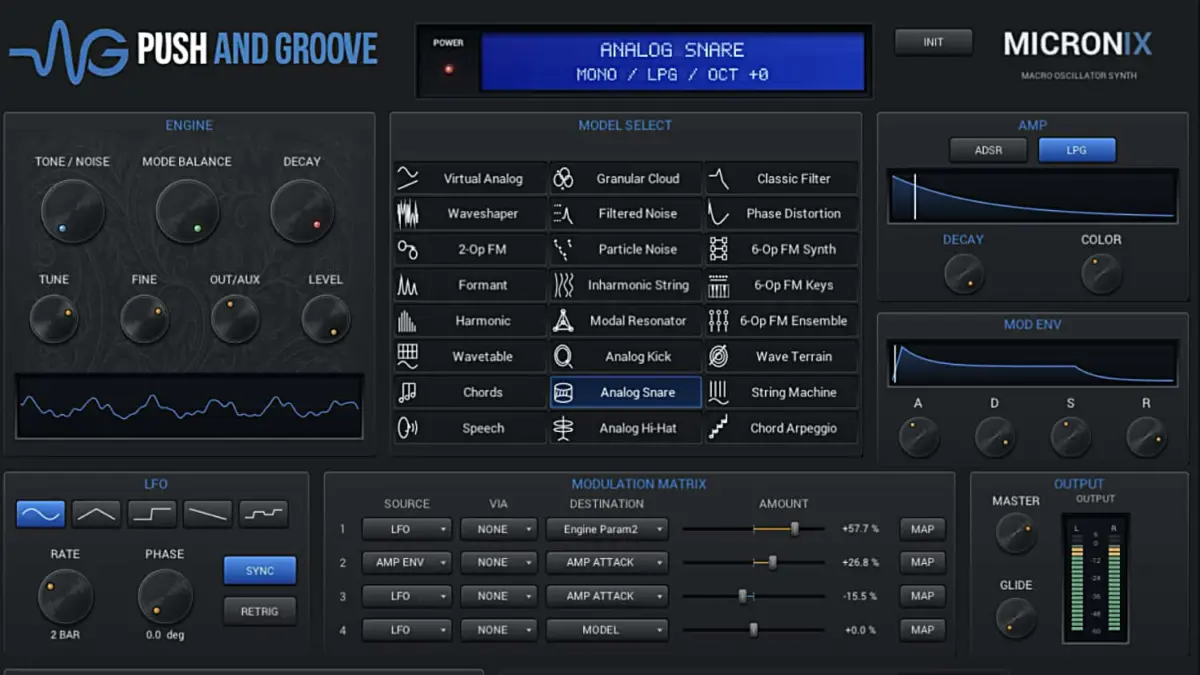
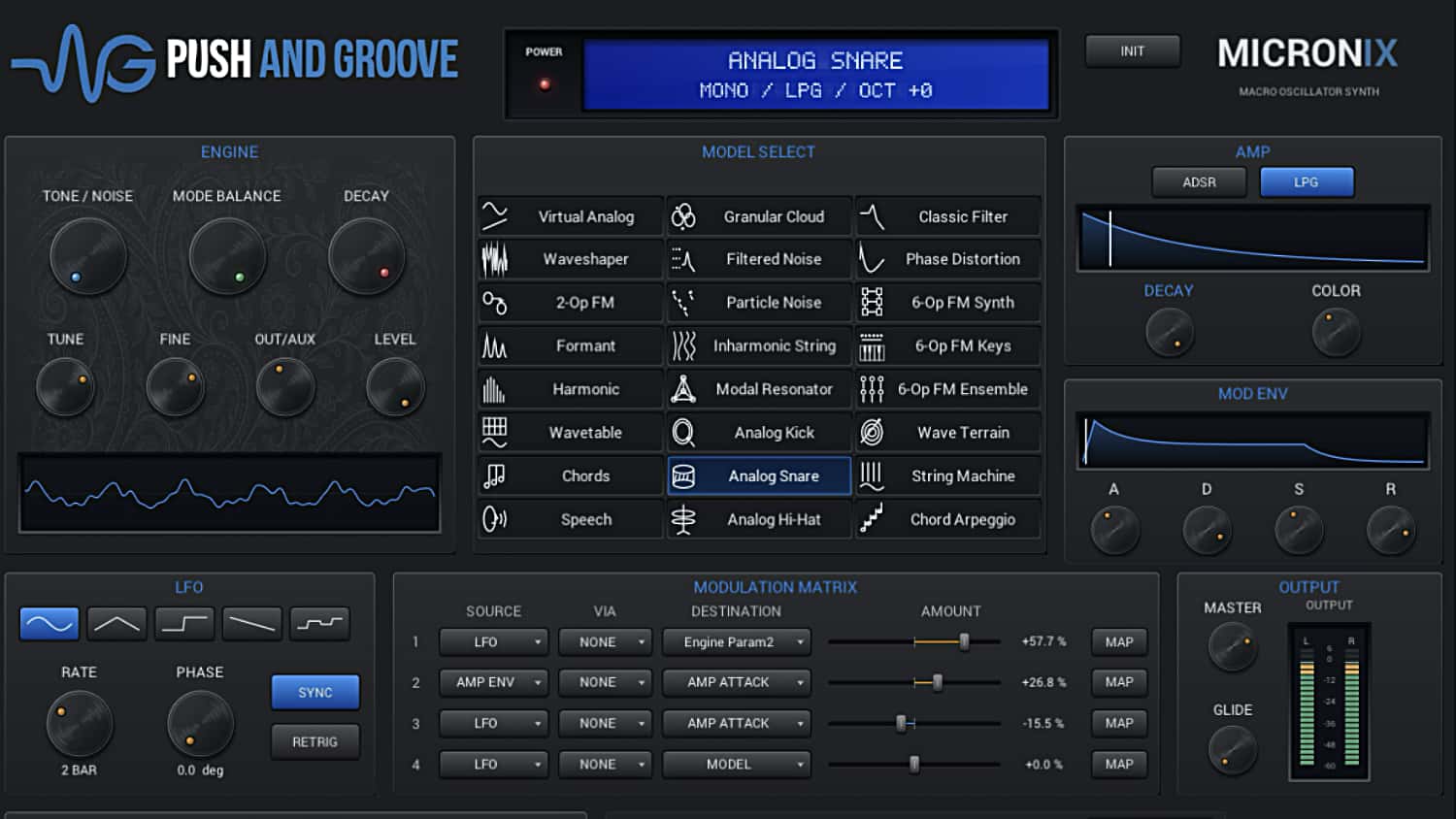
The digital music production landscape has witnessed a significant expansion with the release of MICRONIX, a new monophonic software synthesizer developed by Push and Groove. This virtual instrument is built upon the foundational digital signal processing (DSP) code of the Mutable Instruments Plaits, a legendary hardware macro-oscillator module that has become a staple in the Eurorack modular synthesis community. By porting this highly acclaimed open-source code into a dedicated Digital Audio Workstation (DAW) plugin, Push and Groove offers producers and sound designers access to a diverse array of synthesis techniques without the financial barrier of hardware acquisition. Available for both macOS and Windows platforms, MICRONIX enters the market as a free utility, further democratizing the high-fidelity sound engines originally conceived by Émilie Gillet, the founder of Mutable Instruments.
The Technical Foundation: From Eurorack to Plugin
To understand the significance of MICRONIX, one must examine the legacy of the Mutable Instruments Plaits. Released in 2018 as the successor to the equally famous Braids module, Plaits redefined the concept of a "macro-oscillator." Rather than providing a single synthesis method, it offered a collection of diverse models ranging from traditional virtual analog to complex physical modeling and FM synthesis.
The transition of this code from hardware to software involves sophisticated porting of the C++ algorithms that define the module’s behavior. MICRONIX utilizes the original DSP code, licensed under the permissive MIT License, which allows developers to use, copy, and modify the software freely. Push and Groove has effectively "wrapped" these algorithms into a user interface (UI) suitable for modern computer screens, adding essential software-specific features such as MIDI mapping, internal modulation sources, and preset management.
As a monophonic synthesizer, MICRONIX focuses on one note at a time, making it an ideal tool for crafting intricate basslines, soaring lead melodies, and percussive textures. While the original hardware module was designed to be part of a larger modular system, MICRONIX functions as a self-contained unit within a DAW, bridging the gap between the tactile world of modular synthesis and the streamlined workflow of digital production.
Comprehensive Feature Set and Synthesis Models
The core appeal of MICRONIX lies in the versatility of its sound engine. Because it is based on Plaits, it inherits sixteen distinct synthesis models, divided into two "banks" of eight. These models provide a wide palette of sonic possibilities:
Pitch and Percussive Engines
The first bank typically focuses on melodic and harmonic sounds. This includes a Virtual Analog model that emulates the behavior of classic subtractive synthesizers with two detunable oscillators. It also features a Waveshaping engine that provides rich, evolving timbres through asymmetric folding, and a two-operator Frequency Modulation (FM) engine capable of producing metallic and bell-like tones.
Furthermore, the plugin includes granular synthesis models and an additive synthesis engine that allows users to manipulate individual harmonics. These tools are particularly effective for creating "shimmering" pads (when processed through external reverb) or complex, evolving textures that defy traditional categorization.
Physical Modeling and Noise
The second bank of algorithms delves into the realm of physical modeling. This includes the Karplus-Strong string synthesis model, which uses a delay line to simulate the plucking of a string, and a "modal" synthesis engine that emulates the resonance of struck surfaces like wood, glass, or metal. For rhythm-focused producers, MICRONIX provides dedicated percussion models, including a granular drum engine and a 909-style bass drum emulator. These models leverage the "Trigger" and "LPG" (Low Pass Gate) characteristics of the original hardware code, allowing for snappy, organic transients that are often difficult to achieve with standard software oscillators.
Modulation and MIDI Integration
While the DSP code provides the "voice" of the synthesizer, Push and Groove has added several layers of control to enhance its playability in a DAW environment. MICRONIX features an expanded modulation section that goes beyond the original hardware’s CV (Control Voltage) inputs.
Users can take advantage of dedicated Low-Frequency Oscillators (LFOs) and ADSR (Attack, Decay, Sustain, Release) envelopes to shape the timbre over time. In the original hardware, these would require external modules; here, they are integrated directly into the interface. Additionally, MICRONIX supports comprehensive MIDI integration. This allows for the mapping of parameters like "Timbre," "Morph," and "Harmonics" to external MIDI controllers, enabling expressive live performances. The inclusion of velocity sensitivity and aftertouch support further ensures that the software responds dynamically to a player’s touch, a feature that is highly valued in lead and bass performance.
A Chronology of Open Source Innovation
The release of MICRONIX is the latest milestone in a timeline that began over a decade ago. In 2009, Émilie Gillet founded Mutable Instruments, initially focusing on DIY hybrid synthesizer kits like the Shruthi-1. As the company transitioned into the Eurorack format, it gained a reputation for innovative designs and a commitment to open-source philosophy.
In 2022, Gillet announced that Mutable Instruments would cease operations, marking the end of an era for the modular community. However, in a move that secured her legacy, she released the source code for her modules under the MIT License. This decision triggered a wave of community-driven projects.
- 2018: Mutable Instruments releases Plaits hardware.
- 2022: Mutable Instruments begins the process of winding down; source code is made public.
- 2023: Various developers begin porting Plaits code to different platforms, including VCV Rack and independent hardware clones.
- 2024: Push and Groove releases MICRONIX, focusing on a streamlined, standalone VST/AU experience for DAW users.
This chronology highlights a shift in the industry where the "end" of a hardware manufacturer does not mean the end of its influence. Instead, through open-source licensing, the technology becomes a public good, allowing independent developers like Push and Groove to continue evolving the tools.
Market Context: The Rise of High-Quality Freeware
The introduction of MICRONIX occurs within a broader market trend where the line between "free" and "premium" software is increasingly blurred. Historically, free plugins were often seen as inferior to paid counterparts from established giants like Arturia, Spectrasonics, or Native Instruments. However, the availability of high-quality open-source DSP code has disrupted this hierarchy.
By utilizing the Plaits engine, MICRONIX offers a level of sonic complexity that was previously only available in expensive hardware or high-end software suites like Arturia’s "Pigments" or "MicroFreak" (which also officially incorporates Mutable Instruments algorithms). For the independent developer, releasing such a tool for free serves as a powerful marketing strategy, building brand recognition and community trust within the highly competitive music technology sector.
Professional Analysis of Implications
The release of MICRONIX carries several implications for the music production industry. First, it reinforces the value of the MIT License in fostering innovation. Without the legal framework provided by open-source licensing, the development of a tool like MICRONIX would be fraught with copyright hurdles. Instead, the focus remains on the implementation and the user experience.
Second, MICRONIX addresses a specific niche: users who want the "Mutable sound" without the complexity of a virtual modular environment like VCV Rack or Cardinal. While those platforms offer more flexibility, they also come with a steeper learning curve. MICRONIX provides a "distilled" experience—a single, powerful oscillator with integrated controls that can be dropped into a channel strip and used immediately.
From a sound design perspective, the monophonic nature of MICRONIX is a deliberate choice. In an era of massive polyphonic workstations, a dedicated monophonic synth forces the producer to focus on the character and movement of a single voice. This often leads to more detailed and intentional sound design, particularly in genres like techno, IDM, and cinematic scoring where texture is as important as melody.
Official Positioning and Legal Clarity
Push and Groove has been transparent regarding the origins of MICRONIX. The company explicitly states that the synthesizer incorporates Mutable Instruments Plaits DSP code licensed under the MIT License. It is also clearly noted that MICRONIX is an independent development and is not affiliated with, sponsored by, or endorsed by Mutable Instruments or Émilie Gillet.
This distinction is crucial in the "clone" and "port" culture of the audio world. It respects the original creator’s intellectual property while utilizing the permissions granted by the open-source license. By clearly labeling the product as independent, Push and Groove avoids potential consumer confusion and maintains professional standards within the developer community.
Conclusion and Future Outlook
MICRONIX represents a successful fusion of hardware-grade DSP and software accessibility. By offering the complex, multifaceted sounds of the Plaits module for free, Push and Groove has provided a valuable resource to the global music-making community. As digital audio technology continues to evolve, the trend of porting iconic hardware algorithms to software is likely to accelerate, ensuring that the innovations of the past remain accessible to the creators of the future.
For producers looking to expand their sonic palette, MICRONIX offers a gateway into the world of macro-oscillation. Whether used for its gritty virtual analog tones or its crystalline physical modeling, the plugin stands as a testament to the enduring power of open-source collaboration in the arts. As of its release, the synthesizer is available for download on the Push and Groove website, compatible with major DAWs including Ableton Live, Logic Pro, FL Studio, and Cubase. The industry will likely watch closely to see if Push and Groove continues this trajectory, perhaps exploring other legendary open-source modules for future releases.
