

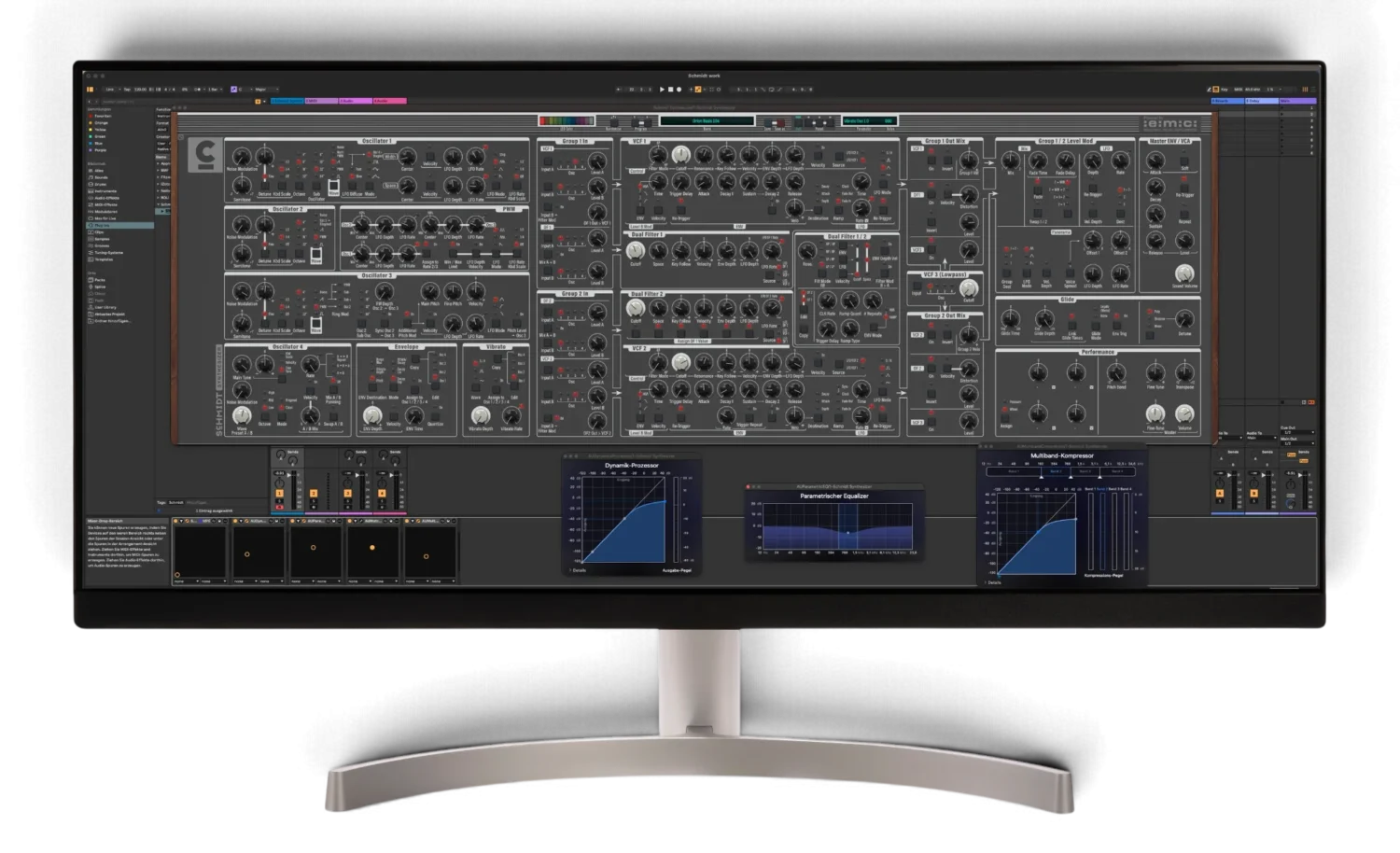
The landscape of high-end analog synthesis has undergone a significant transformation with the official release of the Schmidt Vi, a comprehensive software recreation of the iconic Schmidt Eightvoice polyphonic synthesizer. Developed through a strategic partnership between Schmidt Synthesizer and the renowned software developer UJAM, the Schmidt Vi aims to preserve the complex sonic architecture of one of the most ambitious hardware synthesizers ever produced. This transition from physical hardware to a digital environment comes as the company announces the impending discontinuation of its flagship hardware unit, citing the increasing complexity and prohibitive costs of boutique analog manufacturing in the modern era.
The original Schmidt Eightvoice, first unveiled to the public at the Musikmesse in Frankfurt in 2012, quickly gained a reputation as a "holy grail" of analog synthesis. Designed by Stefan Schmidt, the instrument was a massive, no-compromise polyphonic synthesizer that featured an unprecedented number of discrete components and dedicated controls. By moving this architecture into the digital domain, Schmidt Synthesizer is attempting to ensure that the unique character of the Eightvoice remains accessible to a broader range of musicians and producers, even as the physical production of the hardware comes to a close.
The Evolution of a Modern Classic: From Frankfurt to the Digital Desktop
The history of the Schmidt Eightvoice is rooted in a philosophy of uncompromising analog design. When it debuted in 2012, it stood in stark contrast to the prevailing trends of digital modeling and compact hardware. The Eightvoice was a large-format instrument, hand-assembled in Germany using through-hole construction—a method where components are manually soldered through circuit boards. This design choice was intended to ensure long-term repairability and a specific sonic weight that many enthusiasts argue is missing from surface-mount technology (SMT).
Over the subsequent decade, the Schmidt Eightvoice became a symbol of boutique engineering, favored by high-end studios and collectors. However, the very factors that made the hardware unique also contributed to its eventual transition to software. The global supply chain for high-quality discrete electronic components has become increasingly volatile, and the labor-intensive nature of German hand-assembly has seen costs rise significantly.
According to company statements, the decision to develop the Schmidt Vi was a proactive response to these manufacturing challenges. By collaborating with UJAM, a company known for its expertise in high-fidelity virtual instruments and intuitive user interfaces, Schmidt sought to translate the physical behavior of its analog circuits into a digital format. The development process involved a rigorous analysis of the original signal path, including the non-linear interactions between oscillators, filters, and modulation sources that define the "Schmidt sound."
Technical Specifications and the Virtual Signal Path
The Schmidt Vi is not a mere sample library; it is a component-level model of the Eightvoice’s internal architecture. To understand the significance of the software, one must look at the complexity of the original hardware that UJAM was tasked with replicating. The hardware featured eight-voice polyphony, but each voice was remarkably dense, consisting of four oscillators, multiple filter sections, and a massive array of envelopes and LFOs.
The virtual instrument recreates this architecture, providing users with a digital version of the original’s multi-mode filter system. In the hardware, this included a 24dB Moog-style ladder filter and a complex dual-multimode filter section that allowed for sophisticated parallel and serial routing. The Schmidt Vi replicates these interactions, capturing the way the filters saturate and resonate when pushed.
Furthermore, the software addresses the modulation capabilities that made the Eightvoice a sound designer’s powerhouse. The original featured a dedicated modulation matrix and a physical layout that prioritized "one knob per function" control. While a software interface inherently loses the tactile nature of physical knobs, the Schmidt Vi utilizes a high-resolution graphical user interface designed to maintain the workflow efficiency of the hardware. The integration of iLok authorization ensures that the intellectual property and the complex algorithms powering the modeling remain secure, a standard practice for high-end professional audio software.
The Economic Reality of Boutique Hardware Discontinuation
The announcement that Schmidt Synthesizer will soon discontinue the production of the Eightvoice hardware highlights a broader trend within the music technology industry. High-end analog synthesizers are increasingly difficult to produce at a sustainable price point. The original Schmidt hardware carried a retail price that often exceeded $20,000, placing it out of reach for the vast majority of working musicians.
By contrast, the Schmidt Vi is available for €179. This price point represents a democratization of the Schmidt sound, allowing it to enter the toolsets of bedroom producers and professional film composers alike. Industry analysts suggest that this shift is part of a "software-first" trend among boutique manufacturers. Companies like Moog Music and Oberheim have similarly embraced the digital domain, either through official emulations or partnerships with software developers, to supplement their hardware offerings and provide entry-level access to their brand legacies.
The rising costs of raw materials, such as specialized capacitors and high-tolerance resistors, combined with the shrinking pool of technicians skilled in through-hole assembly, have made the Schmidt Eightvoice a victim of its own complexity. The company’s move to software is viewed by many as a strategic pivot to preserve the brand’s relevance in a market that is increasingly dominated by digital integration and hybrid workflows.
Collaboration and Development: The UJAM Partnership
The development of the Schmidt Vi was a multi-year endeavor that required a bridge between traditional analog engineering and modern DSP (Digital Signal Processing) techniques. UJAM was selected for this partnership due to its track record of creating instruments that balance technical depth with ease of use.
The timeline for the project reached a critical milestone in May 2026, when an early prototype of the Schmidt Vi was demonstrated at Superbooth in Berlin. Superbooth, the world’s premier trade fair for electronic musical instruments, served as the perfect testing ground for the software. Feedback from early adopters and industry veterans was reportedly instrumental in refining the plugin’s user interface and sonic accuracy before its final commercial release.
The collaboration focused heavily on the concept of "circuit modeling." Unlike traditional digital synthesizers that use mathematical approximations of waveforms, circuit modeling attempts to simulate the electricity flowing through individual components. This is particularly important for an instrument like the Schmidt, where the "imperfections" of the analog path—such as thermal drift in the oscillators and the specific phase relationships in the filter section—are essential to its character.
Industry Impact and the Future of Analog Modeling
The release of the Schmidt Vi and the discontinuation of the Eightvoice hardware serve as a case study for the future of the synthesizer industry. As vintage components become scarcer and environmental regulations on manufacturing become more stringent, the industry is seeing a split. On one side are the "luxury" hardware items produced in extremely limited quantities for a high-end niche market. On the other is the high-fidelity software market, which seeks to replicate those luxury experiences for the mass market.
The Schmidt Vi enters a competitive market for high-end virtual analog synthesizers. It faces competition from established plugins like Arturia’s V Collection and U-he’s Diva. However, the Schmidt Vi holds a unique position because it is an official, manufacturer-sanctioned recreation of a specific, rare instrument. For users who could never afford or even find an original Schmidt Eightvoice, the plugin offers a legitimate alternative that carries the endorsement of the original designer.
Furthermore, the move to software allows for features that were impossible or impractical in the hardware version. These include unlimited patch storage, total recall within a Digital Audio Workstation (DAW), and the ability to run multiple instances of the instrument simultaneously. These practical advantages, combined with the significantly lower price point, suggest that the Schmidt Vi may ultimately have a larger cultural and musical impact than the hardware that preceded it.
Conclusion and Market Availability
As of its release, the Schmidt Vi is available through the official Schmidt Synthesizer online store. The plugin is priced at €179, including applicable taxes, making it a professional-grade investment for serious producers. To ensure a stable and secure user experience, the software requires an iLok account and the iLok License Manager for authorization, a common requirement in the professional audio industry to prevent piracy of high-value algorithms.
The transition of the Schmidt Eightvoice from a physical titan to a digital powerhouse marks the end of an era for German boutique hardware but the beginning of a new chapter for the brand. By embracing the digital medium, Schmidt Synthesizer has ensured that the meticulous engineering and unique sonic vision of Stefan Schmidt will continue to influence music production for years to come. While the hardware may eventually disappear from store shelves, its digital ghost is now poised to haunt the tracks of a new generation of artists.
