

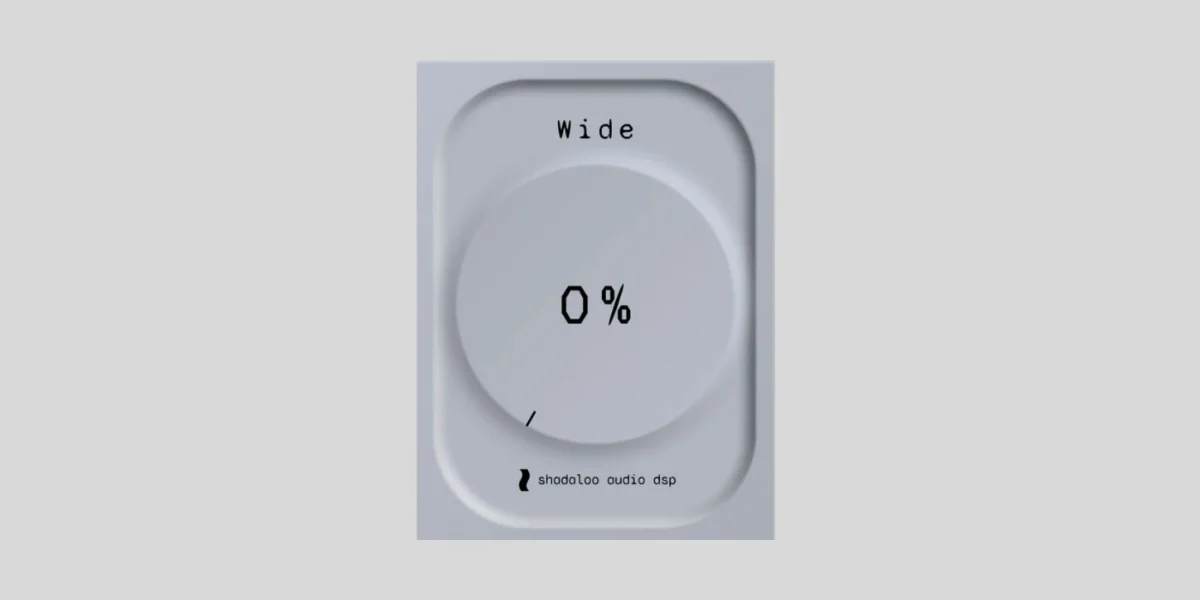
Shadaloo Audio DSP, an emerging innovator in digital audio processing, has officially launched "Wide," a new spatial enhancement tool designed for macOS and Windows platforms. This release marks the second significant offering from the developer in recent months, following the successful introduction of "H," a lauded tone and loudness enhancer. "Wide" distinguishes itself through an exceptionally straightforward, one-knob interface, yet it delivers sophisticated results in adding depth and dimension to audio signals, positioning it as a potentially indispensable utility for producers, mix engineers, and sound designers seeking to enrich their soundscapes without compromising the integrity of the source material.
Shadaloo Audio DSP Unveils "Wide" Plugin for Enhanced Spatial Audio Processing
"Wide" enters the competitive audio plugin market with a clear mission: to provide a fast, effective, and musically intuitive solution for common challenges related to soundstage and mix presence. The plugin’s core functionality revolves around its ability to inject a sense of spaciousness and depth into sounds that may otherwise appear flat or struggle to sit cohesively within a larger mix. This capability is particularly vital in modern music production, where expansive sound design and immersive listening experiences are increasingly paramount.
At the heart of "Wide" lies an innovative "internal micro-space stage" that meticulously processes the audio signal before it undergoes stereo expansion. This proprietary stage is crucial for maintaining the fundamental character and robustness of the original sound, preventing the aggressive, often detrimental thinning that can occur with less sophisticated widening algorithms. Many traditional stereo widening techniques, while effective in spreading a sound, can inadvertently introduce phase issues, diminish mono compatibility, or strip away the vital low-mid body of a signal, leading to a weak or washed-out result. "Wide" directly addresses these concerns, ensuring that the added spaciousness complements rather than detracts from the source’s core presence.
The user interface of "Wide" exemplifies minimalist design, featuring a single, intuitive knob. This design choice reflects a growing trend in audio software towards streamlined workflows, allowing creators to achieve professional results quickly without navigating complex parameters. Despite its apparent simplicity, the underlying algorithms are finely tuned to react dynamically to incoming audio, producing a more organic and musically pleasing outcome compared to static, linear processing. This adaptive behavior, previously noted in Shadaloo Audio DSP’s "H" plugin, suggests a deliberate design philosophy focused on delivering nuanced, context-aware processing.
The Philosophy Behind Shadaloo Audio DSP: Bridging Engineering and Artistry
The driving force behind Shadaloo Audio DSP is Fabio "Shadaloo" Caterino, whose extensive background as a professional mix and mastering engineer profoundly influences the development of his audio tools. Caterino’s approach is rooted in practical problem-solving, born from years of experience in the demanding environment of professional audio production. This hands-on expertise translates into plugins that are not merely technical utilities but rather musically refined instruments designed to address real-world mixing challenges efficiently and effectively.
Caterino’s philosophy posits that the most valuable audio tools are those that simplify complex tasks without sacrificing quality or musicality. This belief system is evident in both "H" and "Wide." "H," released prior to "Wide," is a tone and loudness enhancer celebrated for its ability to subtly shape the spectral balance and perceived volume of a signal in an adaptable manner. Users reported that "H," despite its straightforward surface, offered results that felt more organic and musically integrated than many conventional processors. This set a precedent for "Wide," which extends the same principles to the domain of spatial enhancement.
The development process for plugins like "Wide" likely involves rigorous testing across diverse audio sources and genres, ensuring that the "one-knob" control consistently yields desirable results. This dedication to versatility and musicality distinguishes Shadaloo Audio DSP in a crowded market, where many simplified tools often fall short in broader applications. Caterino’s engineering acumen, combined with an artist’s ear, aims to bridge the gap between technical precision and creative expression, offering tools that empower users to focus on the artistic aspects of their craft.
Technical Innovations in Spatial Enhancement
The "internal micro-space stage" within "Wide" represents a significant technical consideration in spatial audio processing. Historically, achieving convincing stereo width without introducing undesirable artifacts has been a complex endeavor. Early techniques often relied on simple delays, phase shifts, or mid-side (M/S) processing, each with its own set of advantages and drawbacks. While M/S processing allows for independent manipulation of the center (mono) and side (stereo) components of a signal, aggressive application can sometimes lead to a disconnected soundstage or phase issues when collapsed to mono.
"Wide’s" approach, by first processing the signal through a "micro-space stage," suggests a more nuanced manipulation of psychoacoustic cues. This stage likely employs a combination of subtle delays, early reflections, and frequency-dependent panning or phase manipulation to create a sense of internal dimension before the signal is expanded across the stereo field. The goal is to simulate the natural perception of space, where sound reflections and minute timing differences between the ears contribute to our spatial awareness. By creating this "micro-space" first, "Wide" can then expand a more spatially rich signal, ensuring that the widened sound still retains its perceived location and sonic weight, rather than simply spreading a flat signal thin.
The ability to "maintain the core of the sound without spreading it too thin" is a critical distinction. This implies that "Wide" likely employs frequency-conscious processing, perhaps preserving mono low-end information while applying more aggressive widening to higher frequencies, where spatial cues are more easily perceived. Such intelligent processing mitigates the common problem of bass frequencies losing punch or clarity when excessively widened, ensuring that the overall mix remains solid and impactful. This advanced internal architecture allows the single knob to control a complex interplay of parameters, offering sophisticated results from a deceptively simple control.
Market Trends and the Rise of "One-Knob" Solutions
The audio plugin market has witnessed a significant shift towards simplicity and efficiency in recent years. As digital audio workstations (DAWs) become more powerful and producers face increasingly tight deadlines, there is a growing demand for tools that deliver professional results with minimal fuss. "One-knob" plugins, once viewed with skepticism by some traditionalists, have gained considerable traction due to their ability to streamline workflows and reduce decision fatigue.
This trend is not merely about convenience; it reflects a deeper understanding of user experience in audio production. Many modern producers, especially those in home studios or working on independent projects, benefit immensely from tools that allow them to focus on creative aspects rather than getting bogged down in intricate technical adjustments. "Wide" perfectly aligns with this market demand, offering a quick, effective solution for spatial enhancement that integrates seamlessly into fast-paced production environments.
Furthermore, the emphasis on "musical" and "organic" results in "Wide" speaks to a broader artistic preference in contemporary audio. While precise, analytical tools remain essential, there’s a discernible move towards processors that imbue sound with character, warmth, and naturalness. This contrasts with older digital tools that sometimes produced sterile or overtly artificial effects. Shadaloo Audio DSP, through "Wide" and "H," appears to be deliberately catering to this artistic sensibility, offering tools that enhance audio in a way that feels inherently musical. Industry analysts estimate the global music production software market to be growing steadily, with a significant segment dedicated to plugins and virtual instruments. This growth is fueled by both professional studios and the ever-expanding community of bedroom producers, all seeking high-quality, accessible tools.
The "Pay-What-You-Want" Model: Democratizing Professional Audio Tools
Shadaloo Audio DSP has adopted a "pay-what-you-want" pricing model for "Wide," allowing users to download the plugin for free and then offering the option to donate based on their perceived value and financial capacity. This model, often referred to as "freemium" or "name-your-price," has become an increasingly popular strategy for independent developers in the software industry, particularly within the creative arts.
This approach offers several compelling advantages. For users, it democratizes access to professional-grade tools, removing financial barriers that might otherwise prevent aspiring producers or those with limited budgets from utilizing high-quality software. It fosters a sense of community and goodwill, as users feel empowered to support a developer whose tools genuinely benefit their work. For Shadaloo Audio DSP, this model helps build a loyal user base, encourages widespread adoption, and provides a sustainable revenue stream through voluntary contributions. It allows the developer to focus on innovation and quality, knowing that their work is supported directly by the community that values it most.
Fabio Caterino’s choice of this pricing structure likely stems from his desire to make impactful tools accessible to as many creators as possible, aligning with a broader ethos of empowering independent artists. This model also allows for direct feedback and engagement with the user base, creating a virtuous cycle of development and improvement. The success of similar models in the software industry indicates a strong user willingness to support developers who consistently deliver high-quality, valuable products.
Real-World Application and Producer Feedback
Extensive testing of "Wide" across various source materials reveals its remarkable adaptability, a trait it shares with its predecessor, "H." Unlike some "one-knob" utility tools that perform well only in specific, limited scenarios, "Wide" demonstrates consistent, musically satisfying results across a broad spectrum of audio signals. This adaptability is crucial for plugins designed for general utility in a producer’s toolkit.
Reviewers and early adopters have noted "Wide’s" effectiveness on poly synth chords, where it can transform a narrow, static sound into an expansive, enveloping pad without losing its harmonic richness. On cinematic samples, such as atmospheres and textural soundscapes, "Wide" enhances immersion, allowing individual elements within complex textures to breathe and occupy their own sonic space, preventing them from being lost in a dense mix. The plugin also excels with pads, adding a lush, wide quality that can fill out a track and create a sense of grandeur.
A particularly praised aspect is its ability to add space and depth without sounding "aggressively artificial." This quality is often elusive in spatial processors, which can sometimes create an unnatural, phasey, or disembodied sound. "Wide’s" nuanced approach ensures that the enhanced spaciousness feels like an inherent characteristic of the sound itself, rather than an applied effect. Furthermore, in many instances, "Wide" has been observed to improve the positional clarity of sound elements, allowing defining aspects of texture, movement, or transient information to stand out more prominently within the stereo field, thereby maximizing their impact rather than allowing them to be masked. This refined spatial placement can significantly elevate the perceived professionalism and depth of a mix.
Chronology of Shadaloo Audio DSP’s Releases
The release of "Wide" follows closely on the heels of "H," demonstrating a focused and efficient development cycle from Shadaloo Audio DSP. "H," introduced approximately a month prior, quickly garnered attention for its intuitive yet powerful approach to tone and loudness enhancement. This sequential release strategy allows the developer to build momentum and establish a clear identity within the audio plugin landscape.
The rapid succession of these two high-quality, musically oriented tools suggests an ambitious roadmap for Shadaloo Audio DSP. Both plugins embody Fabio Caterino’s engineering philosophy: to create elegant solutions for common mixing and mastering challenges. The "Last Updated on April 24, 2026" timestamp on the initial report indicates the currency and relevance of these developments within the ongoing evolution of audio production technology. This timeline highlights the dynamic nature of the independent plugin market, where innovation can emerge swiftly and impact workflows globally. The consistent quality and user-centric design of "H" and "Wide" create significant anticipation for what Shadaloo Audio DSP will unveil next, suggesting a commitment to a growing ecosystem of refined, problem-solving audio tools.
Broader Implications for the Audio Plugin Ecosystem
The emergence of plugins like "Wide" carries broader implications for the audio plugin ecosystem. For independent developers, it validates the strategy of focusing on niche, high-quality tools with streamlined interfaces, proving that innovation isn’t solely the domain of large software houses. It demonstrates that a strong engineering background, combined with a deep understanding of user needs, can lead to highly impactful products.
For the wider industry, "Wide" contributes to a trend of increased competition and innovation, particularly in the freemium and affordable plugin sectors. This competition often pushes larger companies to reconsider their own UI/UX designs, pricing strategies, and feature sets, ultimately benefiting the end-user with a wider array of sophisticated yet accessible tools. The success of the "pay-what-you-want" model, as demonstrated by Shadaloo Audio DSP, also highlights the power of community support in sustaining niche development and fostering a more equitable distribution of creative resources.
Moreover, the emphasis on "musicality" and "organic" processing in "Wide" reflects an ongoing maturation of digital audio processing. As computational power increases, developers are moving beyond mere emulation of analog gear to creating entirely new algorithms that leverage digital precision to achieve musically expressive results. This evolution ensures that digital audio production continues to push boundaries, offering producers unparalleled control over their sound.
Availability and Future Outlook
"Wide" is currently available in AU and VST3 formats, ensuring compatibility with the vast majority of digital audio workstations running on macOS and Windows operating systems. The flexible "pay-what-you-want" pricing model means it can be downloaded for free, with users encouraged to donate to support future development if they find the tool valuable. This accessibility, combined with its high performance, positions "Wide" as a significant addition to any producer’s plugin arsenal.
The consistent quality and user-centric design demonstrated by Shadaloo Audio DSP with both "H" and "Wide" suggest a bright future for the developer. Fabio Caterino’s unique blend of engineering prowess and real-world mixing experience is clearly translating into highly effective and appreciated audio tools. The audio production community will undoubtedly be watching with keen interest to see what innovative solutions Shadaloo Audio DSP brings to the market next, further solidifying its reputation as a provider of musically refined and indispensable audio processing plugins.
Last Updated on April 24, 2026 by Tomislav Zlatic.
