

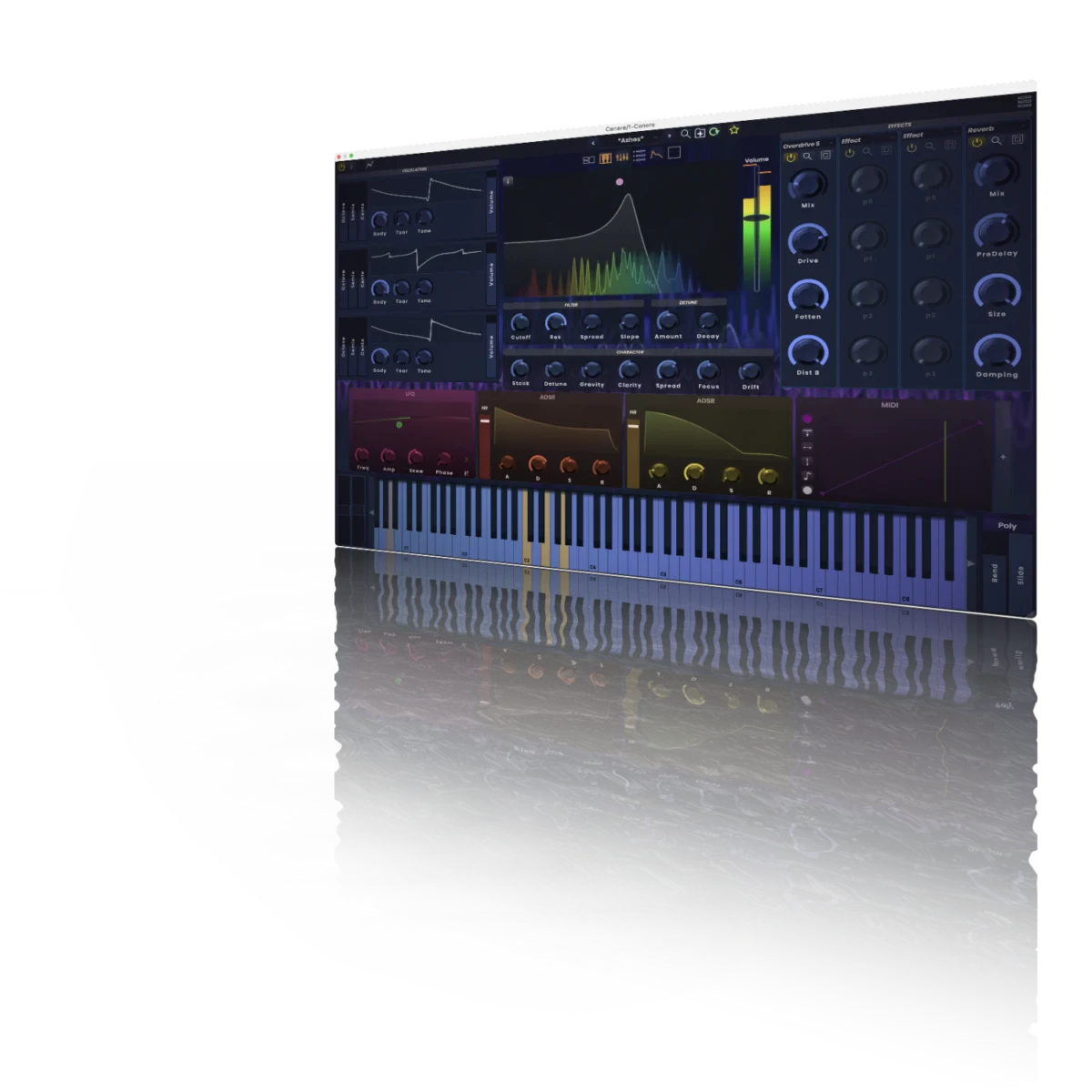
Stagecraft Software, a prominent developer in the digital audio workstation plugin market, has officially announced the release of Cenere, a new subtractive synthesizer designed to bridge the gap between the organic warmth of legacy analog hardware and the precision of contemporary wavetable synthesis. The instrument arrives as a comprehensive solution for sound designers and music producers seeking a high degree of modulation flexibility combined with a user interface that emphasizes visual feedback and intuitive control. Priced at $200 USD and available for both macOS and Windows platforms, Cenere represents a significant addition to Stagecraft’s growing portfolio of audio processing tools.
The synthesizer is built upon a hybrid engine that allows users to leverage traditional subtractive synthesis techniques—utilizing oscillators and filters to carve out sounds—while incorporating the complex harmonic structures afforded by modern wavetables. This dual-natured approach is intended to provide a palette that ranges from "sweet, light organs" to "growling, aggressive leads," according to the developer’s technical documentation. By integrating these two distinct synthesis methods, Stagecraft aims to capture the "drift" and "character" of vintage gear without sacrificing the clinical accuracy required for modern electronic music production.
Technical Architecture and Modulation Capabilities
At the core of Cenere’s design is a sophisticated modulation system that distinguishes it from more traditional software synthesizers. One of the standout features highlighted by Stagecraft Software is the ability to automate every parameter at audio rate. In most standard synthesizers, modulation signals (such as those from an LFO or envelope generator) operate at a lower "control rate" to save CPU cycles. By enabling audio-rate automation, Cenere allows for extremely fast modulation changes that can introduce complex sidebands and frequency modulation (FM) characteristics into the sound, resulting in textures that are far more intricate than those produced by standard control-rate modulation.
The synthesis engine is further augmented by a robust unison system. Cenere supports up to nine unison layers per voice, a feature designed to create thick, expansive soundscapes. To prevent these layers from sounding overly "static" or "digital," the software includes dedicated controls for drift and detune. These parameters are specifically calibrated to emulate the slight pitch instabilities found in classic voltage-controlled oscillators (VCOs) of the 1970s and 1980s. When pushed to its maximum settings, the unison engine is intended to make the digital instrument feel like analog hardware being pushed to its physical limits.
The filtering section of Cenere utilizes analog morphing filters. These filters are designed to transition smoothly between different filter states—such as low-pass, high-pass, and band-pass—without the stepping or digital artifacts often associated with software filters. This morphing capability allows for dynamic tonal shifts during a performance or throughout a programmed sequence, providing a level of expression that is highly sought after in genres ranging from cinematic scoring to industrial techno.
Historical Context and Developer Evolution
Stagecraft Software has spent several years establishing a reputation for creating plugins that prioritize a "visual first" approach to sound design. Prior to the release of Cenere, the company gained recognition for its "Addiction" synthesizer and various specialized effects like the "Bitcrush" and "AutoFilter" plugins. The development of Cenere marks a maturation of the company’s synthesis technology, moving toward a more premium, high-feature-set instrument intended to compete with industry-standard wavetable synths like Xfer Records’ Serum or Arturia’s Pigments.
The timeline of Cenere’s development reflects a broader trend in the audio industry: the move toward "hybridization." In the early 2010s, the market was largely divided between pure analog emulations and pure digital wavetable synths. However, as processing power has increased, developers have found ways to combine these worlds. Cenere is the result of several years of refinement at Stagecraft, incorporating feedback from their previous synth iterations to create a more streamlined yet powerful workflow.
Supporting Data and System Integration
The release of Cenere comes at a time when the virtual instrument market is experiencing steady growth. According to industry market reports, the global music production software market is expected to continue its expansion as more independent creators enter the field. Stagecraft’s decision to price Cenere at $200 places it in the professional tier of software instruments, signaling confidence in its feature set and sonic quality.
From a technical perspective, the software is optimized for modern computing environments. It is compatible with both Windows and macOS, supporting standard plugin formats such as VST3, AU, and AAX. This ensures that Cenere can be integrated into nearly any professional digital audio workstation (DAW), including Ableton Live, Logic Pro, Pro Tools, and FL Studio. The developer has also focused on ensuring that the visual interface is high-resolution and scalable, catering to the needs of producers using 4K monitors or multi-screen setups.
Official Positioning and Sound Design Versatility
In official statements regarding the launch, Stagecraft Software emphasized the versatility of the instrument’s signal path. The ability to "crank it up" to nine unison layers is positioned as a primary selling point for users who require "wall-of-sound" leads or deep, atmospheric pads. The inclusion of an onboard effects suite further extends the instrument’s utility, allowing users to apply processing like delay, reverb, and distortion within the plugin itself, rather than relying on external inserts.
The developer’s claim that Cenere can handle everything from "sweet organs to growling leads" is supported by the inclusion of a comprehensive preset library. These presets serve as a showcase for the synth’s range, demonstrating how the combination of wavetable oscillators and analog-style filtering can be applied to various musical contexts. For professional sound designers, the draw lies in the "drift" and "detune" parameters, which allow for a level of "organic imperfection" that is often missing in purely digital instruments.
Broader Impact and Market Implications
The introduction of Cenere is likely to influence the competitive landscape of mid-to-high-priced software synthesizers. While many developers have moved toward subscription models, Stagecraft’s adherence to a one-time purchase price of $200 appeals to a segment of the market that prefers perpetual licensing. This pricing strategy, combined with the synth’s deep feature set, positions Cenere as a long-term investment for a studio’s toolkit.
Furthermore, the emphasis on audio-rate automation reflects an increasing demand for "complex synthesis" tools. As listeners become accustomed to more sophisticated sound design in modern productions, tools that allow for extreme modulation—like Cenere—become essential for producers looking to innovate. The "analog morphing" aspect of the filters also taps into the persistent industry-wide desire for "warmth," a subjective tonal quality that remains a benchmark for digital audio quality.
Conclusion and Availability
Stagecraft Software’s Cenere stands as a testament to the ongoing evolution of software synthesis. By merging the historical strengths of subtractive synthesis with the modern advantages of wavetable technology and high-speed modulation, Stagecraft has produced an instrument that is both a nod to the past and a tool for the future. The inclusion of drift and detune parameters, alongside nine-layer unison and audio-rate automation, provides a level of control that allows for highly nuanced sound creation.
Cenere is currently available for purchase directly through the Stagecraft Software website. The $200 USD price tag includes installers for both Mac and Windows systems, and the plugin is compatible with most major DAWs. As the music production community begins to integrate Cenere into its workflows, the synth’s reputation will likely be built on its ability to deliver the "maxed out" analog feel that Stagecraft has promised, backed by the precision of a modern digital engine. With its launch, Stagecraft Software reaffirms its commitment to providing high-quality, visually engaging tools for the modern recording artist.
