

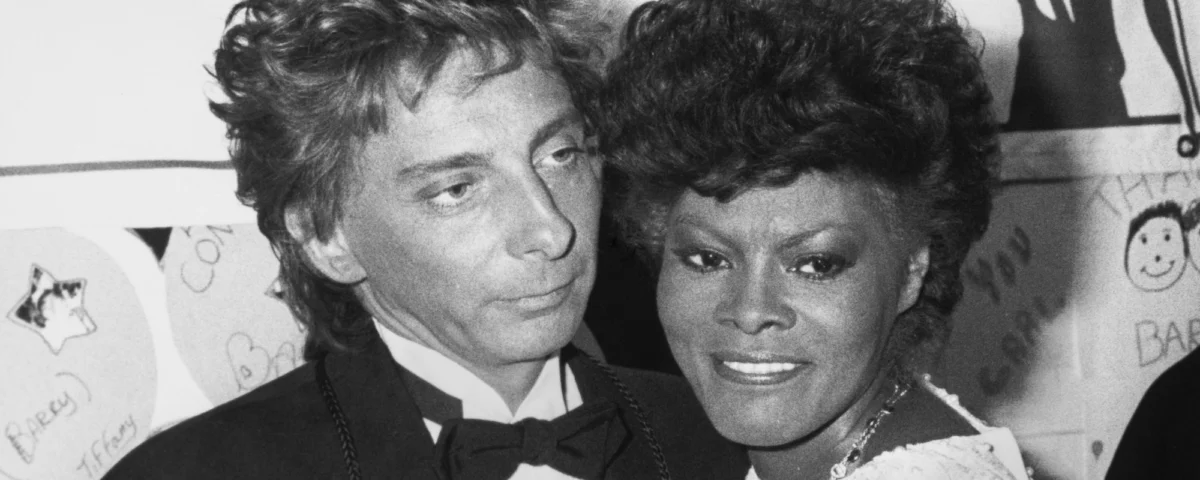
The landscape of American popular music in the late 1970s was defined by a shift toward polished, adult contemporary sounds, a movement spearheaded by Arista Records and its visionary leader, Clive Davis. At the heart of this era was an unexpected but profoundly successful collaboration between two industry titans: the master of the pop hook, Barry Manilow, and the sophisticated songstress, Dionne Warwick. By 1979, Manilow had transitioned from a jingle writer and Bette Midler’s musical director into a global superstar and a highly disciplined producer. Warwick, meanwhile, was a legendary figure with nearly two dozen albums to her name, yet she found herself at a commercial crossroads. The intersection of their careers not only revitalized Warwick’s chart presence but also cemented Manilow’s reputation as one of the era’s most effective producers and arrangers.
The Architect of a Comeback: Clive Davis and the 1979 Sessions
The partnership began when Clive Davis facilitated a meeting between the two artists to discuss Warwick’s debut for Arista Records, simply titled Dionne. At the time, Manilow was arguably the busiest man in music, balancing his own massive touring schedule with production duties. Despite his success, industry whispers suggested that Warwick, a seasoned veteran of the Scepter and Warner Bros. eras, might be a challenging collaborator. Manilow later recalled these warnings, noting that people cautioned him about her potential difficulty in the studio. However, the reality proved to be the opposite.
The sessions for Dionne were characterized by a high degree of mutual respect and creative synergy. Manilow found in Warwick a vocalist of unparalleled precision and emotional depth. He frequently remarked that the recording process felt more like a daily social gathering than a grueling professional obligation. This atmosphere of ease translated into the music, as Warwick explored the upper registers of her vocal range—notes Manilow admitted he didn’t initially know she possessed. The result was a platinum-certified album that peaked at No. 12 on the Billboard 200, yielding two of Warwick’s most enduring hits: "I’ll Never Love This Way Again" and "Déjà Vu." While Manilow did not write these specific hits, his production was the catalyst that brought them to life, earning Warwick two Grammy Awards in 1980 for Best Female Pop Vocal Performance and Best Female R&B Vocal Performance.
Deep Dive into the Manilow-Penned Classics of 1979
While Manilow’s production was the overarching framework of the Dionne album, his contributions as a songwriter were equally vital. Working with his longtime lyrical collaborators, he tailored several tracks specifically for Warwick’s sophisticated delivery.
"In Your Eyes" (1979)
Co-written by Manilow alongside Jack Feldman and Bruce Sussman—the team responsible for "Copacabana (At the Copa)"—"In Your Eyes" is a poignant exploration of a fraying relationship. The lyrics describe the painful realization that a partner’s affection has shifted: "It’s in your eyes / I see that you wanna run away / And in your eyes / I don’t see the kind of love you say." The track showcases Manilow’s ability to blend theatrical melodrama with pop accessibility, providing Warwick with a narrative arc that she navigated with characteristic grace.
"All the Time" (1979)
The closing track of the album, "All the Time," remains one of the most personal entries in the Manilow-Warwick catalog. Written with Marty Panzer, the lyricist behind Manilow’s "Even Now" and Kenny Rogers’ "Through the Years," the song deals with themes of isolation and the eventual redemption found in a soulmate. The song serves as a vulnerable confession: "All the time I thought there’s only me / Crazy in a way / That no one else could be." Manilow’s arrangement for the track emphasizes Warwick’s ability to convey intimacy, making it a standout ballad that resonated deeply with fans of the adult contemporary genre.
The Mid-Eighties Expansion: Finder of Lost Loves and Friends
The professional bond between Manilow and Warwick extended well into the 1980s. By 1985, Warwick was experiencing a second career peak, participating in the "We Are the World" charity single and collaborating with a new generation of songwriters. However, she returned to Manilow for her album Finder of Lost Loves. This project was a star-studded affair, featuring contributions from Stevie Wonder and Burt Bacharach, yet Manilow’s influence remained a cornerstone of the record.
In this period, Manilow and Warwick finally stepped in front of the microphone together for a cover of the Bee Gees’ 1972 hit "Run to Me." Their voices blended seamlessly, bridging the gap between Manilow’s pop sensibilities and Warwick’s soulful phrasing. Beyond the duet, Manilow contributed two more original compositions to the album.
"It’s Love" (1985)
Written with Adrienne Anderson, "It’s Love" is a celebratory, mid-tempo track that captures the excitement of a new romance. The lyrics—"I can tell by the way / That he’s looking at me, it’s love"—offered a lighter, more rhythmic contrast to the heavy ballads of their earlier work. Manilow’s production on this track incorporated the synthesizer-heavy textures of the mid-80s while maintaining the melodic integrity that was his trademark.

"Bedroom Eyes" (1985)
Again collaborating with Feldman and Sussman, Manilow provided Warwick with "Bedroom Eyes," a track that leaned into a more sultry, atmospheric sound. The song’s lyrics—"Your eyes, those bedroom eyes / They hypnotize with their desire"—allowed Warwick to showcase a more seductive side of her vocal persona. It was a testament to the versatility of their partnership that they could move from the innocence of "All the Time" to the sophisticated allure of "Bedroom Eyes" over the course of six years.
The Lost Duet: "Never Gonna Let You Get Away"
One of the most intriguing chapters in the Manilow-Warwick history is the story of "Never Gonna Let You Get Away." Originally written by Manilow and recorded in 1976 by his backup group, Lady Flash (Debra Byrd, Monica Pege, and Reparata Mazzola) for their album Beauties in the Night, the song was a soulful, soaring ballad.
During the 1979 Dionne sessions, Manilow and Warwick recorded a duet version of the track, intended for inclusion on the album. For reasons that remain a subject of debate among music historians—likely involving album length or label sequencing preferences—the duet was shelved. It remained in the vaults for nearly four decades, becoming a "holy grail" for collectors. The song finally saw the light of day in 2018, featured in the PBS documentary My Music: Dionne Warwick – Then Came You and the compilation Dionne Warwick: Hits & Rarities 1974-1999. The eventual release confirmed what many had suspected: the vocal chemistry between the two in 1979 was electric, capturing a moment in time when both artists were at the height of their powers.
Technical Analysis and Production Style
The success of the Manilow-Warwick collaborations can be attributed to Manilow’s specific approach to "The Arista Sound." Manilow’s background in commercial jingles gave him an acute sense of brevity and "the hook," but his training as an arranger allowed him to build complex, orchestral crescendos.
When producing Warwick, Manilow utilized a "vocal-first" philosophy. He often stripped back the instrumentation during the verses to allow Warwick’s diction and phrasing to take center stage, building the arrangement toward a dramatic "Manilow modulation" in the final chorus. This technique is evident in "I’ll Never Love This Way Again," where the production supports the vocal without ever overwhelming it. Furthermore, Manilow’s use of session musicians—often the best in the business—ensured that the recordings had a timeless, high-fidelity quality that allowed them to transition easily from AM radio to the burgeoning FM "Soft Rock" formats.
Broader Impact and Industry Implications
The Manilow-Warwick partnership was a blueprint for the "diva comeback" strategy that Clive Davis would later use with artists like Aretha Franklin and Whitney Houston. By pairing a legendary voice with a contemporary hitmaker who respected the artist’s legacy, Arista Records proved that "legacy acts" were still commercially viable in a rapidly changing market.
For Manilow, producing Warwick was a crucial step in diversifying his career. It proved he could steer a project to Grammy-winning heights for someone other than himself, a feat that garnered him immense respect within the industry. For Warwick, the collaboration was a lifeline that re-established her as a premier interpreter of the Great American Songbook and modern pop alike.
The friendship between the two survived long after their chart-topping days. They continued to perform together in various television specials and tribute concerts, most notably the 1988 Starlight Foundation Humanitarian Awards. Their bond was built on a foundation of shared work ethic and a mutual love for the craft of songwriting.
Chronological Summary of Major Collaborative Works
- 1979: Release of the album Dionne. Produced by Barry Manilow.
- "In Your Eyes" (Songwriter: Manilow/Feldman/Sussman)
- "All the Time" (Songwriter: Manilow/Panzer)
- "I’ll Never Love This Way Again" (Producer: Manilow)
- "Déjà Vu" (Producer: Manilow)
- 1980: Joint performance on the TV special One Voice.
- 1985: Release of the album Finder of Lost Loves.
- "Run to Me" (Duet with Manilow)
- "It’s Love" (Songwriter: Manilow/Anderson)
- "Bedroom Eyes" (Songwriter: Manilow/Feldman/Sussman)
- 1985: Release of the album Friends.
- "No One There (To Sing Me a Love Song)" (Producer: Manilow)
- 2018: Official release of the 1979 duet "Never Gonna Let You Get Away."
The legacy of Barry Manilow and Dionne Warwick remains a high-water mark for pop collaboration. In an era often criticized for over-production, their work together stood out for its emotional clarity and musical integrity. They didn’t just make records; they crafted a sophisticated soundscape that defined the aspirations and heartbreaks of a generation. Through their shared catalog, the "Manilow magic" and the "Warwick elegance" continue to resonate, proving that when two masters of their craft unite, the results are truly timeless.
