

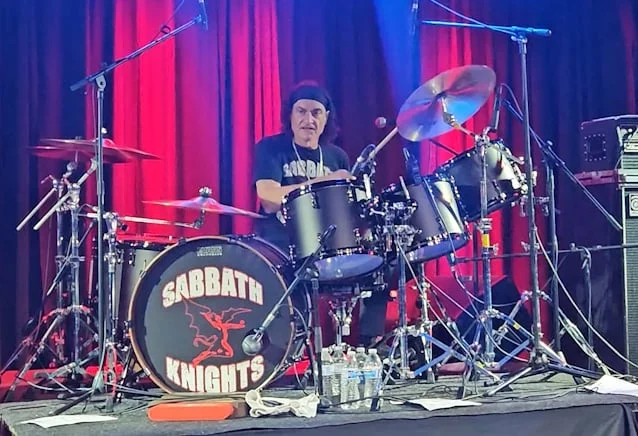
Legendary drummer Vinny Appice, a titan behind the drum kits of iconic bands like Black Sabbath and Dio, recently sat down with Eddie Trunk on SiriusXM’s "Trunk Nation" to delve into the intricacies of his drumming style, most notably his steadfast commitment to a single bass drum. The conversation, which aired on March 25th, provided a fascinating glimpse into the artistic choices that have shaped Appice’s illustrious career, revealing a deliberate philosophy rooted in the influences of drumming giants and a pursuit of singular power and precision.
The Genesis of a Singular Approach
Appice, whose career spans decades and includes collaborations with an array of rock royalty, including John Lennon, Rick Derringer, and Heaven & Hell, confessed that the allure of double bass drumming was a fleeting curiosity rather than a sustained pursuit. He recalled an early encounter with his brother, fellow drumming legend Carmine Appice, who utilized a double-bass setup. “No, I never did,” Vinny stated when asked about his use of double bass. “One time, when I was growing up, ‘cause [my brother, fellow legendary drummer] Carmine [Appice] had double bass, [I thought], ‘Oh, let me try double bass.’ And then I didn’t really get into it that much, and I thought, ‘Carmine’s doing so much with it, I’ll just stay with single bass.’ So, I just stayed with a single bass drum.”
This decision, seemingly minor at the time, became a defining characteristic of Appice’s sound. It wasn’t a lack of technical capability, but a conscious choice to refine and maximize the impact of a single instrument. His reasoning stemmed from a deep admiration for drummers who achieved monumental impact with a more minimalist setup. “I grew up heavily on [Led Zeppelin’s] John Bonham, who was one bass drum, one pedal, and Buddy Rich, who was the best ever — one pedal,” Appice explained. “So I thought, I’d rather have one strong, fast foot, powerful foot, than diluting it with two — not that these guys dilute it; they’re incredible, some of these guys. So I stayed with that one bass drum and kept it heavy, and I think it worked great playing with the bands I played with — with [Black] Sabbath and Dio, it was perfect.”
Influences and the Pursuit of Power
The reverence for John Bonham and Buddy Rich is a common thread among many drummers, but Appice’s interpretation of their influence goes beyond mere emulation. He saw in their single-pedal mastery an opportunity to cultivate a more potent and focused percussive attack. The implication here is a philosophical stance: rather than spreading technical focus across two bass drums, Appice dedicated himself to developing unparalleled strength, speed, and dexterity within his single foot. This commitment would translate into the thunderous, driving rhythms that became synonymous with his work in some of the most influential heavy metal bands.
The discussion then naturally gravitated towards the historical context of drumming techniques. When prompted by Eddie Trunk about jazz drummers and their adoption of double bass, Appice pointed to a pioneering figure. "Louie Bellson. He came around the Buddy Rich time, and he came out with double-bass drums, and that was, like, ‘Whoa. Wow.’ People hadn’t seen that before. And he was great; it was a great thing. But Buddy Rich was just so phenomenal. He was just so far ahead of everybody. He was gifted. He never practiced. It just was a gift from God that he could sit there and just crank it. It was just incredible. So he used one bass drum, so I was very influenced by Buddy… And then there’s ways to use the one bass drum to make it sound really powerful and heavier, almost like two bass drums here and there."
This analysis highlights a crucial point: Appice’s approach wasn’t about rejecting innovation, but about finding unique ways to achieve comparable or even superior sonic impact through refined technique. The ability to make a single bass drum "sound really powerful and heavier, almost like two bass drums" speaks to his mastery of dynamics, articulation, and rhythmic phrasing, allowing him to evoke a sense of immense power without the physical addition of another drum. This perspective positions Appice not as a traditionalist clinging to the past, but as an innovator within established parameters, pushing the boundaries of what a single bass drum could achieve.
The Discipline of a Drummer’s Physique and Health
Beyond his technical prowess, the interview also touched upon Appice’s personal well-being, particularly his strategies for maintaining peak physical condition at the age of 68. His candidness about managing Type 2 diabetes offers a relatable and informative dimension to his disciplined lifestyle.
"You know what? First of all, about 10, 12 years ago, I got diabetes type two. And when you get diabetes, you gotta watch the sugar — and the breads. Unfortunately, I’m Italian. I love the bread, I love pizza, the whole thing. So I wound up focusing on, okay, carbohydrates. If I’m gonna eat the carbohydrates, I get on an exercise bike or I play the drums, I go to walk. Me and my girl, we go walking every morning. And I try to eat good, and go to the gym. And I think the years of not taking any drugs — not that I did, [but] in the ‘80s, [Black Sabbath and Dio singer] Ronnie [James Dio] and I used to smoke a lot of pot, and that was it. I didn’t do the blow, I didn’t do any of that hard stuff. So I think that helped me along and [kept] me in good shape."
This statement provides valuable insight into the holistic approach Appice takes towards his health. The acknowledgment of his Italian heritage and the associated dietary challenges adds a layer of authenticity. His proactive measures, including cardiovascular exercise and consistent physical activity, underscore the commitment required to sustain a demanding performance career, especially when managing a chronic condition. Furthermore, his frank discussion about substance use in the past, and his assertion of avoiding harder drugs, subtly contrasts his lifestyle with that of some of his peers during a notoriously challenging era for musicians, suggesting a personal discipline that has contributed to his longevity and sustained vitality.
The Enduring Legacy of "Mr. Single Bass"
Appice’s preference for a single-bass setup is not a new revelation. He has spoken about it extensively throughout his career, even as far back as an interview with Metal Edge more than fifteen years prior. "Both Carmine and I started with a single bass. Then he moved over to double bass, so I thought I’d see if it was for me. It didn’t blow me away, so I just kept the single bass. I never used a double pedal either, so I’m known as ‘Mr. Single Bass.’ The good thing is that with a double bass your foot can’t get lazy, so I’ve got a lot of power with one foot and it’s fairly fast from playing with one just bass drum." This consistent articulation of his philosophy reinforces the deliberate nature of his choices and the pride he takes in mastering his chosen setup. The moniker "Mr. Single Bass" is not just a nickname; it’s a testament to his expertise and his ability to make that setup deliver maximum impact.
The Art of In-Song Drumming and Live Evolution
Appice’s drumming style is characterized by its integration within the song, rather than simply laying down a beat on top of it. This concept was explored in a December 2021 interview on the "All Access Live! With Kevin Rankin" podcast, where he described his approach as being "inside that song."
"I always say ‘I go where no man has gone before’ where some of these fills start. See, I play in the song. Whatever I do, I get into the song. I don’t play on top of the song. I hear a lot of drummers can play on top of the song and they’re just playing the song. I’m inside of that song, and that’s the way I hear the stuff. It’s kind of like an artist painting pictures, and I’m in there putting the colors in it. And I just hear it like that — fills that could go over the bar, maybe a bar and a half. And they start in an odd place. And luckily, that worked for me with Sabbath. Sabbath, I didn’t do quite as much because Sabbath was so legendary, you had to keep that in your mind that this is Black Sabbath and there’s a certain way to play fills that are a little darker maybe — not so much snare drum; more dark stuff. And then with Dio, anything went. And Ronnie [James Dio] never had a problem with me playing… nor did Sabbath; they never said ‘don’t play a fill there’ or anything like that. And Ronnie, I’d play over his vocal line. We kicked each other in the ass. When I hear him starting to go, I go, ‘Woah, dude.’ Now something comes out of me that got inspired; he inspired me. We fed off each other, absolutely."
This vivid analogy of painting pictures captures the essence of Appice’s improvisational genius. He doesn’t just execute fills; he weaves them into the fabric of the song, creating unexpected melodic and rhythmic counterpoints. His understanding of the sonic identity of Black Sabbath, a band known for its heavier, darker tones, and the more expansive freedom he experienced with Dio, demonstrates his adaptability and his respect for the artistic direction of each band. The dynamic interplay he describes with Ronnie James Dio, where vocal lines and drum fills inspire each other in real-time, is a testament to the profound musical connection they shared and a key factor in the potent energy of Dio’s live performances.
The evolution of his performance from studio recording to live spectacle was further elaborated upon: "Like one night, [Dio] played ‘The Last In Line,’ and at the third verse, [Ronnie] goes, ‘And you never, never, never come home.’ And then one night, he kept it going. He went, ‘Never, never, never, never, never, never, never…’ He kept it going. And I just heard that and I followed him," Vinny said. "And we went, ‘That was cool, dude.’ And we still do that. I’m playing with Last In Line now with Vivian [Campbell, former Dio guitarist]. And we do that. Andy Freeman [Last In Line singer] and I, we worked it out so that part’s in there."
This anecdote perfectly illustrates Appice’s philosophy of active listening and responsiveness on stage. The willingness to deviate from the recorded part and spontaneously react to a bandmate’s improvisation not only keeps the performance fresh but also deepens the connection between musicians and the audience. This adaptability is a hallmark of seasoned performers and a crucial element in maintaining the excitement and raw energy of live music.
"See, I’m always listening," Appice continued. "Drummers, you’ve gotta listen to what’s going on on stage. I don’t close my eyes and space out. I look around. I’m scanning the stage. If I’m hearing somebody playing something, maybe I’ll jump on it. That keeps it really exciting. That’s why I don’t play the same stuff every night. Certain fills are the same. But then I go kick in the ass as much as I could."
This commitment to awareness and engagement transforms each performance into a unique experience. It’s a philosophy that transcends mere technical execution, emphasizing the collaborative and dynamic nature of live music. The ability to consistently deliver powerful performances while remaining open to spontaneous musical dialogue is a rare talent, and one that has cemented Vinny Appice’s legacy as a true master of his craft.
A Legacy Etched in Sound and Instruction
Vinny Appice’s prolific career has seen him contribute to dozens of albums and CDs, many achieving multi-platinum status. His drumming can be heard on soundtracks for films such as "Wayne’s World 2," "Heavy Metal," "Iron Eagle," and "Bedazzled," further attesting to the broad appeal and impact of his percussive artistry. Beyond his performance work, Appice has also dedicated himself to educating future generations of drummers. He is the author of the instructional book "Rock Steady" and the DVD "Hard Rock Drumming Techniques," both of which offer invaluable insights into his approach. His power-driven drum clinics have taken him around the globe, inspiring countless aspiring musicians. The consistent mention of his drumming style in numerous books about Black Sabbath and Dio further solidifies his place in the pantheon of rock drumming legends, a testament to the enduring power and influence of his singular approach.
