

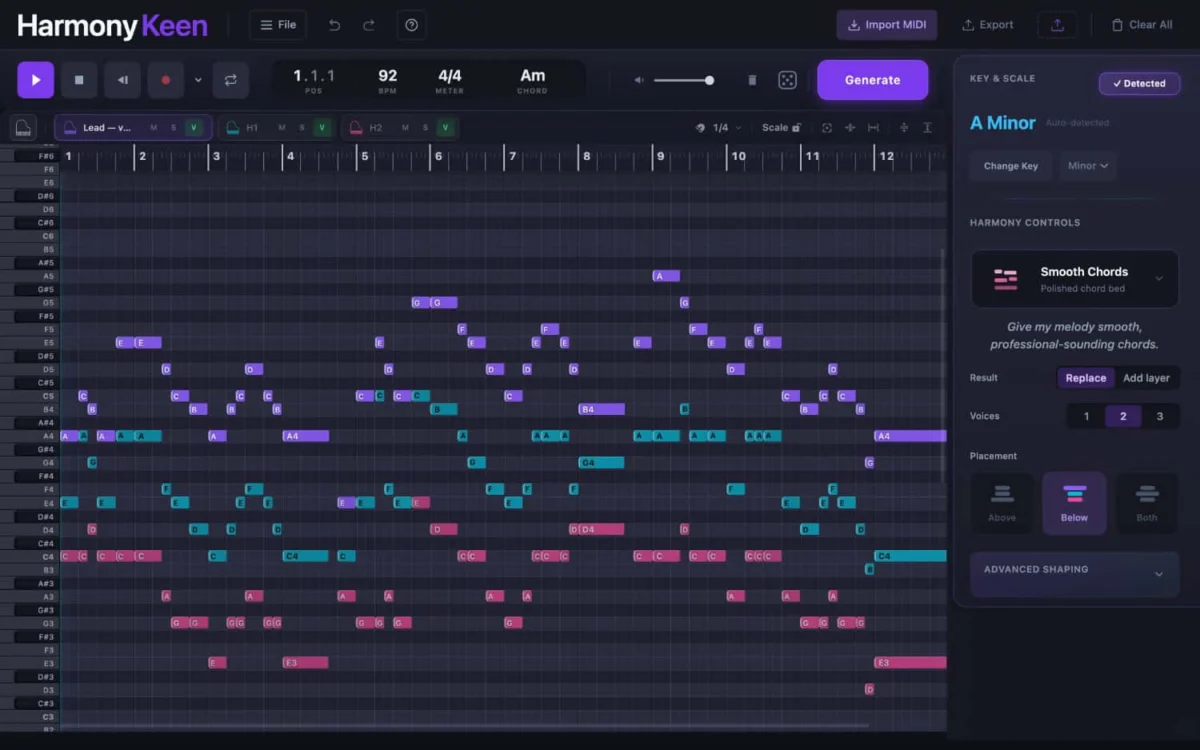
The landscape of digital music production has seen a significant shift toward automated creative assistance, yet the method by which these tools generate content remains a point of intense debate among professionals. Developer Thom Haslam has entered this arena with the release of HarmonyKeen, a specialized harmony assistant designed to bridge the gap between simple melodic ideas and complex, multi-part arrangements. Unlike many contemporary tools that rely on generative artificial intelligence or black-box neural networks, HarmonyKeen utilizes a deterministic engine built upon the foundational rules of classical music theory and voice leading. This release marks a notable moment for composers who require predictable, editable, and theoretically sound accompaniments for their monophonic MIDI inputs.
Technical Architecture and the Logic of Voice Leading
At its core, HarmonyKeen functions as a sophisticated algorithmic translator. The software takes a monophonic MIDI melody—a single line of notes—and processes it through a series of music theory filters. The primary distinction of Haslam’s approach is the software’s commitment to "voice leading." In traditional music composition, voice leading refers to the linear movement of individual musical lines (voices) and how they interact to form chords. The goal is often to create smooth, independent motions that avoid common pitfalls such as parallel fifths or awkward melodic leaps.
HarmonyKeen’s engine does not merely "guess" the next note based on a database of existing songs. Instead, it performs a holistic analysis of the provided melody. The process begins with the software reading the entire melody to identify structural markers, such as phrases and cadences. Cadences—the points of arrival or rest at the end of a musical phrase—are critical in Western harmony for establishing tonality and providing a sense of resolution. By identifying these points first, the software can work backward to select a chord sequence that logically leads to the resolution, mirroring the workflow of a human arranger.
Because the system is based on set rules rather than probabilistic models, it is entirely deterministic. This means that if a user provides the same input melody and maintains the same settings, the software will produce the exact same harmonic output every time. For professional composers working on tight deadlines or within specific stylistic constraints, this level of predictability is often preferred over the randomness inherent in modern AI-driven systems.
Versatility in Arrangement Styles
HarmonyKeen is designed to serve a variety of musical genres and ensemble types. The software offers several presets and modes that dictate the density and complexity of the generated harmony. These styles range from minimalist additions to full-scale ensemble arrangements:
- Single Added Lines: For producers looking for a simple counter-melody or a "doubled" feel that adds texture without overwhelming the lead.
- Close Vocal Harmony: Optimized for three- or four-part vocal arrangements, often seen in pop, barbershop, or jazz contexts where the voices stay in a tight range.
- Four-Part Writing (SATB): A rigorous application of the Soprano, Alto, Tenor, and Bass format. This is the standard for choral music and classical string quartets, adhering strictly to traditional part-writing rules.
- Fuller Arrangements: These settings generate more expansive textures suitable for orchestral sketches or complex synthesizer pads.
The output of HarmonyKeen is entirely MIDI-based. This is a critical feature for integration into modern Digital Audio Workstations (DAWs). Rather than generating audio that might be difficult to manipulate, the software provides editable MIDI data. This allows producers to assign different virtual instruments to each voice—for example, sending the soprano line to a flute, the alto to an oboe, and the lower voices to a cello and bass.
Bridging the Gap Between Intuition and Theory
The release of HarmonyKeen highlights a recurring challenge in the music industry: the "theory gap." Many talented producers and songwriters possess a strong intuitive sense of melody but may lack the formal training required to write complex four-part counterpoint or navigate intricate harmonic transitions. Historically, this has required either years of study or the hiring of a professional orchestrator.
HarmonyKeen positions itself as a "bridge" tool. By automating the mechanical aspects of music theory—such as ensuring a third is present in every chord or managing the resolution of leading tones—it allows the creator to focus on the emotional and timbral aspects of the composition. However, because the MIDI remains fully editable, the user is never locked into the software’s decisions. It serves as a sophisticated starting point that can be refined by hand.
Development Context and Market Position
Thom Haslam’s development of HarmonyKeen comes at a time when the market is saturated with "smart" plugins. Competitors such as Mixed In Key’s Captain Chords, Scaler 2, and various AI-based MIDI generators offer similar promises of simplified composition. However, most of these tools are "chord-first," meaning the user chooses a chord progression and then writes a melody over it. HarmonyKeen reverses this workflow, making it "melody-first."
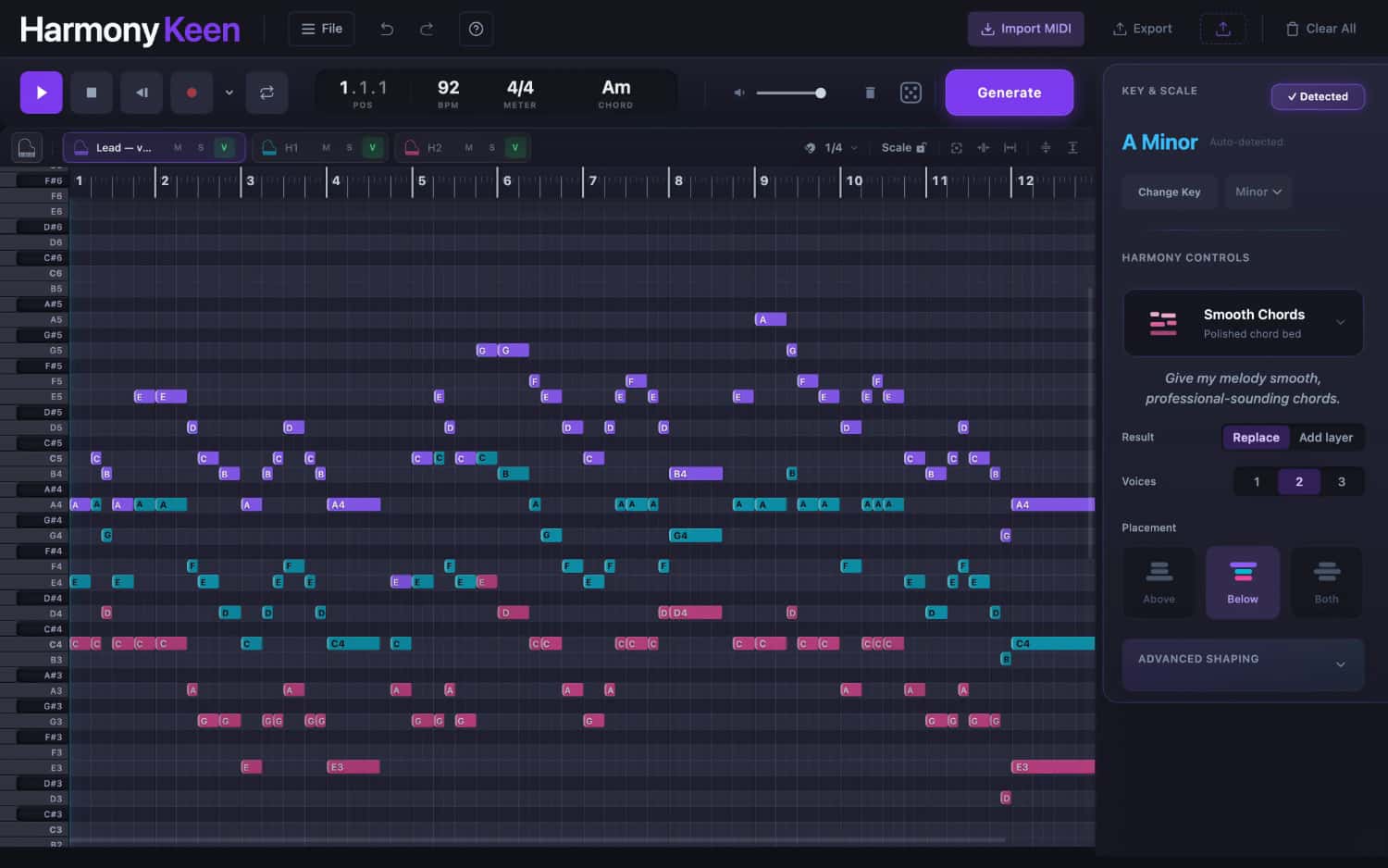
This distinction is vital for film scorers and songwriters who often start with a thematic motif. In a cinematic context, a melody might need to remain consistent while the harmony underneath changes to alter the mood (reharmonization). HarmonyKeen’s ability to analyze an existing melody and find a fitting chord sequence makes it a unique utility in a composer’s toolkit.
The software is available as a standalone application for macOS and Windows, as well as in VST3 and Audio Unit (AU) formats. This ensures compatibility with nearly every major DAW, including Ableton Live, Logic Pro, Cubase, and FL Studio. The inclusion of a standalone version also suggests utility for music educators and students who may wish to explore harmonic concepts without the overhead of a full production environment.
The Evolution of Algorithmic Composition
To understand the significance of HarmonyKeen, one must look at the history of algorithmic music. The concept of using rules to generate music dates back centuries, most famously seen in the "Musikalisches Würfelspiel" (Musical Dice Game) attributed to Mozart. In the digital age, this evolved into software like Band-in-a-Box in the late 1980s, which used style files to generate accompaniments.
In the 2010s, the focus shifted toward "big data" and neural networks. These systems were trained on thousands of MIDI files to mimic the style of Bach or The Beatles. While impressive, these systems often suffer from "hallucinations"—musical phrases that make no sense in a structural context—and a lack of transparency. HarmonyKeen represents a return to "Good Old Fashioned AI" (GOFAI), or symbolic AI, where the intelligence is derived from human-coded logic and mathematical rules. This ensures that the output is always "grammatically" correct in the language of Western music theory.
Pricing and Availability
HarmonyKeen is currently available through the official website. To encourage early adoption among the production community, Thom Haslam has launched the software with an introductory price of $59 USD. Following the initial promotional period, the price is expected to rise to its standard MSRP of $79 USD. A single license grants the user access to all formats—standalone, VST3, and AU—allowing for a flexible workflow across different machines and environments.
The developer has also provided a dedicated "Hear It" section on the product website, featuring a wide array of audio examples. These demonstrations show the software tackling various melodic challenges, from simple folk tunes to more chromatic and complex modern lines, providing prospective users with a clear understanding of the engine’s capabilities.
Broader Implications for the Music Industry
The introduction of tools like HarmonyKeen raises important questions about the future of music education and professional craftsmanship. On one hand, purists may argue that automating harmony reduces the need for musicians to learn the "craft" of composition. On the other hand, proponents of music technology argue that these tools democratize creativity, allowing a wider range of people to express complex musical ideas.
For the professional sector, HarmonyKeen is less about replacing the composer and more about increasing efficiency. In the high-pressure world of television and game scoring, where a composer may need to produce 20 minutes of music a week, a tool that can instantly generate a technically correct string arrangement from a lead line is an invaluable asset. It eliminates the "blank page" syndrome and handles the tedious aspects of part-writing, leaving the composer free to make high-level creative decisions.
Furthermore, HarmonyKeen’s deterministic nature makes it a reliable tool for live performance. Musicians using laptops on stage can feed live MIDI melodies into the software and receive harmonized backing in real-time, knowing that the software will not produce unexpected or dissonant results due to a random seed in a neural network.
Conclusion
Thom Haslam’s HarmonyKeen is a focused, theory-driven solution for a specific problem in music production. By prioritizing the rules of voice leading and providing a melody-first workflow, it carves out a distinct niche in the crowded market of MIDI assistance tools. As the industry continues to grapple with the role of automation, HarmonyKeen stands as a testament to the enduring relevance of classical music theory in a digital age. Whether used as an educational aid, a creative spark, or a professional time-saver, it offers a structured and reliable approach to the complex art of harmony.
