

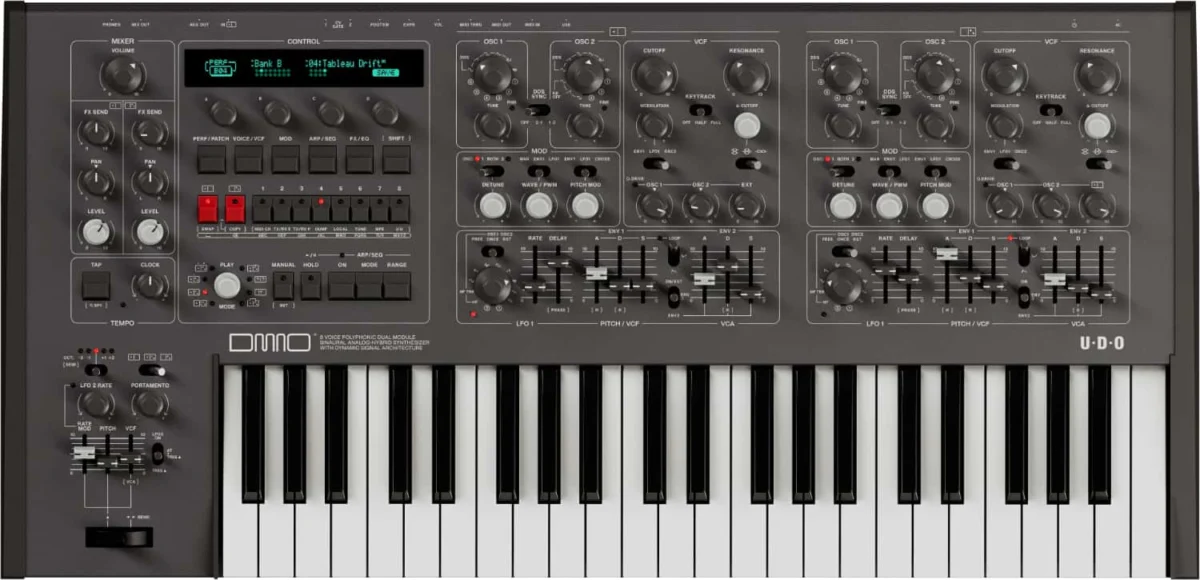
The UDO Audio DMNO, a highly anticipated multitimbral polyphonic synthesizer, has officially entered the commercial market, marking a significant expansion of the British manufacturer’s hardware portfolio. Following the success of the Super 6 and the flagship Super Gemini, the DMNO—often referred to during its development as the "Domino"—represents UDO Audio’s latest foray into high-end analog-hybrid synthesis. The instrument arrives with a sophisticated architecture that balances the precision of digital control with the organic character of analog signal paths, specifically designed to facilitate sonic exploration and complex sound design through its unique feedback-driven workflows.
Architectural Overview and Core Specifications
The UDO Audio DMNO is an 8-voice, 2-part multitimbral synthesizer. Its internal architecture is comprised of two independent 4-voice analog-hybrid synthesizer engines. This dual-engine design allows users to layer two distinct sounds, split the keyboard for different timbres, or treat the instrument as two separate instruments controlled via different MIDI channels.
At the heart of the DMNO is the newly developed Dynamic Multi-Core Stereo VCF (Voltage Controlled Filter). Unlike standard filters that process a mono signal or a simple stereo pair, the DMNO’s filter architecture is designed to maintain a true stereo signal path from the oscillator stage through to the output. This "Super" synthesis approach, a hallmark of George Hearn’s design philosophy at UDO, ensures that the spatial characteristics of the sound remain intact, providing a wider and more immersive sonic image than traditional monaural-path polyphonic synthesizers.
The oscillators utilize Direct Digital Synthesis (DDS) technology, typically powered by a high-resolution FPGA (Field Programmable Gate Array). This allows for exceptionally high sample rates and a lack of aliasing, providing the stability of digital oscillators while retaining the ability to produce complex, evolving waveforms. These oscillators feed into the analog filters, creating a hybrid signal chain that leverages the strengths of both domains: the flexibility and stability of digital synthesis and the warmth and harmonic saturation of analog filtering.
Expert Evaluations and Initial Field Testing
The release of the DMNO has been met with a series of comprehensive reviews from prominent figures in the synthesizer community, providing a multi-faceted look at the instrument’s capabilities.
Ziv Eliraz, the synthesist behind the influential Loopop channel, provided an exhaustive technical breakdown of the DMNO’s workflow. Eliraz highlighted the instrument’s propensity for "happy accidents," a term used to describe the intuitive results of the synthesizer’s feedback loops and modulation routing. According to Eliraz, the DMNO is designed for exploration, encouraging users to push the boundaries of conventional synthesis. His review noted the instrument’s tactile interface, which prioritizes hands-on control over deep menu diving, a consistent design choice in UDO’s product line.
Synthesist Starsky Carr offered a comparative analysis, focusing on the DMNO’s sonic character relative to its predecessors. Carr’s evaluation centered on the richness of the analog-hybrid path, noting that while the DMNO occupies a smaller footprint than the Super Gemini, it does not compromise on the "weight" or "presence" of its output. His review emphasized the effectiveness of the 2-part multitimbrality, which allows for the creation of dense, cinematic textures that would typically require multiple hardware units.
Contributing to the DMNO’s factory library, composer and sound designer Hazel Mills demonstrated the practical application of the synthesizer in a professional production context. Mills showcased a variety of patches that highlight the versatility of the DMNO, ranging from delicate, crystalline leads to aggressive, modulated basses. Her contribution underscores the instrument’s appeal to professional musicians who require a reliable yet creative tool for both studio and stage use.
Further demonstrating the instrument’s performance capabilities, Martin Stürtzer, known for his work in the ambient and electronic genres, released an improvisation featuring the DMNO. Stürtzer’s performance utilized deep unison drones and modulated pad sounds, illustrating the synthesizer’s ability to handle long-form, evolving soundscapes. Stürtzer noted that the DMNO’s internal sequencer patterns and built-in delay effects provide a robust foundation for live performance, though he complemented the internal effects with external reverb for his specific ambient requirements.
Chronology of Development and Market Context
The journey of the DMNO began as a conceptual expansion of the technology first introduced in the UDO Super 6, which debuted in 2019. The Super 6 was praised for its binaural signal path, a feature that set it apart in a crowded market of polyphonic synthesizers. Following the Super 6, UDO released the Super Gemini, a dual-layer powerhouse that effectively doubled the capabilities of the original design.
The DMNO was developed to fill a specific niche: a more compact, desktop-friendly unit that retains the sophisticated multitimbral capabilities of the larger models. The announcement of the DMNO followed months of industry speculation and teaser appearances at major trade shows like Superbooth in Berlin. Its official release in late 2024 represents the culmination of UDO Audio’s efforts to streamline their high-end synthesis technology into a form factor that appeals to modern producers with limited studio space but high demands for sonic quality.
Technical Deep Dive: The Dynamic Multi-Core Stereo VCF
The "Dynamic Multi-Core" aspect of the DMNO’s filter is perhaps its most significant technical innovation. Traditional analog filters can often lose low-end presence when resonance is increased, or they may behave in a predictable, linear fashion. UDO’s new VCF is designed to respond dynamically to the input signal and modulation sources, allowing for more organic and unpredictable (yet musical) tonal shifts.
The filter is a 4-pole low-pass design but includes several modes that allow for high-pass and band-pass characteristics. Because the DMNO is 2-part multitimbral, each part has its own dedicated filter section, allowing for complex interactions between the two layers. This is particularly effective when using the cross-modulation features, where one engine can modulate parameters of the other, leading to the "feedback" and "exploration" themes noted by early reviewers.
Broader Industry Impact and Implications
The release of the UDO DMNO arrives at a time when the synthesizer market is seeing a resurgence in high-end, boutique hardware. While software synthesizers offer immense flexibility, the tactile experience and dedicated DSP/analog signal paths of hardware remain highly sought after by professionals.
The DMNO competes in a market segment occupied by established brands like Sequential, Novation, and Arturia. However, UDO Audio distinguishes itself through its commitment to the binaural/stereo signal path and the use of high-performance FPGA technology. By offering an 8-voice multitimbral unit in a desktop format, UDO is positioning the DMNO as a centerpiece for hybrid studio setups.
The implications for sound design are significant. The ability to manage two independent 4-voice engines with such a high degree of stereo movement allows for a level of spatial complexity that is difficult to achieve with standard mono-path synthesizers. This makes the DMNO particularly attractive for film scoring, ambient music, and modern electronic production where stereo width and texture are paramount.
Supporting Data and Connectivity
The DMNO is designed to integrate seamlessly into modern production environments. It features a comprehensive array of connectivity options:
- Stereo Outputs: Independent outputs for the two parts, allowing for separate processing in a mixer or DAW.
- MIDI Integration: Full MIDI In/Out/Thru via 5-pin DIN and USB-MIDI, ensuring compatibility with both vintage gear and modern computers.
- Clock Sync: External clock input for synchronizing the internal sequencers and arpeggiators with modular systems or drum machines.
- Build Quality: The unit features a robust metal chassis and high-quality sliders and pots, consistent with UDO’s reputation for industrial-grade build quality.
The inclusion of high-quality internal effects, such as the delay mentioned by Martin Stürtzer, adds to the unit’s value as a standalone instrument. While many synthesists still prefer external processing for reverb, the DMNO’s internal delay is tightly integrated into the modulation matrix, allowing for time-based effects that can be modulated by the LFOs or envelopes for rhythmic complexity.
Conclusion and Future Outlook
The UDO Audio DMNO Multitimbral Polyphonic Synthesizer is more than just a scaled-down version of its predecessors; it is a refined evolution of the "Super" synthesis concept. By providing two independent engines and a revolutionary new filter design, UDO has created an instrument that prioritizes the "happy accidents" and deep exploration that many modern musicians feel is missing from purely digital or overly simplified hardware.
As initial units reach consumers and more artists share their findings, the DMNO is expected to solidify its place as a modern classic in the hybrid synthesizer category. Its balance of multitimbral power, stereo architecture, and tactile workflow addresses the needs of a diverse range of musicians, from studio-bound composers to live electronic performers. The success of the DMNO will likely influence future designs from UDO Audio, as the company continues to push the boundaries of what is possible in the realm of polyphonic synthesis.
