

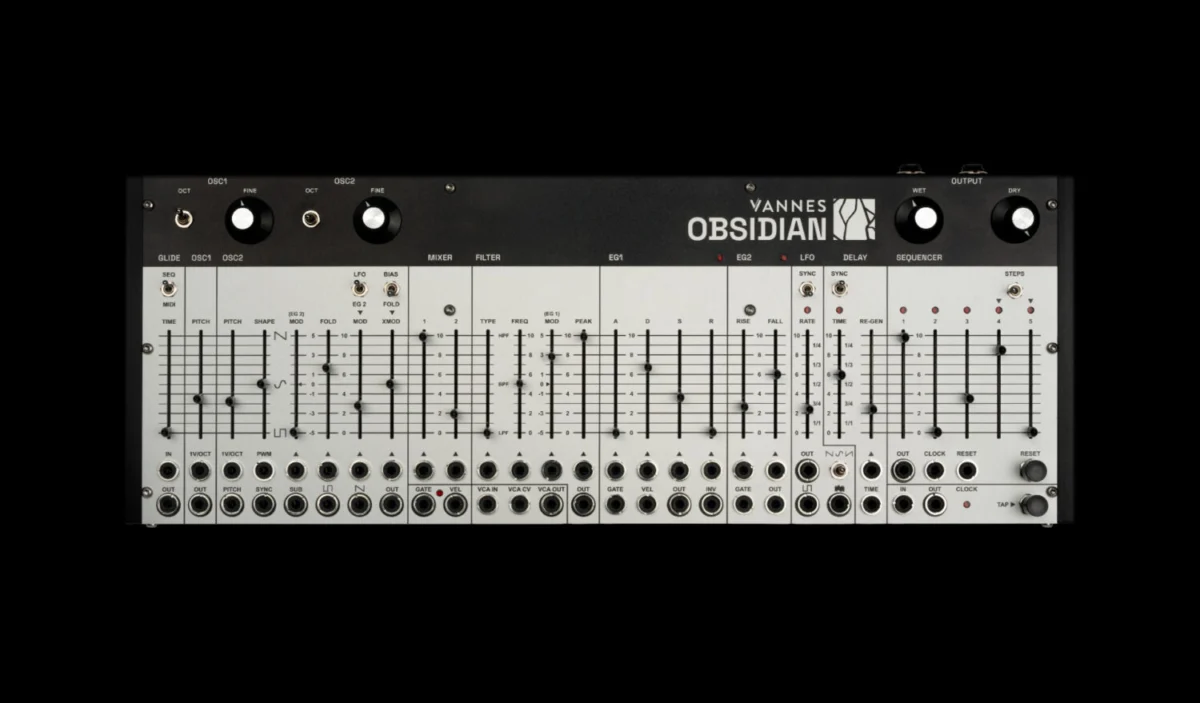
The electronic musical instrument industry has seen a significant shift toward boutique, specialized hardware, and the latest entry into this competitive landscape comes from Vannes Devices with the announcement of the Obsidian desktop synthesizer. Revealed through a comprehensive sneak preview titled "Keys & Steps," the Obsidian represents a departure from traditional subtractive synthesis, leaning heavily into the "West Coast" philosophy of sound design. This architectural choice places the instrument in a niche category of synthesizers that prioritize additive synthesis, complex wavefolding, and non-linear modulation over the more common oscillator-filter-amplifier signal path popularized by East Coast pioneers like Robert Moog.
The Obsidian is designed as a standalone desktop unit, emphasizing a tactile, hands-on user experience that bypasses the menu-diving often associated with modern digital or hybrid instruments. By integrating a dedicated sequencing environment directly into the hardware, Vannes Devices aims to provide a comprehensive workstation for experimental soundscapes, percussive timbres, and evolving melodic patterns. While the company has yet to release a full technical specification sheet, the preview highlights a focus on immediate playability and real-time manipulation, features that are increasingly prioritized by live performers and studio producers alike.
The Architectural Shift: Understanding West Coast Influence
To understand the significance of the Obsidian, one must look at the historical context of synthesis. The "West Coast" style, pioneered by Don Buchla in the 1960s, focuses on creating complex timbres from relatively simple starting points. Unlike East Coast synthesis, which starts with harmonically rich waveforms (like sawtooth or square waves) and removes frequencies using a filter, West Coast synthesis often begins with a pure sine wave. This wave is then processed through frequency modulation (FM) and wavefolders to add harmonics, resulting in organic, metallic, or woody textures.
The Obsidian appears to embrace these principles through its internal signal routing. By utilizing wavefolding—a process where the peaks of a waveform are "folded" back onto themselves when they exceed a certain threshold—the Obsidian can generate a vast array of overtones that are difficult to achieve with standard subtractive methods. This approach is often complemented by Low Pass Gates (LPGs), which combine the functions of a filter and an amplifier to simulate the natural decay of struck objects, such as bells or drums. The inclusion of this architecture in a desktop format suggests that Vannes Devices is targeting a segment of the market that values sonic exploration and "happy accidents" over traditional keyboard-centric composition.
Integrated Sequencing and Interface Ergonomics
A central feature of the Obsidian is its integrated sequencing engine, which is highlighted in the "Keys & Steps" demonstration. In the current market, the "brain" of a hardware setup is often a separate sequencer or a computer-based Digital Audio Workstation (DAW). By building a robust sequencer into the Obsidian, Vannes Devices offers a self-contained ecosystem. This is particularly relevant for the growing community of "dawless" performers who seek to minimize their reliance on computer screens during live sets.
The interface of the Obsidian is tailored for high-velocity interaction. The layout suggests a one-knob-per-function philosophy, or at least a very shallow menu structure. This design choice is critical for West Coast instruments, where the interaction between modulation sources and destinations is often the primary method of performance. The preview shows a series of encoders and tactile buttons that correspond to the sequencing steps, allowing users to "play" the sequencer as much as they play the synthesizer itself. This blur between composition and performance is a hallmark of modern boutique instrument design.
Chronology of Development and Market Context
The announcement of the Obsidian comes at a time when the synthesizer industry is experiencing a resurgence in hardware sales. Following a decade dominated by software plugins, the mid-2020s have seen a "tactile revolution." Musicians are increasingly seeking physical instruments that offer a unique "voice" and a physical connection to sound production.
Vannes Devices has followed a strategic release timeline common among boutique manufacturers:
- Initial Teasers: Short, cryptic audio clips shared on social media platforms to generate curiosity within the modular and desktop synth communities.
- The "Sneak Preview": The release of the "Keys & Steps" video, which provides the first visual confirmation of the hardware’s form factor and core workflow.
- Community Engagement: Following the preview, the manufacturer typically engages with specialized forums and trade publications to gauge interest and gather feedback on desired features.
- Full Specification Launch: A formal announcement detailing the oscillator count, modulation matrix, connectivity (MIDI, CV/Gate), and internal storage capabilities.
- Pre-order Phase: Usually accompanied by professional artist demonstrations to showcase the instrument’s range.
This methodical rollout allows a smaller company like Vannes Devices to build a dedicated following before the product even hits the shelves, ensuring that the initial production run meets a pre-qualified demand.

Supporting Data: The Growth of Boutique Synthesis
The rise of instruments like the Obsidian is supported by broader industry data. According to market research reports on the global musical instrument sector, the synthesizer segment has maintained a steady compound annual growth rate (CAGR) of approximately 4.5% over the last five years. Within this segment, "specialty" or "boutique" hardware has outperformed mass-market keyboards.
The shift is attributed to several factors:
- The Eurorack Halo Effect: The popularity of modular synthesis (Eurorack) has educated a new generation of musicians on West Coast concepts. Many users now look for desktop versions of these complex modules to save space and money.
- Content Creation Culture: Platforms like YouTube and Instagram have turned "synth-jamming" into a visual art form. Instruments with striking aesthetics and glowing LEDs, such as the Obsidian, are highly marketable in this visual-centric economy.
- Production Diversification: As standard subtractive sounds become ubiquitous in pop and electronic music, producers are looking for "fringe" sounds—the glitchy, FM-heavy, and non-linear tones that West Coast synthesis excels at providing.
Official Responses and Industry Implications
While Vannes Devices has remained tight-lipped regarding specific pricing, the industry’s reaction to the preview has been one of cautious optimism. Analysts note that the success of the Obsidian will likely depend on its connectivity. In a modern studio, a desktop synth must play well with others. If the Obsidian includes Control Voltage (CV) inputs and outputs alongside standard MIDI, it could become a centerpiece for hybrid setups that bridge the gap between modular racks and digital workstations.
Early reactions from the synthesis community highlight the Obsidian’s aesthetic design. The use of the name "Obsidian"—a naturally occurring volcanic glass—suggests a sound profile that is sharp, dark, and perhaps "crystalline." This branding aligns with the West Coast ethos of creating sounds that feel organic yet alien. Industry insiders suggest that if Vannes Devices can keep the price point competitive with other desktop West Coast units (such as those from Make Noise or Buchla’s modern collaborations), the Obsidian could see significant adoption among professional sound designers for film and gaming.
Broader Impact on Electronic Music Production
The introduction of the Obsidian is more than just a product launch; it is a reflection of the maturing tastes of the electronic music community. We are moving away from the "one-size-fits-all" approach of the 1990s and 2000s, where a single workstation was expected to do everything. Instead, we are entering an era of "instrumental character."
The Obsidian does not aim to be the only synthesizer a musician owns. Instead, it aims to be the instrument that provides the specific, unpredictable textures that a standard polyphonic synth cannot. This specialization encourages a more modular way of thinking about music production, where different "voices" are brought together to create a complex whole.
Furthermore, the emphasis on integrated sequencing suggests a move toward "performance-based composition." Rather than drawing notes in a piano roll on a computer screen, the Obsidian encourages the user to interact with the hardware in real-time, allowing the sequence to evolve through physical manipulation. This return to performative electronic music is a direct response to the perceived "stagnation" of mouse-and-keyboard production.
Future Outlook: Availability and Specifications
As of the current announcement, Vannes Devices has indicated that specifications, pricing, and exact availability dates are forthcoming. Potential customers are encouraged to monitor the official Vannes Devices website for updates. Given the complexity of the "Keys & Steps" preview, it is expected that the unit is in the final stages of firmware refinement.
The electronic music world will be watching closely to see if the Obsidian can live up to its "West Coast" promise. If it succeeds in delivering a high-quality, integrated sequencing experience with a unique sonic signature, it may well become a staple in the setups of experimental musicians and electronic enthusiasts worldwide. For now, the Obsidian remains a tantalizing glimpse into a future where the boundaries between the laboratory and the stage continue to blur, offering musicians new ways to shape, fold, and sequence the sound of tomorrow.
