

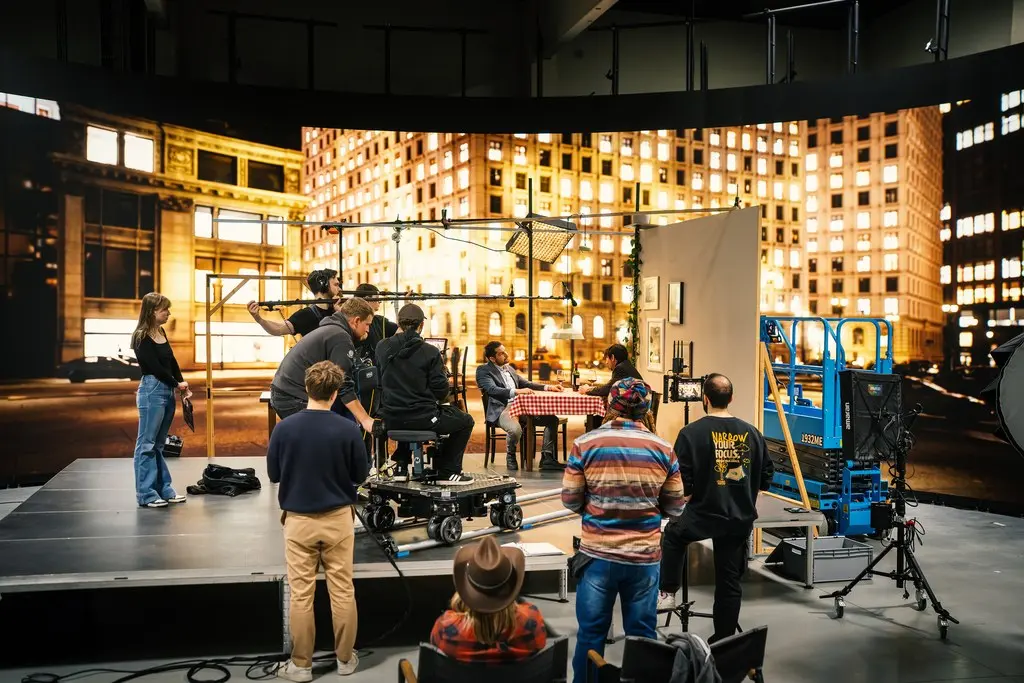
The landscape of European film and commercial production has undergone a significant transformation with the official unveiling of VG Media Studio’s new state-of-the-art Virtual Production (VP) facility. Located in Laichingen, strategically positioned near the industrial and automotive powerhouse of Stuttgart, Germany, this new studio represents a sophisticated convergence of high-end LED display technology, precision camera tracking, and industry-leading image processing. The facility, which was born out of a strategic partnership between the marketing and production agency VG Media Studio and global electronics giant LG, is now positioned as a primary reference site for Virtual Production across the continent. Built around a massive 100-square-meter LG LED volume and powered by Brompton Technology’s Tessera processing, the studio has already proven its commercial viability, having successfully hosted its first full-length feature film production in July 2026 and maintaining a full booking schedule just months after its operational debut.
The genesis of this facility marks a pivotal shift for VG Media Studio. Originally, the agency’s expansion plans for its building complex did not explicitly include a high-end Virtual Production stage. However, as the construction progressed, a dialogue opened with LG, which was actively seeking a flagship location in Europe to showcase its professional cinema and broadcast LED solutions in a real-world production environment. This synergy transformed a standard studio expansion into a cutting-edge technological project. The resulting LED volume is not merely a backdrop but a fully integrated digital environment designed to meet the rigorous demands of automotive marketing, high-end commercial advertising, and narrative cinema.
Architectural Layout and Spatial Design
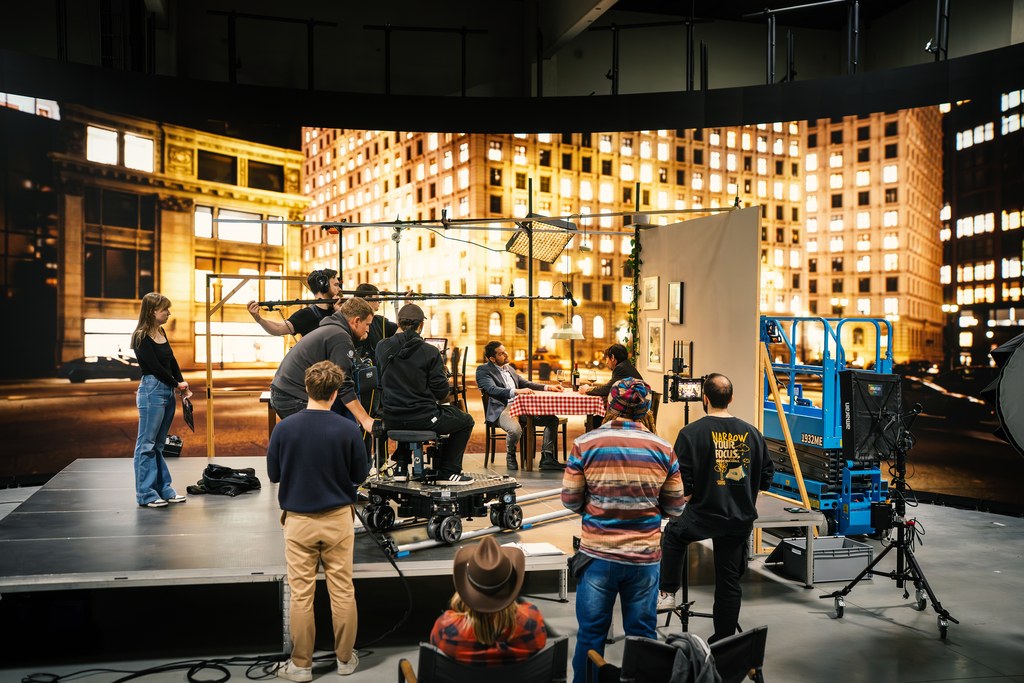
The facility is divided into two distinct operational areas to provide maximum flexibility for production crews. The centerpiece is the main Virtual Production studio, which offers a 250-square-meter "play area" or "acting area" in front of the curved LED wall. This space is designed to accommodate large-scale props, including full-sized vehicles—a critical requirement given the studio’s proximity to Stuttgart’s automotive sector. The curvature of the wall is engineered to provide an immersive 180-degree field of view, ensuring that reflections on metallic or glass surfaces, such as car chassis or windows, are rendered with naturalistic accuracy.
Adjacent to the main volume is a secondary 70-square-meter studio. This space is configured as a traditional film and photography studio, providing a "clean" environment for product shots, headshots, or green-screen work that does not require the immersive capabilities of the LED wall. By offering both spaces, VG Media Studio allows production companies to run parallel workflows, such as capturing social media assets in the smaller studio while the main unit films principal photography on the LED stage.
Technical Infrastructure: The Brompton and LG Synergy
At the heart of the studio’s visual performance is the integration of LG’s LED panels with Brompton Technology’s processing hardware. The main wall is driven by two Tessera SX40 4K LED processors. The SX40 is widely regarded as the industry standard for high-stakes Virtual Production due to its ability to handle massive resolutions with near-zero latency. To manage the data distribution across the 100-square-meter surface, the processors are paired with four Tessera XD 10G data distributors, ensuring a stable and redundant signal path that is essential for live-action filming where downtime is economically devastating.
In addition to the main wall, the studio features a dedicated LED ceiling, controlled by a Tessera S8 processor. The ceiling is a vital component of the "Volume" philosophy; it provides ambient lighting and realistic overhead reflections that ground the physical actors and objects within the digital world. This holistic approach to lighting—where the LED panels themselves serve as the primary light source—eliminates the "flat" look often associated with traditional green-screen compositing.
The system currently operates at a standard 60 frames per second (fps), but the technical team at VG Media Studio has confirmed that the infrastructure is being configured to support up to 120 fps. This move toward High Frame Rate (HFR) production is significant for the automotive industry, where slow-motion shots of moving vehicles are a staple of luxury advertising. Achieving 120 fps requires a perfect synchronization between the camera shutter, the tracking system, and the LED refresh rate, a feat made possible by the Brompton processing pipeline.
Precision Tracking and Multi-Camera Capabilities
For Virtual Production to be effective, the digital background (rendered in real-time via engines like Unreal Engine) must move in perfect sync with the camera’s perspective. VG Media Studio utilizes Mo-Sys tracking technology to achieve this "parallax" effect. A standout feature of this installation is the use of "invisible markers." These markers are placed within the LED volume and are detected by the Mo-Sys StarTracker system but remain invisible to the production camera.
Furthermore, the studio utilizes Brompton’s "Frame Remapping" feature. This technology is a game-changer for multi-camera productions. It allows the LED wall to display different backgrounds on alternating frames. For example, in a two-camera setup, Camera A can see the "inner frustum" (the high-resolution background specific to its angle), while Camera B, shooting from a different angle, sees its own correct perspective on the same wall. To the human eye, the wall looks like a flicker, but to the cameras, each receives a unique, perfectly aligned background.

The facility also employs "Custom Markers," which allow the production team to overlay text, cues, or instructional markers on the LED wall. These are visible to the actors and crew on set but are filtered out by the camera’s shutter sync, ensuring they never appear in the final "in-camera" footage. This feature streamlines communication on set, allowing directors to place digital "X" marks for actors without needing physical tape on the floor that would have to be removed in post-production.
Workflow Optimization and Engineer Perspectives
Simon Brüstl, the Virtual Production Engineer at VG Media Studio, emphasizes the reliability of the system as its greatest asset. In the high-pressure environment of a film set, where hundreds of thousands of euros can be at stake each day, the stability of the hardware is paramount. Brüstl notes that the Brompton interface is remarkably clean and intuitive, allowing for rapid adjustments to color temperature, brightness, and seam correction. The integration with Elgato Stream Decks allows the engineering team to trigger complex lighting changes or background shifts at the press of a button, mirroring the speed of a traditional live broadcast environment.
The color pipeline is another area of technical excellence. Brompton’s processing ensures that the color output of the LG LED panels remains consistent across various camera sensors. Whether a production is using an ARRI Alexa, a RED V-Raptor, or a Sony Venice, the studio’s calibration tools allow for precise matching, ensuring that the "digital" light from the wall interacts with skin tones in a way that is indistinguishable from natural light.
Market Positioning and Economic Impact
The decision to open the studio in Laichingen was a calculated move by the management team. Philipp Offermann, Head of Management and Booking at VG Media Studio, explains that while the agency will use the studio for its own internal clients, the primary business model is built on external rentals. The goal is to provide a "turnkey" solution for external production houses that may have the creative vision for Virtual Production but lack the specialized hardware and technical "know-how" to execute it.
The success of this model is already evident. According to Oliver Dier, Technical Solutions Manager EMEA at Brompton Technology, the studio has seen a surge in demand since its opening. The fact that a full-length cinema film was completed at the facility as early as July 2026 serves as a powerful "proof of concept" for the European film industry. By reducing the need for location travel, Virtual Production offers a more sustainable and cost-effective alternative to traditional filmmaking. Productions can "travel" from a desert at sunrise to a neon-lit city at midnight in a matter of minutes, all within the controlled climate of the Laichingen facility.
The Broader Implications for the Industry
The establishment of the VG Media Studio facility is a signal of the maturing Virtual Production market in Germany. For years, VP was seen as a luxury reserved for massive Hollywood productions like The Mandalorian. However, the Laichingen studio demonstrates that high-end VP is now accessible for mid-range feature films and regional commercial work.
The proximity to Stuttgart suggests a specific focus on the future of automotive marketing. As car manufacturers shift toward electric vehicles and digital-first branding, the ability to film a car in any environment in the world—without ever leaving Germany—is an invaluable asset. It allows for absolute secrecy for unreleased models and provides a level of lighting control that is impossible to achieve on an outdoor road.
As we move toward the end of 2026, the success of VG Media Studio’s partnership with LG and Brompton serves as a blueprint for future production hubs. By combining world-class hardware with a focus on external rental and technical expertise, the agency has not only expanded its own service portfolio but has also strengthened the regional film infrastructure of Baden-Württemberg, positioning it as a rival to established media hubs in Berlin and Munich. The studio stands as a testament to the fact that the future of cinema is no longer just about what is in front of the lens, but about the sophisticated digital ecosystem that powers the entire environment.
