

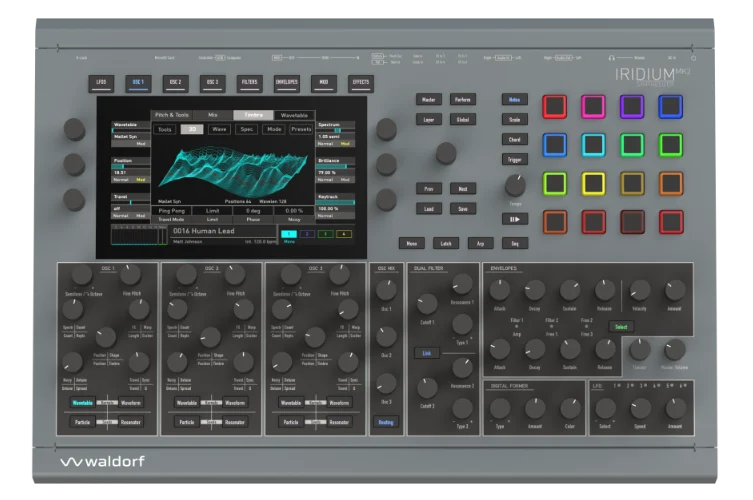
Waldorf Music, the German manufacturer renowned for its pioneering role in wavetable synthesis, has formally announced the release of the Iridium Desktop MK2. This second-generation hardware synthesizer represents a significant technical evolution of the original Iridium platform, integrating a more powerful processing architecture, expanded memory capacity, and innovative sound design features developed in direct collaboration with the influential electronic musician Richard D. James, better known as Aphex Twin. The MK2 arrives as a sophisticated successor to the 2020 original, addressing the demands of professional sound designers and live performers who require higher multitimbral counts and more intricate modulation capabilities in a desktop format.
The Evolution of the Iridium Platform
The Iridium series was originally conceived as a compact, desktop-friendly alternative to Waldorf’s flagship Quantum synthesizer. While it inherited the Quantum’s powerful synthesis engine, the Iridium focused on a purely digital signal path, replacing the Quantum’s analog filters with high-resolution digital models to offer greater polyphony and a smaller footprint. Since its debut, the Iridium has become a staple in modern electronic music production due to its versatile "five-engine" synthesis architecture.
The introduction of the MK2 marks the first major hardware revision for the desktop unit. While the aesthetic remains consistent with Waldorf’s industrial design language, the internal components have undergone a total overhaul. The primary driver behind this update is the integration of a new CPU board, which provides the computational overhead necessary to support the expanded feature set. This hardware refresh ensures that the Iridium remains at the cutting edge of digital synthesis, capable of handling complex algorithmic tasks that were previously limited by the original hardware’s processing constraints.
Hardware Advancements: CPU, RAM, and Storage
At the core of the Iridium MK2 is an improved industrial-grade CPU board. This upgrade is not merely a marginal increase in speed; it fundamentally alters the instrument’s performance envelope. The MK2 features significantly more RAM and expanded internal flash storage. The increase in RAM is particularly critical for the "Particle" (granular) and "Resonator" synthesis engines, which rely on high-speed data access for real-time sample manipulation.
The expanded flash storage serves a dual purpose. First, it allows for a larger factory library of high-quality samples and wavetables. Second, it provides users with more space for custom user samples, a feature that has become central to the Iridium workflow. By increasing the memory ceiling, Waldorf has effectively future-proofed the device, allowing for more complex firmware updates and more demanding synthesis algorithms to be implemented in the coming years.
The Aphex Twin Collaboration: Per-Note-Parameter-Locks
Perhaps the most significant addition to the Iridium MK2 is the introduction of Per-Note-Parameter-Locks. This feature was developed in collaboration with Richard D. James (Aphex Twin), a long-term user of the original Iridium Desktop. Known for his intricate and often chaotic rhythmic and melodic structures, James sought a method to apply the "parameter locking" concept—popularized by manufacturers like Elektron—to a more traditional polyphonic synthesis environment.

In the MK2, each of the 128 MIDI notes can be assigned up to 16 individual parameter variations. By simply holding a note and adjusting the physical knobs on the interface, a user can lock specific values to that specific pitch. This allows for unprecedented sonic diversity within a single patch. For example, a C3 note could be assigned a short decay and a high filter resonance, while a D3 note in the same sequence could trigger a completely different oscillator waveform or an entirely different synthesis engine altogether.
This system effectively turns a single patch into a 128-slot sound bank where every key can represent a unique sonic event. The Per-Note-Parameter-Locks are saved within the patch metadata and can be viewed and refined on a dedicated editing page on the unit’s high-resolution touchscreen. This functionality bridges the gap between traditional synthesis and the granular, step-based sequencing common in IDM (Intelligent Dance Music) and experimental electronic genres.
Expanded Multitimbrality and Layering
One of the direct benefits of the upgraded CPU board is the expansion of the Iridium’s multitimbral capabilities. While the original Iridium was limited to two-part multitimbrality (allowing for two simultaneous layers or a keyboard split), the MK2 doubles this capacity to four layers.
The addition of two extra layers significantly broadens the scope for complex sound design. Users can now stack four distinct patches to create massive, evolving textures or split the keyboard into four zones for intricate live performances. To manage these layers, Waldorf has introduced advanced voice allocation modes, including "round-robin" and "random-robin." In round-robin mode, the synthesizer cycles through the four layers sequentially with each new note press, while random-robin selects layers at random. These modes are particularly effective when used in conjunction with the new Per-Note-Parameter-Locks, creating a generative quality where no two notes sound exactly the same.
Innovative Synthesis: The "Seeds" Engine and "Flavour" Control
The Iridium MK2 introduces a sixth synthesis method to complement the existing five (Wavetable, Waveform, Particle, Resonator, and Kernels). This new engine, titled "Seeds," is a direct result of the increased RAM capacity.
The Seeds engine is described by Waldorf as a "dynamic synthesis of waypoints from sub-oscillators." Inspired by the principles of wavetable synthesis, Seeds allows the oscillators to generate and transition between various sonic waypoints in real-time. These waypoints can be manipulated using frequency modulation (FM), ring modulation, and the addition of noise or non-pitched material. This engine is designed to produce organic, shifting timbres that move beyond the static nature of traditional digital oscillators.
Complementing the Seeds engine is the new "Flavour" knob. This control is derived from Waldorf’s "Protein" synthesizer project and is designed to introduce "micro-variations" into the signal path. By adjusting the Flavour knob, users can introduce subtle, non-linear fluctuations in timing, timbre, and pitch. These variations mimic the instability of vintage analog hardware or the natural inconsistencies of acoustic instruments, adding a layer of "sonic liveliness" to the otherwise precise digital output of the Iridium.

Comprehensive Technical Specifications and Connectivity
The Iridium MK2 retains the robust connectivity that made its predecessor a favorite for integration into modular and studio setups. The rear panel includes:
- Audio I/O: Two inputs and two outputs (stereo) for external signal processing and sampling.
- Digital Connectivity: S/PDIF output for lossless digital recording.
- Control Voltage (CV): Four CV inputs and a Gate/Trigger input, allowing the Iridium to be controlled by Eurorack systems or other modular gear.
- MIDI: Traditional 5-pin DIN MIDI In, Out, and Thru, as well as USB MIDI.
- Storage Expansion: A microSD card slot and a USB host port for importing samples, exporting patches, and connecting external MIDI controllers.
The interface is dominated by a large, industrial-grade color touchscreen that provides visual feedback for the various synthesis engines, including real-time spectrum analysis and wavetable visualization. Surrounding the screen are high-quality encoders and buttons that offer tactile control over the most critical parameters, such as filter cutoff, resonance, and envelope stages.
Industry Implications and Market Analysis
The release of the Iridium MK2 signals a broader trend in the synthesizer industry toward high-density digital instruments that prioritize flexibility and depth over analog purity. As component costs for high-speed processors and high-capacity RAM continue to shift, manufacturers like Waldorf are able to pack workstation-level power into desktop units.
The collaboration with Aphex Twin is also a significant marketing and developmental milestone. It highlights a shift where hardware manufacturers are working more closely with high-profile artists to solve specific workflow challenges. The Per-Note-Parameter-Lock feature, in particular, addresses a long-standing limitation of polyphonic synthesizers—the tendency for every note in a chord or sequence to share the same global parameters.
In the current market, the Iridium MK2 competes with other high-end digital and hybrid synthesizers such as the Novation Peak/Summit, the ASM Hydrasynth, and the Polyend Sentinel. However, the Iridium’s unique combination of five (now six) distinct synthesis engines and its extensive CV integration gives it a distinct advantage for users who operate at the intersection of modular synthesis and digital production.
Pricing, Availability, and Conclusion
The Waldorf Iridium MK2 is positioned as a premium professional instrument with a retail price of 2,399.00 €. At the time of the official announcement, the Waldorf website listed the initial production run as "out of stock," a common occurrence for boutique high-end hardware due to high demand and the complexities of modern electronics supply chains.
The MK2 represents more than just a mid-cycle refresh; it is a significant expansion of the Iridium’s sonic potential. By doubling the multitimbral count, introducing a new synthesis engine, and implementing the groundbreaking Per-Note-Parameter-Locks, Waldorf has solidified the Iridium’s reputation as one of the most powerful digital synthesizers ever produced. As the industry continues to move toward more complex, software-integrated hardware, the Iridium MK2 stands as a benchmark for how processing power can be harnessed to provide musicians with new levels of creative expression. For professional sound designers and experimental musicians, the MK2 offers a depth of control that is rarely matched in the hardware domain, ensuring its relevance in studios and on stages for years to come.
