

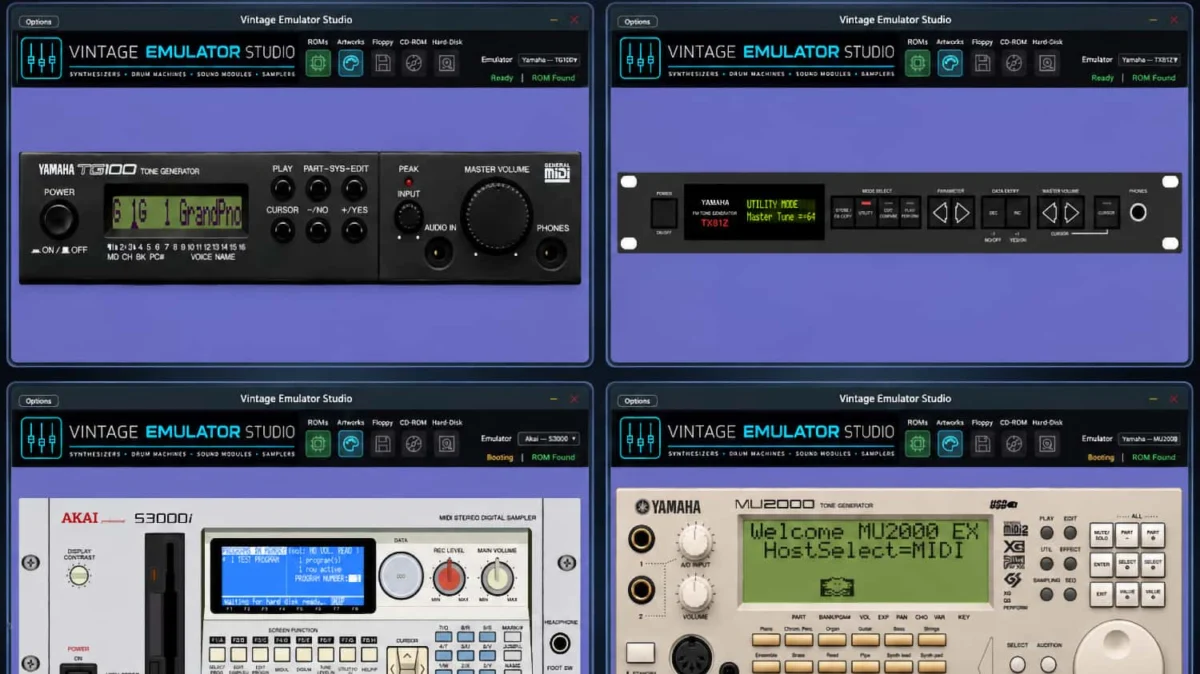
The digital music production landscape has witnessed a significant technological milestone with the release of Vintage Emulator Studio (VES), a free and open-source virtual instrument collection developed by Autodafe. This new platform leverages the robust emulation capabilities of the Multiple Arcade Machine Emulator (MAME) project to bring authentic digital recreations of vintage synthesizers, samplers, drum machines, and sound modules into a contemporary studio environment. By providing a bridge between legacy hardware logic and modern Digital Audio Workstations (DAWs), VES offers musicians and sound designers a method of accessing rare and historically significant hardware without the logistical challenges of maintaining physical vintage equipment.
A New Paradigm in Hardware Emulation
Vintage Emulator Studio distinguishes itself from traditional software synthesizers through its fundamental architecture. Most modern "vintage" plugins are simulations—software written to mimic the sound and behavior of old hardware through digital signal processing (DSP) techniques that approximate the original circuits. In contrast, VES utilizes true machine emulation. This process involves creating a virtual environment that replicates the original hardware’s central processing unit (CPU), memory map, and peripheral chips.
By running the original firmware and machine code of the target hardware, VES ensures that the logic, timing, and operational quirks of the original instruments are preserved with high fidelity. This "bit-accurate" approach means that the software does not merely sound like the original; it functions as the original, executing the same binary instructions that were once processed by physical silicon decades ago. The project preserves the individual workflows and operating systems of the original machines, eschewing standardized modern interfaces in favor of historical authenticity.
Technical Foundation and the Role of MAME
The core of Vintage Emulator Studio is built upon the decades of research and development contributed by the MAME developer community. While MAME is most commonly associated with arcade game preservation, its scope has expanded over the years to include a vast array of computing devices, including professional musical instruments from the 1980s and 1990s.
MAME’s architecture is designed to document the internal workings of these machines for archival purposes. Autodafe has taken this archival technology and wrapped it in a musician-friendly shell. This "wrapper" handles the complexities of modern audio and MIDI routing, allowing the emulated hardware to communicate with MIDI keyboards and output high-quality digital audio to a computer’s sound card or a host DAW.
The technical specifications of VES include:
- Platform Support: Native compatibility with macOS (both Apple Silicon and Intel architectures), Windows, and Linux.
- Plugin Formats: Availability as a standalone application and as VST3 and Audio Unit (AU) plugins.
- Interface Design: Interactive front-panel artwork that mimics the physical layout of the original hardware, providing a tactile experience for the user.
- Connectivity: Full MIDI integration, allowing for external control of parameters and performance data.
The Chronology of Digital Preservation in Music
The journey toward Vintage Emulator Studio began in the late 1990s and early 2000s, as the processing power of consumer computers reached a threshold capable of emulating complex 8-bit and 16-bit architectures in real-time. Initially, the music industry focused on "virtual analog" technology, which used mathematical models to recreate the behavior of transistors and capacitors found in Moog or Sequential Circuits synthesizers.
However, the digital era of the mid-1980s introduced a different challenge. Instruments like the Yamaha DX series, the Roland D-50, and the Fairlight CMI relied on proprietary chips and complex firmware. As these machines aged, the degradation of physical components—particularly custom integrated circuits (ICs) and floppy disk drives—threatened to silence them forever.
In the 2010s, the MAME project began incorporating "MESS" (Multi Emulator Super System), which brought a more rigorous focus to non-gaming hardware. This led to the successful emulation of various sound chips and music-specific microprocessors. The release of Vintage Emulator Studio represents the culmination of this timeline, transitioning these emulations from the realm of academic computer science into the hands of creative professionals.
Operational Requirements and the Legal Framework
One of the most critical aspects of Vintage Emulator Studio is its approach to software licensing and copyright. VES is an open-source "host" environment, but it does not include the proprietary firmware (ROMs) required to operate the emulated machines.
In the world of emulation, the software that replicates the hardware logic is generally legal to distribute, but the firmware—the "operating system" of the synthesizer—is the intellectual property of the original manufacturer. Users of VES are required to obtain these ROM files independently. This can be done by dumping the data from hardware they already own or by sourcing them through archival repositories, provided such actions comply with local intellectual property laws.
This distinction is a standard practice in the emulation community, ensuring that the developers of the emulator remain protected while placing the responsibility for content acquisition on the end-user. It also highlights the role of VES as a preservation tool, encouraging the digital backup of aging hardware components before they succumb to "bit rot" or hardware failure.
Implications for the Music Production Industry
The introduction of VES into the market has several significant implications for producers, educators, and historians.
1. Democratization of Rare Sound Palettes
Many of the instruments emulated by MAME and hosted by VES are currently trading for thousands of dollars on the secondary market. By providing a free, accurate alternative, VES democratizes access to these specific sonic textures. Producers who cannot afford a vintage sampler or a rare Japanese FM synthesizer can now integrate those exact sounds into their productions.
2. Educational and Archival Value
For students of music technology, VES provides a "living museum." Because the software preserves the original operating systems and menu structures, users can learn the limitations and creative workflows that defined specific eras of electronic music. This is a stark contrast to modern "all-in-one" plugins that often obscure the historical context of the sounds they produce.
3. Stability and Portability
Vintage hardware is notoriously fragile. Issues such as leaking capacitors, failing screens, and corrupted storage media make taking original gear on tour a risky proposition. VES allows performers to bring the "soul" of their vintage gear on a laptop, providing a stable and recallable environment that fits within a modern hybrid setup.
Market Context and Competitive Landscape
The release of Vintage Emulator Studio comes at a time when major manufacturers are also looking toward their past. Companies like Roland (with the Roland Cloud) and Korg (with the Korg Collection) have released their own official software versions of classic gear.
However, there is a fundamental difference in philosophy. Official manufacturer releases are often redesigned to be "better" than the original—adding more polyphony, modern effects, and simplified interfaces. VES, by contrast, prioritizes the "flaws" and exact constraints of the original machines. This appeals to a specific segment of the market: purists and "lo-fi" enthusiasts who value the specific aliasing noise, bit-depth limitations, and unique filtering characteristics of 1980s digital hardware.
Future Outlook and Community Development
As an open-source project, the trajectory of Vintage Emulator Studio is likely to be shaped by community contributions. The developer, Autodafe, has positioned VES as a framework that can grow as MAME’s library of supported musical hardware expands. There is potential for future updates to include more sophisticated media handling, such as the ability to import user samples into emulated vintage samplers, further bridging the gap between old-school hardware and modern file systems.
The response from the online synthesis community has been largely positive, with many praising the project for its transparency and commitment to the "no-frills" emulation of digital history. While the requirement to source ROMs manually presents a barrier to entry for some casual users, it reinforces the project’s status as a serious tool for those dedicated to technical accuracy.
In conclusion, Vintage Emulator Studio represents more than just another free plugin; it is a significant step forward in the digital preservation of musical heritage. By repurposing the power of MAME for the DAW environment, Autodafe has provided a platform that ensures the unique voices of the digital revolution will continue to be heard in the music of the future. As hardware continues to age and disappear, the importance of bit-accurate emulation as a creative and historical resource cannot be overstated.
