

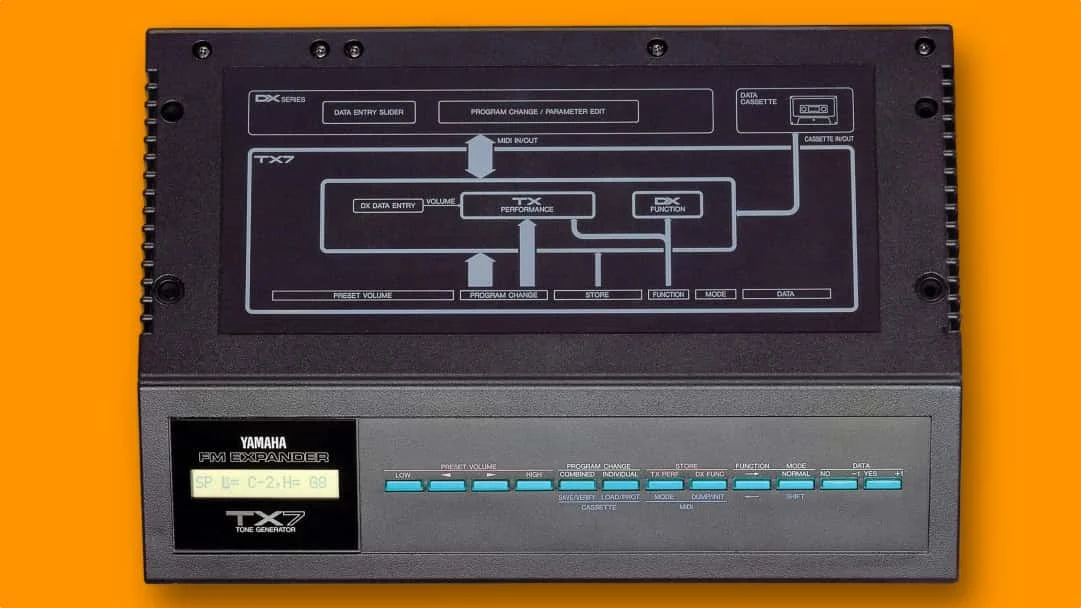
The landscape of vintage synthesizer maintenance and integration has shifted significantly with the release of a new, browser-based patch editor and librarian designed specifically for the Yamaha TX7. Developed by Ian Dixon, a prominent technologist and synthesist known for his work at The Digital Lifestyle, this tool addresses a long-standing challenge for owners of the 1980s-era FM synthesis module. By leveraging the Web MIDI API, the editor provides a modern, visual interface for a device that was originally criticized for its lack of onboard editing controls, effectively bridging the gap between forty-year-old hardware and contemporary digital workflows.
The Yamaha TX7, released in 1985, was the desktop counterpart to the world-renowned DX7. While it contained the same powerful six-operator FM synthesis engine, it was designed primarily as a "preset" or "expander" module, lacking the plethora of sliders and the iconic membrane buttons found on its keyboard-based sibling. This design choice necessitated the use of external software or a master DX7 keyboard to unlock its full programming potential. Dixon’s new editor restores this functionality to the modern user, offering a platform-agnostic solution that requires no software installation beyond a MIDI-capable web browser.
The Technical Evolution of the Yamaha TX7 and Its Place in FM History
To understand the significance of a new TX7 editor, one must examine the historical context of Yamaha’s FM (Frequency Modulation) revolution. The technology, based on the research of Dr. John Chowning at Stanford University in the late 1960s, was licensed by Yamaha and culminated in the 1983 release of the DX7. The DX7 became one of the best-selling synthesizers in history, defining the sound of 1980s pop and film scores.
However, the DX7 was a large, heavy instrument. In response to the growing demand for MIDI-based studio setups, Yamaha released the TX7 in 1985. The TX7 was marketed as a "DX7 in a box," intended to sit on top of another keyboard or a studio desk. Despite having the same 12-bit internal architecture and the capability to produce identical sounds, the TX7 was notoriously difficult to program from its front panel, which featured only a small LED display and a handful of buttons for selecting patches and adjusting basic parameters.
Dixon’s editor recognizes the specific architectural quirks of the TX7. While the TX7 is compatible with DX7 patches, it possesses unique "Function Memory" settings—parameters such as portamento, pitch bend range, and foot controller assignments—that are stored per voice. These parameters often behave differently than those on the original DX7, and managing them through the TX7’s limited interface has historically been a deterrent for many musicians.
Core Features of the Dixon Patch Editor and Librarian
The newly released editor is designed to be a comprehensive command center for the TX7. It operates locally within the browser, utilizing the Web MIDI protocol to communicate directly with the hardware via a connected MIDI interface. This approach eliminates the compatibility issues often associated with legacy "sysex" (System Exclusive) software on modern operating systems like Windows 11 or macOS Sonoma.
Key features of the tool include:
- Visual FM Voice Editing: Users can manipulate the parameters of all six operators simultaneously. This includes frequency ratios, detuning, and the complex 8-parameter envelope generators that define the FM sound. The interface provides a visual representation of the 32 algorithms, making it easier to understand how operators are modulating one another.
- SysEx Bank Management: The editor can read entire voice banks from the TX7 hardware, allowing users to back up their sounds to a local computer. Conversely, it can load standard .syx files, which are the industry-standard format for DX7 and TX7 patches.
- Real-Time Parameter Streaming: As users adjust sliders in the browser, the editor sends the corresponding MIDI CC or SysEx data to the TX7 in real-time. This allows for "live" sound design, where the user can hear the timbral changes instantly.
- Library Organization: Beyond simple editing, the tool acts as a librarian. Users can organize hundreds of voices into custom banks, a task that was previously cumbersome and required specialized, often obsolete, software.
The Role of Web MIDI in Modernizing Vintage Hardware
The choice of Web MIDI as the foundation for this project is a strategic one. For decades, owners of vintage synthesizers have struggled with "software rot." Standalone editors created for Windows 95 or early versions of Mac OS X often fail to run on modern machines, leaving hardware owners with few options.
Web MIDI is a W3C specification that allows web applications to enumerate, select, and interact with MIDI devices connected to a user’s computer. Because the logic resides in a web browser (such as Google Chrome or Microsoft Edge), the editor is inherently cross-platform. It ensures that as long as browsers support the MIDI standard, the TX7 editor will remain functional, providing a level of "future-proofing" that standalone applications cannot match.
Historical Chronology of Yamaha FM Development and Support
The release of this editor is the latest entry in a timeline that spans over five decades of synthesis history:
- 1967–1971: Dr. John Chowning at Stanford University discovers FM synthesis while experimenting with extreme vibrato.
- 1973: Yamaha enters an exclusive licensing agreement with Stanford to develop the technology for commercial use.
- 1983: The Yamaha DX7 is released, featuring 6-operator FM synthesis and 16-note polyphony. It changes the industry, moving away from analog subtractive synthesis.
- 1985: The Yamaha TX7 is launched as a cost-effective, space-saving expander module for the DX7.
- Late 1980s – 1990s: Third-party developers like Opcode and Caged Artist release early MIDI editors for Atari ST and Macintosh computers to facilitate TX7 programming.
- 2010s: The rise of Web MIDI API begins, allowing developers to create browser-based tools for hardware.
- 2024: Ian Dixon releases the TX7 Patch Editor and Librarian, providing a free, modern solution for the aging hardware.
Community Reaction and Industry Implications
The synth community has responded with notable enthusiasm to Dixon’s release. On platforms such as Gearspace and various FM synthesis forums, users have noted that the TX7 often sells for significantly less than a vintage DX7 on the second-hand market. The primary drawback of the TX7 has always been its "black box" nature. With a reliable, free editor, the TX7 becomes a highly attractive option for producers seeking the authentic 12-bit "grit" of original Yamaha hardware without the footprint of a full keyboard.
Industry analysts suggest that the trend of "Web-based hardware companions" is likely to grow. As vintage gear continues to appreciate in value, the demand for accessible maintenance and programming tools increases. Dixon’s project serves as a case study in how individual developers can preserve the utility of classic instruments through clever application of modern web standards.
Furthermore, the editor’s ability to handle DX7 SysEx banks is a crucial feature. There are estimated to be tens of thousands of DX7 patches available for free online, ranging from classic electric pianos to avant-garde textures. By providing a seamless way to audition and load these patches onto a TX7, Dixon has effectively revitalized the module’s library for a new generation of musicians.
Technical Analysis: The TX7 vs. Software Emulations
In an era where software plugins like Arturia’s DX7 V or Dexed can emulate FM synthesis with high precision, the question arises: why use a TX7 and a dedicated editor?
Fact-based analysis of the hardware reveals that the TX7 utilizes a specific 12-bit Digital-to-Analog Converter (DAC) and unique output circuitry that introduces a subtle non-linear distortion and "aliasing" noise. Many purists argue that these "imperfections" are what give the original Yamaha hardware its punchy, aggressive character, particularly in the lower frequencies. Dixon’s editor allows users to harness this specific hardware character while enjoying the convenience of a software-like interface.
The editor also addresses the "Function Memory" discrepancy. On a DX7, function settings (like glide and modulation wheel assignments) are global or semi-global depending on the firmware version. On the TX7, these are tied more closely to the individual patches. Dixon’s editor accounts for these MIDI implementation differences, ensuring that when a patch is sent from the browser to the hardware, it sounds exactly as intended, with all performance controllers mapped correctly.
Conclusion and Availability
Ian Dixon’s Yamaha TX7 Patch Editor and Librarian represents a significant contribution to the electronic music community. It democratizes the programming of a notoriously difficult piece of hardware and ensures that the "sound of the 80s" remains accessible to modern creators. By removing the barriers of complex SysEx strings and obsolete software, Dixon has turned the TX7 from a static preset player back into a dynamic, programmable synthesizer.
The tool is currently available for use via Dixon’s website, The Digital Lifestyle. It is offered as a free resource, reflecting a commitment to the preservation of music technology. As the vintage market continues to evolve, tools like this ensure that the hardware of the past remains a functional part of the studios of the future. For the thousands of TX7 units still in circulation worldwide, this editor provides a new lease on life, proving that even the most "difficult" vintage gear can be tamed with the right digital key.
