

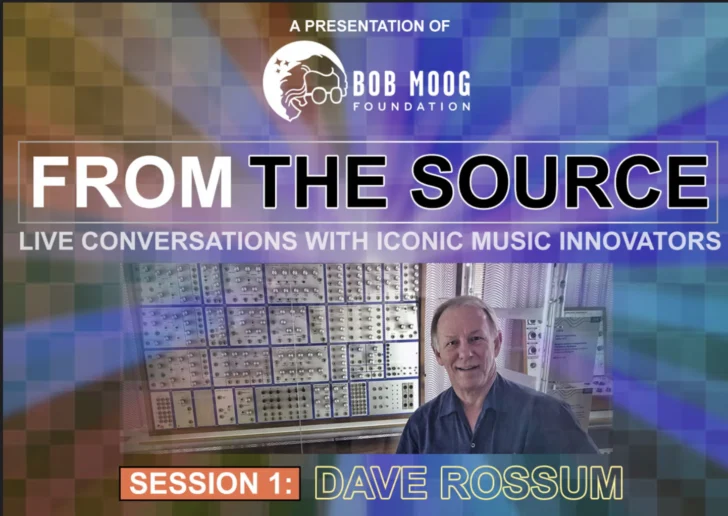
The Bob Moog Foundation has officially unveiled a new high-access educational initiative titled From the Source: Live Conversations with Iconic Music Innovators, a series designed to bridge the gap between contemporary music enthusiasts and the legendary figures who engineered the foundations of modern electronic sound. This livestreamed series will feature an interactive "Ask Me Anything" (AMA) format, providing a rare platform for musicians, engineers, composers, and synthesizer aficionados to engage directly with the architects of the industry. The inaugural session, scheduled for Saturday, October 24, 2026, at 5:00 pm ET, will feature Dave Rossum, the co-founder of E-mu Systems and a seminal figure in the development of polyphonic synthesis and digital sampling.
The event is structured to be an intimate and highly technical exchange, conducted via a private Zoom session that is strictly limited to 100 participants to ensure the quality of interaction. Moderating the debut session is Marcus Ryle, himself a titan of music technology and the co-founder of Fast Forward Designs and Line 6. This pairing represents a significant meeting of minds, as both Rossum and Ryle have spent decades at the forefront of the digital and analog revolutions that redefined how music is composed, recorded, and performed.
Strategic Objectives and Educational Mission
The "From the Source" series serves as a vital fundraising and awareness vehicle for the Bob Moog Foundation, a non-profit organization dedicated to preserving the legacy of Dr. Robert Moog. Unlike Moog Music Inc., the commercial entity, the Foundation focuses on historical preservation and STEM (Science, Technology, Engineering, and Mathematics) education. Proceeds from ticket sales—priced at $20 for general attendance and $40 for prioritized question submission—are earmarked for the Foundation’s primary projects, including Dr. Bob’s SoundSchool and the Moogseum located in Asheville, North Carolina.
Dr. Bob’s SoundSchool is an innovative curriculum that teaches the physics of sound to elementary school students, reaching thousands of children annually. By hosting innovators like Dave Rossum, the Foundation reinforces the connection between the history of electronic music and the future of scientific innovation. The series aims to document the oral histories of these pioneers, ensuring that the nuances of their inventions and the challenges they faced during the nascent years of the synthesizer industry are preserved for future generations of scholars and engineers.
The Career and Innovations of Dave Rossum
Dave Rossum’s influence on the landscape of electronic music is difficult to overstate. His journey began in 1970 at the University of California, Santa Cruz, where his interest in synthesis was ignited by a Moog modular system introduced to him by his advisor, Dr. Harry Noller. By December of that year, Rossum and his partner Scott Wedge founded E-mu Systems. What began as a venture to build modular synthesizers eventually evolved into a powerhouse of intellectual property and hardware design that fueled the entire industry.
The E-mu Systems Era and the Polyphonic Breakthrough
In the early 1970s, synthesizers were primarily monophonic, meaning they could only play one note at a time. Rossum’s work was instrumental in breaking this barrier. He invented the first practical polyphonic synthesizer keyboard, a breakthrough that allowed performers to play chords and complex arrangements. This technology was licensed to other major manufacturers, including Oberheim Electronics for the 4-Voice and 8-Voice systems.
Rossum was also a pioneer in the integration of microprocessors within musical instruments. E-mu’s 4060 polyphonic keyboard and sequencer was among the first to utilize a microprocessor, a move that foreshadowed the digital revolution of the 1980s. His ability to blend analog warmth with digital precision became the hallmark of E-mu Systems, leading to the creation of the Audity, a massive, computer-controlled analog synthesizer that, while commercially rare, showcased the peak of Rossum’s early engineering prowess.
The SSM Chip Legacy
Perhaps Rossum’s most pervasive contribution to the "golden age" of synthesizers was his design of the Solid State Microtechnology for Music (SSM) family of integrated circuits. These chips consolidated complex synthesizer components—such as oscillators, filters, and envelopes—into small, reliable packages. The SSM chips were the engine behind some of the most iconic instruments in music history, including:
- Sequential Circuits Prophet-5 (early revisions): The first fully programmable polyphonic synthesizer.
- Korg Polysix and Mono/Poly: Instruments that brought polyphony and versatility to a broader market.
- Fairlight CMI II: The legendary digital workstation and sampler.
- PPG Wave 2: A pioneer in wavetable synthesis.
By providing the underlying hardware for these competitors, Rossum effectively shaped the sonic character of the 1980s, from New Wave to experimental film scores.
Transition to Sampling and Digital Signal Processing
As the industry shifted from analog synthesis to digital sampling, Rossum remained at the cutting edge. E-mu Systems introduced the Emulator in 1981, one of the first affordable digital samplers. The Emulator series, followed by the SP-12 and SP-1200 drum machines, became foundational tools for hip-hop and electronic dance music. The SP-1200, in particular, is still revered today for its unique "gritty" 12-bit sound, a result of the specific filter and sampling algorithms Rossum helped develop.
Following the acquisition of E-mu Systems by Creative Labs in 1994, Rossum took on the role of Chief Scientist. In this capacity, he influenced the development of the Sound Blaster line and various PC audio technologies, bringing high-fidelity sound to the burgeoning home computer market. His later work at Audience, Inc. involved designing sophisticated multi-core audio DSP (Digital Signal Processing) chips for mobile phones, focusing on noise suppression and voice clarity—technologies now used by millions of people daily.
Current Ventures and Technical Leadership
Today, Dave Rossum continues to innovate through Rossum Electro-Music, a company dedicated to creating high-end Eurorack modules and boutique instruments that push the boundaries of modern synthesis. His recent designs, such as the Morpheus stereo morphing Z-plane filter and the Assimil8or multi-timbral sampler, demonstrate a continued commitment to deep, user-controlled modulation and sonic fidelity.
Furthermore, Rossum serves as a Technical Fellow for Universal Audio and continues to design specialized chips for Sound Semiconductor. With over 40 US patents to his name, his career represents a continuous line of innovation from the first modular patches of the 1970s to the complex software-hardware hybrids of the 21st century.
The Role of Marcus Ryle as Moderator
The selection of Marcus Ryle as the moderator for the first "From the Source" event adds a significant layer of depth to the conversation. Ryle’s career began at Oberheim Electronics, where he contributed to the design of the Matrix-12 and the Xpander. He later co-founded Fast Forward Designs, where he was a key architect of the Alesis ADAT, a digital recording format that revolutionized the home studio movement.
As a co-founder of Line 6, Ryle pioneered digital modeling technology, allowing guitarists to emulate a vast array of classic amplifiers and effects through DSP. His historical perspective on the transition from analog hardware to digital modeling complements Rossum’s background, ensuring that the livestream will cover the technical evolution of the industry from multiple vantage points.
Broader Impact and Industry Implications
The "From the Source" series arrives at a time of renewed global interest in synthesizer history and analog technology. The "synthesizer renaissance" of the last decade has seen a surge in modular synthesis and a desire among younger musicians to understand the origins of their tools. By facilitating direct dialogue with pioneers like Rossum, the Bob Moog Foundation is performing a critical service in "tech-archaeology."
From a pedagogical standpoint, the event provides a masterclass in engineering philosophy. Participants will likely gain insights into how Rossum balanced the technical limitations of early 1970s components with the artistic demands of musicians. This "real-time" access to historical data is a significant shift from traditional music journalism, offering a primary-source experience that is often lost in secondary reporting.
Moreover, the event highlights the evolving nature of non-profit fundraising in the digital age. By leveraging high-value intellectual content and the global reach of platforms like Zoom, the Bob Moog Foundation can engage a worldwide audience, transcending the geographical limitations of its physical museum in Asheville.
Conclusion and Future Outlook
The Bob Moog Foundation’s From the Source: Live Conversations with Iconic Music Innovators is more than a series of interviews; it is an active effort to bridge the generational divide in music technology. As Dave Rossum takes the digital stage on October 24, the conversation will likely span the entirety of modern electronic music history—from the first voltage-controlled oscillators to the complex algorithms of modern mobile telephony.
For the 100 participants fortunate enough to secure a place in the session, the event offers a unique opportunity to query a man whose fingerprints are on nearly every significant development in synthesis over the last fifty years. For the broader music community, the series stands as a testament to the enduring legacy of Robert Moog and the community of innovators who turned his vision of electronic sound into a global cultural phenomenon. Future installments of the series are expected to feature other luminaries of the industry, further cementing the Bob Moog Foundation’s role as the preeminent guardian of electronic music’s technological heritage.
